Highlight
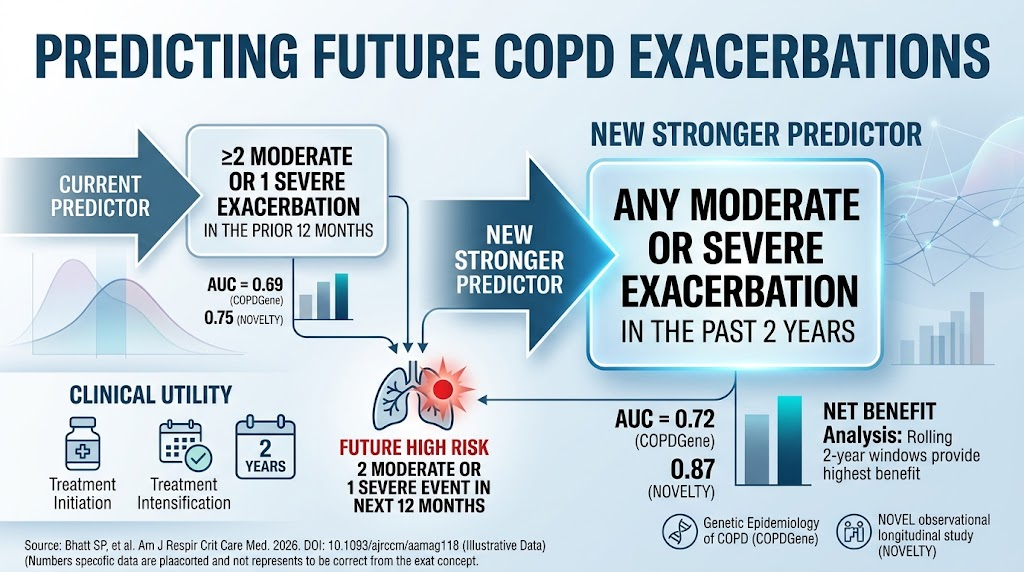
- The standard COPD exacerbation risk definition (≥2 moderate or ≥1 severe exacerbation in the past year) has limited discriminative power.
- In both COPDGene and NOVELTY cohorts, considering any moderate or severe exacerbation within the prior two years yielded superior accuracy (AUC up to 0.87) for predicting future exacerbations.
- Using rolling two-year exacerbation windows also provided the highest clinical utility across relevant treatment thresholds (5%-30%) for initiating or intensifying therapy.
Study Background
Chronic obstructive pulmonary disease (COPD) is a progressive respiratory illness characterized by persistent airflow limitation and episodic exacerbations that significantly influence morbidity, mortality, and healthcare utilization worldwide. Preventing future exacerbations is a cornerstone of COPD management, as exacerbation frequency correlates directly with disease progression and patient quality of life. Current clinical guidelines primarily rely on historical exacerbation frequency within the last 12 months to stratify exacerbation risk and guide treatment decisions. However, the evidence base supporting the commonly employed risk category—at least two moderate or one severe exacerbation in the prior year—is sparse. This uncertainty limits precision in identifying patients who would most benefit from therapeutic intensification, thereby raising a critical need to re-evaluate and optimize exacerbation risk categorization using more nuanced longitudinal data.
Study Design
This investigation examined the discriminative capability and clinical utility of various COPD exacerbation categories for predicting near-term exacerbation risk by leveraging two large, well-characterized prospective cohorts: COPDGene (n=3035) and NOVELTY (n=3080). Eighteen different exacerbation categories were constructed based on the frequency and severity of exacerbations, considering moderate and severe exacerbations separately and combined. These categories were assessed using recall periods of one year and two years, and exacerbation data were ascertained using three different approaches: (1) within a single year, (2) in two consecutive years, and (3) across rolling two-year windows. The primary endpoint was the occurrence of either two moderate or one severe exacerbation in the following 12 months. Statistical analyses included the area under the receiver operating characteristic curve (AUC) to evaluate discrimination, complemented by net benefit analyses to capture clinical utility across plausible treatment threshold probabilities ranging from 5% to 30%.
Key Findings
The most notable finding was that defining “high exacerbation risk” as any moderate or severe exacerbation in the prior two years outperformed the current guideline benchmark based on the last 12 months alone. Specifically, in the COPDGene cohort, this category yielded an AUC of 0.69 (95% CI, 0.67–0.71), significantly better than the standard definition’s AUC of approximately 0.66 (ΔAUC=0.03; P<0.001). The discriminative improvement was even more pronounced in the NOVELTY cohort, with an AUC of 0.87 (95% CI, 0.85–0.88) for the two-year definition versus approximately 0.75 for the current standard (ΔAUC=0.12; P<0.001). These differences indicate a substantially enhanced ability to correctly classify patients at risk for future exacerbations.
Importantly, net benefit analyses—which take into account the clinical consequences of classification decisions—showed that exacerbation patterns derived from rolling two-year windows provided the greatest net benefit across a clinically relevant range of treatment thresholds (5% to 30%). This means that using a longer, rolling observational period to define exacerbation history could improve patient selection for preventative therapies, reducing unnecessary treatment in low-risk patients and increasing treatment among those at genuine high risk.
These findings have translational implications for clinical practice, suggesting that physicians should consider exacerbation histories extending beyond the past year when assessing risk and making treatment decisions. The approach also harmonizes well with the chronic and progressive nature of COPD, wherein exacerbation risk may not fully manifest over shorter intervals.
Expert Commentary
Experts in COPD management recognize that prior exacerbations are the strongest predictor of future events, but this study provides the first rigorous, large-scale validation that extends the conventional observation period for risk stratification. The superior performance of the two-year recall window aligns with the biological and clinical understanding that exacerbation risk is cumulative and sustained rather than episodic. However, some considerations remain. The two cohorts studied include diverse patient populations and healthcare settings, increasing generalizability, yet external validation in additional groups—especially in primary care settings—would be informative.
Furthermore, while the net benefit framework offers a pragmatic decision-making tool, integrating these new criteria into existing treatment algorithms will require clinician education and incorporation into guideline updates. Mechanistically, exacerbations likely reflect a trajectory of increasing airway inflammation and respiratory vulnerability; thus, a longer cumulative exacerbation history may better capture this underlying pathophysiology.
Conclusion
This robust, multicohort study establishes that a definition of COPD exacerbation risk based on any moderate or severe exacerbation over the preceding two years enhances prediction accuracy and offers greater clinical utility compared to the current one-year standard. Adopting this extended observation window may optimize treatment decisions, ultimately improving patient outcomes by more precisely targeting interventions to those at highest risk. Prospective studies and guideline revisions incorporating these findings could facilitate a paradigm shift in COPD management toward more refined, evidence-based risk stratification.
Funding and Trial Registration
The study was published in the American Journal of Respiratory and Critical Care Medicine, August 2026 issue. The COPDGene and NOVELTY studies are supported by various NIH grants and industry collaborations, with data available upon reasonable request from the respective study investigators. Details referencing funding and trial registrations were not explicitly provided in the publication abstract.
References
1. Bhatt SP, Adibi A, Bodduluri S, et al. Discriminative performance and clinical utility of chronic obstructive pulmonary disease exacerbation categories for predicting future exacerbations. Am J Respir Crit Care Med. 2026;212(8):1721-1729. PMID: 42085195.
2. Global Initiative for Chronic Obstructive Lung Disease (GOLD). Global Strategy for the Diagnosis, Management, and Prevention of COPD, 2024 Report.
3. Wedzicha JA, Seemungal TA. COPD exacerbations: defining their cause and prevention. Lancet. 2007;370(9589):786-796.
4. Suissa S, Dell’Aniello S, Ernst P. Long-term natural history of chronic obstructive pulmonary disease: severe exacerbations and mortality. Thorax. 2012;67(11):957-963.
5. Sadatsafavi M, Gershon AS, Sin DD, et al. Clinical prediction models for exacerbations of COPD. Chest. 2019;156(6):1120-1133.