Highlight
- Oral dapsone showed promising clinical efficacy in patients with refractory rosacea who failed multiple prior treatments.
- Proteomic analysis identified a “high inflammatory burden” rosacea subtype characterized by downregulated inflammation-related proteins in the stratum corneum.
- The “high inflammatory burden” subtype demonstrated a trend toward higher rates of deep remission with dapsone, yielding a rationale for biomarker-driven precision treatment.
- The study provides an effect-size estimate and subtype definition suitable for future enriched clinical trials to validate these exploratory findings.
Study Background
Rosacea is a chronic inflammatory disorder affecting the central facial skin, manifesting as erythema, telangiectasia, papules, pustules, and sometimes ocular involvement. Despite many approved topical and systemic therapies, a subset of patients with “refractory rosacea” do not achieve satisfactory disease control, leading to considerable morbidity and impaired quality of life. The underlying mechanisms of treatment resistance remain poorly understood. There is a critical unmet need for evidence-based guidance and novel precision approaches that can tailor treatment according to underlying pathophysiology. This motivates investigation of novel agents such as oral dapsone, an antimicrobial and anti-inflammatory sulfone familiar in dermatology but not widely studied for rosacea refractory to standard therapies.
Study Design
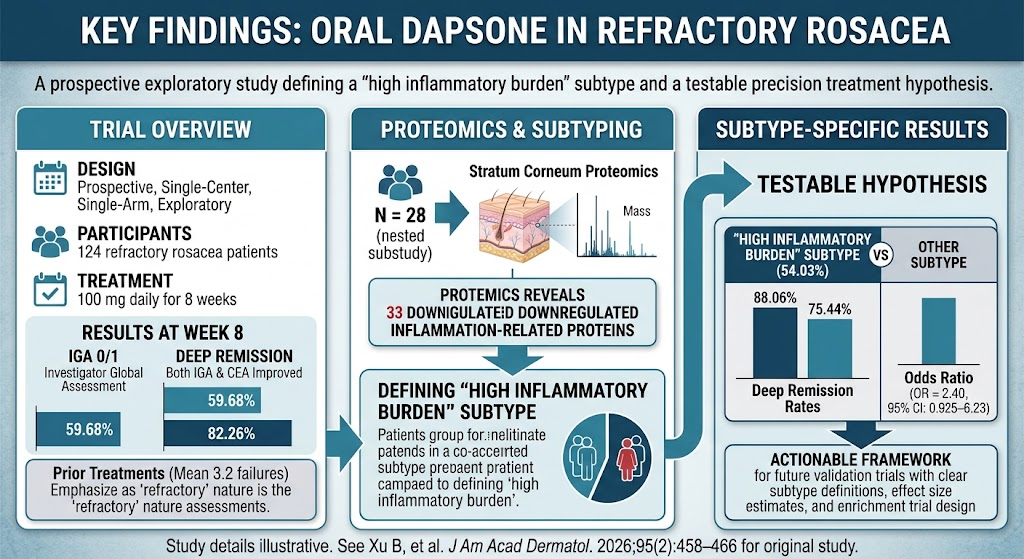
This was a prospective, single-center, single-arm exploratory clinical trial enrolling 124 patients with strictly defined refractory rosacea. Eligibility required failure of on average 3.2 prior treatments, underscoring the resistant nature of enrolled patients. Participants received oral dapsone 100 mg once daily for 8 weeks. A nested proteomics substudy included 28 participants who provided stratum corneum samples for detailed protein expression profiling.
Clinical endpoints included Investigator Global Assessment (IGA) scores and Clinician Erythema Assessment (CEA) to measure treatment response and remission status. The study also employed proteomic data integration to define a novel rosacea subtype termed “high inflammatory burden.”
Key Findings
At week 8, 59.7% of patients achieved clinical improvement to IGA scores of 0 or 1, indicating clear or almost clear skin. More notably, 82.3% attained “deep remission,” defined by simultaneous improvement in both IGA and CEA scores. This response magnitude surpasses typical placebo response rates estimated to range between 20% and 45%, although the uncontrolled design necessitates cautious interpretation.
Proteomic analyses identified 33 inflammation-related proteins significantly downregulated following dapsone treatment, shedding light on potential molecular mechanisms involving immune modulation within the epidermal barrier.
The authors further stratified patients into “high inflammatory burden” and “low inflammatory burden” subtypes based on proteomic profiles. The high inflammatory burden subgroup comprised approximately 54.0% of patients and demonstrated a higher deep remission rate (88.1% vs 75.4%) compared to the low burden group. The absolute difference in remission rates was 12.6%, corresponding to an odds ratio of 2.40 (95% CI: 0.925 to 6.23, P = 0.110), which did not reach statistical significance but suggested a clinically meaningful trend favoring this subtype.
Expert Commentary
The study’s exploratory design and single-arm format limit definitive conclusions regarding dapsone’s efficacy or the predictive value of the inflammatory subtype. However, its strengths lie in comprehensive proteomic integration and clear operationalization of a subtype hypothesis, paving the way for more targeted investigations. The identification of a molecularly defined subset aligns with emerging paradigms in dermatology emphasizing stratified precision medicine over one-size-fits-all approaches.
Future randomized placebo-controlled trials incorporating this subtype definition as an enrichment criterion are warranted to confirm these findings. Moreover, the proteomic markers may enable development of accessible diagnostic assays to guide clinicians on therapy selection.
Mechanistically, dapsone’s broad anti-inflammatory effects likely mediate improvements by downregulating key inflammatory pathways in keratinocytes and infiltrating immune cells. The protein signature highlighted hints at potential involvement of neutrophilic and complement pathways, areas meriting deeper investigation.
Conclusion
This prospective exploratory study demonstrates oral dapsone as a promising option for refractory rosacea and proposes a novel “high inflammatory burden” subtype that may enrich for better responders. Although limited by the study’s uncontrolled design, the results provide a solid scientific and clinical framework to design future validation trials of precision treatment strategies in rosacea. Given rosacea’s significant disease burden and heterogeneity, such approaches represent an important advance towards personalized dermatologic therapy.
Reference
Xu B, Liu H, Yang Y, Qing Y, Wang Y, Xiao T, Yang P, Yu B, Xiao S, Xia Y, Zhang T, Wu J. Oral dapsone in refractory rosacea: A prospective exploratory study defining a “high inflammatory burden” subtype and a testable precision treatment hypothesis. J Am Acad Dermatol. 2026 Aug;95(2):458-466. doi: 10.1016/j.jaad.2026.04.020. Epub 2026 May 8. PMID: 42104980.