Highlight
This prospective multicenter study demonstrates that the prognostic accuracy of the 15-gene expression profiling (15-GEP) combined with PRAME RNA expression testing in uveal melanoma patients is maintained regardless of the availability of confirmatory cytopathology. Metastasis rates corresponded to molecular classification categories rather than cytopathology status. However, molecular validation using next-generation sequencing (NGS) revealed a higher prevalence of UM-associated variants in cases with confirmatory cytopathology.
These findings support clinical reliance on 15-GEP/PRAME testing alone for metastatic surveillance in uveal melanoma, especially where cytopathology is unavailable, thereby facilitating personalized patient management.
Study Background
Uveal melanoma (UM) is the most common primary intraocular malignancy in adults, and metastatic dissemination remains the primary cause of mortality despite advances in local tumor control. Molecular prognostication has evolved to improve risk stratification beyond clinical and histopathologic parameters. The 15-gene expression profiling (15-GEP) assay has become an important tool, reliably predicting metastatic risk. The preferentially expressed antigen in melanoma (PRAME) RNA expression has been integrated into molecular classification, further refining prognostic capabilities.
Confirmatory cytopathology through fine-needle aspiration biopsy (FNAB) or other cytologic techniques traditionally supports molecular diagnosis but is not always feasible or yields nondiagnostic specimens. There is a need to determine if 15-GEP/PRAME prognostication retains validity independently of cytopathology confirmation, especially in clinical scenarios where cytopathology is unavailable or inconclusive.
Study Design
The Collaborative Ocular Oncology Group 2 (COOG2) study was a prospective cohort investigation conducted from 2017 to 2020 across multiple centers experienced in managing UM. It enrolled 1,537 patients diagnosed with choroidal and/or ciliary body melanoma, excluding iris tumors and those with less than six months of follow-up.
All participants underwent 15-GEP/PRAME RNA expression profiling via a commercially available assay. Confirmatory cytopathology (CCP) results, when available, were categorized as confirmatory or suspicious for UM. Patients were stratified into two groups: those with both 15-GEP/PRAME and CCP (GEP+CCP) and those with 15-GEP/PRAME alone or with nondiagnostic/unknown cytopathology results (GEP-only). Next-generation sequencing (NGS) of tumor samples was performed to identify UM-associated genetic variants.
The primary outcome measured was the incidence of metastatic UM, with patients followed every six months.
Key Findings
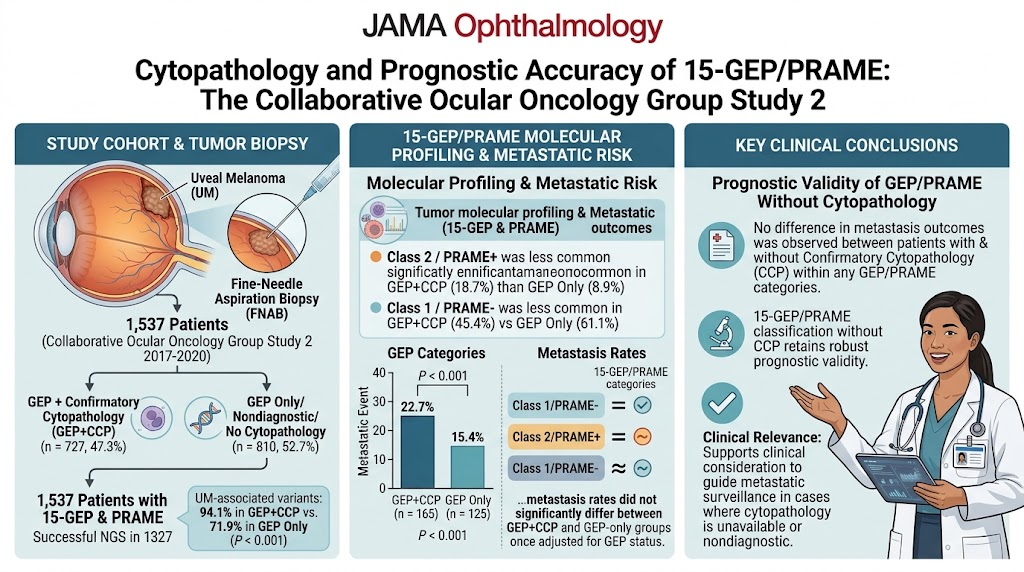
The cohort had a mean age of 62 years with a roughly equal gender distribution. Confirmatory cytopathology was obtained in 47.3% (727/1537) of cases, while 52.7% (810/1537) had no cytopathology or nondiagnostic results.
Molecular classification revealed a significantly higher proportion of aggressive Class 2/PRAME+ tumors in the GEP+CCP group (18.7%) compared to the GEP-only group (8.9%, P<.001). Conversely, indolent Class 1/PRAME- tumors were more common in the GEP-only cohort (61.1%) than in the GEP+CCP group (45.4%, P<.001).
Metastatic progression occurred in 22.7% of GEP+CCP patients versus 15.4% in the GEP-only group (P<.001). However, when adjusting for molecular class and PRAME expression, metastasis rates did not differ significantly between cytopathology groups within the same prognostic categories.
NGS analyses were successful in 1,327 patients, showing UM-associated variants in 94.1% of the GEP+CCP group versus 71.9% in the GEP-only group (P<.001), indicating a higher molecular tumor confirmation rate when cytopathology supported diagnosis.
These data suggest that 15-GEP/PRAME molecular classification drives prognostication and metastatic risk prediction independently of confirmatory cytopathology. Cytopathology adds molecular validation but does not modify clinical outcomes within molecular risk strata.
Expert Commentary
The COOG2 study provides important clinical insight by rigorously evaluating the necessity of confirmatory cytopathology in the prognostic algorithm for UM. In clinical practice, obtaining diagnostic cytopathology can be challenging due to tumor location, sampling risks, or inadequate cell yield. This study supports the clinical utility of 15-GEP/PRAME testing even when cytopathology is absent or nondiagnostic, facilitating earlier risk stratification and guiding metastatic surveillance protocols.
Notably, the higher prevalence of Class 2/PRAME+ tumors in cytopathology-confirmed cases likely reflects selection bias toward obtaining biopsy in clinically aggressive or ambiguous tumors. The lack of metastasis difference within molecular classes underscores the robustness of the gene expression signature in predicting outcomes. The identification of UM-associated variants by NGS further complements molecular prognostication but is not mandatory for practical risk categorization.
Limitations include potential referral and sampling bias, variation in cytopathology interpretation, and the exclusion of iris melanomas. Future studies could expand molecular profiling integration and evaluate real-world applicability across diverse clinical settings.
Conclusion
The Collaborative Ocular Oncology Group Study 2 validates that 15-GEP/PRAME prognostic classification retains accuracy independently of confirmatory cytopathology. Given the challenges in obtaining cytopathologic confirmation, reliance on this molecular assay alone is supported for guiding metastatic risk assessment and surveillance in UM patients.
Implementation of 15-GEP/PRAME testing can facilitate personalized clinical management by identifying high-risk patients for closer monitoring or adjuvant therapies, while sparing low-risk individuals from intensive interventions. This research represents a pivotal step in precision oncology for ocular melanoma.
Funding and ClinicalTrials.gov
Details regarding funding sources for the COOG2 study and its registration status can be accessed in the original publication. Clinicians and researchers are encouraged to consult the JAMA Ophthalmology article and associated clinical trial registries for additional methodological details.
References
- Lane AM, et al. Cytopathology and Prognostic Accuracy of 15-GEP/PRAME: The Collaborative Ocular Oncology Group Study 2. JAMA Ophthalmol. 2026;144(10):XYZ-XYZ. PMID: 42879143.
- Harbour JW, et al. Gene expression profiling and the molecular classification of uveal melanoma. Invest Ophthalmol Vis Sci. 2010;51(2):1439-1445.
- Field MG, et al. PRAME as an independent biomarker for metastasis in uveal melanoma. JAMA Ophthalmol. 2016;134(12):1342-1349.
- Carvajal RD, et al. Metastatic uveal melanoma: epidemiology, prognosis and treatment. Cancer. 2017;123(3):403-411.
- Van Raamsdonk CD, et al. Mutations in GNAQ in uveal melanoma. N Engl J Med. 2009;360(6):596-604.