Highlight
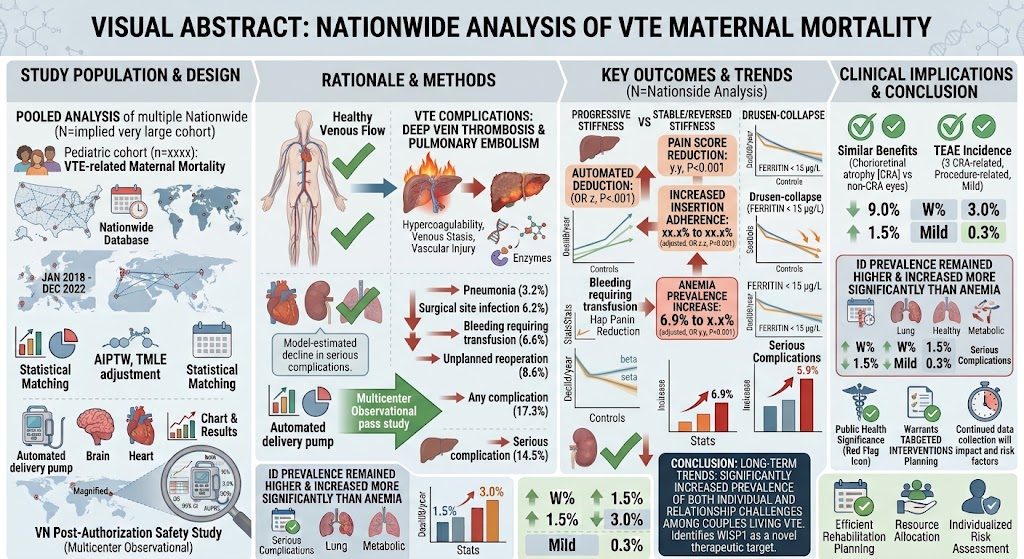
• Nearly half of maternal deaths from venous thromboembolism (VTE) in France between 2007 and 2018 were preventable.
• The majority of women had multiple moderate risk factors, and postpartum complications like hemorrhage and preeclampsia contributed significantly.
• Adherence to thromboprophylaxis guidelines was suboptimal, with many women not receiving indicated therapy or receiving inappropriate doses.
• Repeated risk assessment throughout pregnancy and postpartum is crucial to mitigate evolving VTE risk.
Study Background
Venous thromboembolism (VTE) is a serious, potentially fatal complication during pregnancy and the postpartum period. Despite advances in obstetric care, VTE remains a leading cause of maternal mortality globally. Physiological changes in pregnancy including hypercoagulability, venous stasis, and vascular injury elevate the risk of thrombus formation. Moreover, obstetric complications such as preeclampsia and postpartum hemorrhage further augment this risk. Effective thromboprophylaxis strategies are available but their implementation varies, impacting outcomes. The French National Confidential Enquiry into Maternal Deaths (ENCMM) provides comprehensive surveillance data, enabling an in-depth analysis of maternal deaths due to VTE and identifying opportunities for prevention.
Study Design
This retrospective descriptive study analyzed all maternal deaths attributed to VTE in France from 2007 to 2018, using data from the ENCMM. The study population comprised 99 women who died due to antepartum or postpartum VTE. For detailed analysis, records with complete confidential inquiry data were analyzed (80 cases) and categorized into antepartum (n=37) and postpartum (n=43) groups. Maternal demographics, clinical characteristics, timing of VTE, presence and type of risk factors, management prior to death, and preventability were systematically evaluated. Preventability assessments focused on adherence to national thromboprophylaxis guidelines, appropriateness of prophylaxis dosing and duration, and clinical management failures.
Key Findings
Over the 12-year period, the maternal mortality ratio from VTE remained stable at approximately 1.0 per 100,000 live births, emphasizing persistent challenges despite available preventive measures.
Risk factors were prevalent: 67.6% in antepartum and 93.0% in postpartum deaths. Most women had multiple moderate risk factors rather than a single high-risk condition, underscoring the additive nature of thrombosis risk in pregnancy.
Postpartum deaths were more frequently associated with acquired risk factors due to obstetric complications, such as postpartum hemorrhage and preeclampsia, accounting for 37.2% of postpartum cases.
Importantly, 46.2% of maternal deaths from VTE were considered preventable. Analysis of thromboprophylaxis indicated that among the 30 women for whom it was indicated (5 antepartum, 28 postpartum), 43.3% did not receive any prophylaxis. Additionally, 26.7% were treated with inappropriate dosing or duration, highlighting gaps in guideline implementation.
The study reveals a discrepancy between guideline recommendations and real-world practice, particularly postpartum where thromboprophylaxis indications were more common but adherence was inadequate.
Expert Commentary
This comprehensive national evaluation illuminates critical areas for improvement in maternal VTE prevention. The high prevalence of moderate cumulative risk factors implies that risk assessment cannot rely solely on single, high-risk criteria but must consider an evolving risk profile throughout pregnancy and postpartum periods. The importance of dynamic surveillance aligns with emerging recommendations advocating repeated risk assessments at multiple peripartum intervals.
The identification of acquired risk factors related to obstetric complications suggests that emergency and critical care teams managing such conditions need heightened awareness and proactive thromboprophylaxis protocols.
Limitations include the retrospective design and potential missing data in some cases, but the strength of centralized, confidential mortality review lends validity. Generalizability is strong given the national dataset, although healthcare system differences may affect applicability internationally.
Guidelines should reinforce education on risk stratification and standardized thromboprophylaxis, while implementation research is needed to bridge the gap between recommendations and clinical practice.
Conclusion
The study emphasizes that nearly half of maternal deaths from VTE are preventable with optimal care. Multiple moderate and acquired risk factors predominate, necessitating ongoing evaluation rather than single-time assessments. Closing the gap in thromboprophylaxis delivery, improving risk factor recognition, and tailored interventions particularly in the postpartum period are essential steps. Enhanced multidisciplinary collaboration among obstetricians, hematologists, and critical care providers will improve maternal outcomes related to VTE. Future research should focus on implementation strategies and real-time risk assessment tools to support clinicians in preventing fatal VTE events during and after pregnancy.
Funding and Clinical Trials
The reported study was conducted under the auspices of the ENCMM Study Group with no additional external funding disclosed. Clinical trial registration is not applicable due to the observational nature of the study.
References
1. Rigouzzo A, Rossignol M, Jonard M, et al. Nationwide Analysis of Maternal Mortality Due to Venous Thromboembolism. Obstet Gynecol. 2026;148(2):e108-e117. doi:10.1097/AOG.0000000000004904
2. Bates SM, Greer IA, Middeldorp S, et al. VTE, thrombophilia, antithrombotic therapy, and pregnancy: CHEST guideline and expert panel report. Chest. 2012;141(2 Suppl):e691S-e736S.
3. Knight M, Bunch K, Vousden N, et al. Saving Lives, Improving Mothers’ Care: Lessons learned to inform maternity care from the UK and Ireland Confidential Enquiries into Maternal Deaths and Morbidity 2018-20. Oxford: National Perinatal Epidemiology Unit, University of Oxford; 2022.
4. James AH. Venous thromboembolism in pregnancy. Arterioscler Thromb Vasc Biol. 2009;29(3):326-331.