Highlight
– Limbal stem cell deficiency (LSCD), lid margin keratinization (LMK), and conjunctivalization are prevalent in chronic SJS and predict the need for surgical intervention.
– Antibiotic and NSAID exposure during acute SJS correlates with higher risk of progressive vision loss.
– Delayed presentation to specialized centers (median delay of 1 year) suggests gaps in early referral and acute-phase management.
– Systemic immunomodulatory therapy use and longer follow-up duration associate with worse visual outcomes, possibly reflecting severity of disease.
Study Background
Stevens-Johnson syndrome (SJS) is a rare but devastating mucocutaneous disorder characterized by immune-mediated widespread epithelial necrosis, frequently causing severe ocular surface involvement. The chronic phase can lead to persistent inflammation, scarring, limbal stem cell deficiency, and permanent vision loss. Despite advances in acute management, many patients progress to severe ocular complications necessitating surgical interventions such as mucous membrane grafting. There remains a critical unmet need to identify early predictors of poor ocular outcomes in SJS and improve coordinated care pathways to prevent irreversible vision loss.
Study Design
This retrospective multicenter cohort study analyzed medical records from tertiary referral centers nationwide, including 228 eyes from 115 patients with chronic SJS. The median delay from disease onset to presentation at specialized centers was approximately one year, highlighting common referral delays. The study utilized machine-learning-based random forest models followed by multivariate logistic regression to determine clinical predictors associated with the need for surgery and progression of vision loss during follow-up.
Key Findings
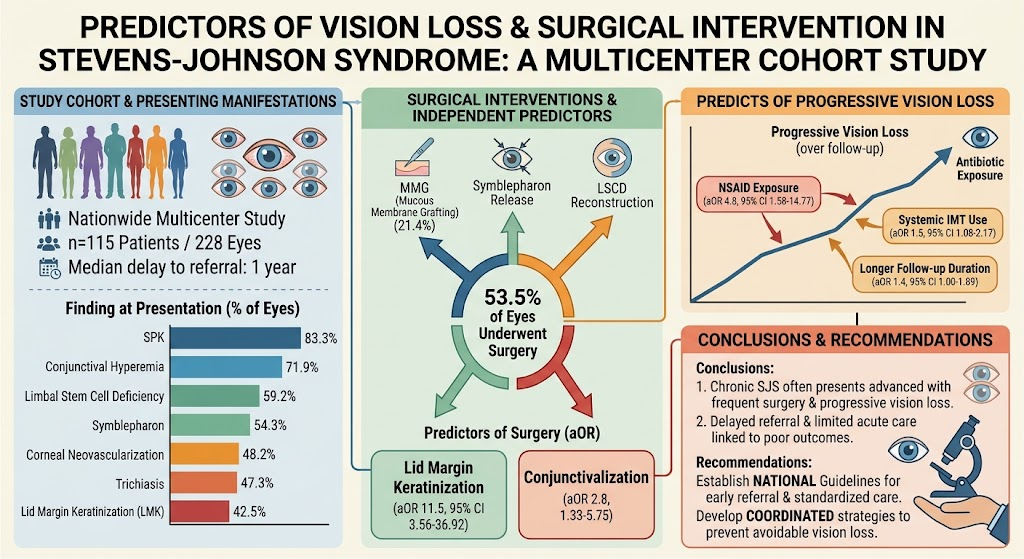
Clinical manifestations at presentation were notable for superficial punctate keratitis (83.3%), conjunctival hyperemia (71.9%), limbal stem cell deficiency (59.2%), symblepharon (54.3%), corneal neovascularization (48.2%), trichiasis (47.3%), and lid margin keratinization (42.5%). More than half the eyes (53.5%) underwent surgical intervention over follow-up, most commonly mucous membrane grafting (21.4%).
Strong predictors of requiring surgery were LMK with an adjusted odds ratio (aOR) of 11.5 (95% CI: 3.56–36.92) and conjunctivalization with aOR 2.8 (95% CI: 1.33–5.75). These features represent chronic epithelial damage and ocular surface instability necessitating surgical correction.
Visual deterioration was independently associated with several variables: longer follow-up duration (aOR 1.4, 95% CI: 1.00–1.89), systemic immunomodulatory therapy (IMT) use (aOR 1.5, 95% CI: 1.08–2.17), and prior exposure to antibiotics (aOR 3.9, 95% CI: 1.60–9.5) or non-steroidal anti-inflammatory drugs (NSAIDs) (aOR 4.8, 95% CI: 1.58–14.77). These findings suggest that drug exposures in the acute phase and persistent inflammation contribute to vision loss progression.
Expert Commentary
This large cohort study underscores the challenging management of chronic ocular complications in SJS. The prevalence of advanced features such as LSCD and LMK at presentation highlights shortcomings in acute management and referral delays. Lid margin keratinization, a hallmark of chronic inflammation and scarring, strongly predicts surgical need, supporting prior work on the importance of early ocular surface stabilization.
The association of antibiotics and NSAIDs with vision loss parallels hypotheses that certain drugs may trigger or exacerbate immune responses in SJS or reflect disease severity. However, use of systemic IMT correlating with worse outcomes may indicate these therapies are administered in more severe cases rather than causing deterioration per se. The study’s retrospective nature and referral bias to tertiary centers are notable limitations, potentially enriching for more severe patients.
These findings reinforce calls for standardized treatment guidelines advocating early referral to specialized centers, prompt initiation of acute-phase therapies such as amniotic membrane grafting or immunomodulation, and close long-term monitoring to detect and treat ocular surface complications before irreversible damage.
Conclusion
Chronic Stevens-Johnson syndrome frequently presents with advanced ocular surface disease leading to progressive vision loss and high surgical intervention rates. Key predictors such as lid margin keratinization and conjunctivalization identify patients at risk for surgery, while drug exposures and disease chronicity correlate with visual decline. Delayed referral and limited application of acute-phase therapies may contribute to poor outcomes. National guidelines promoting early identification, coordinated care, and standardized ocular management are essential to prevent avoidable blindness in SJS.
Funding and Clinical Trials
Not explicitly stated in the primary publication. Further prospective clinical trials are warranted to evaluate guideline-based early interventions and novel therapeutic approaches in SJS ocular management.
References
1. Ortiz-Morales G, Barcelo-Canton RH, Rodriguez-Garcia A, et al. Predictors of Vision Loss and Surgical Intervention in Stevens-Johnson Syndrome: A Multicenter Nationwide Cohort Study. American Journal of Ophthalmology. 2026; PMID: 42759755.
2. Gregory DG, Dart JK, Saw VPJ. Stevens-Johnson Syndrome and Toxic Epidermal Necrolysis: Results from a Cochrane Review on Management and Treatment. Ophthalmology. 2020;127(9):1401-1412.
3. Hau S, Malhotra R, Ramaesh K. Limbal Stem Cell Deficiency in Stevens-Johnson Syndrome: Clinical Outcomes and Therapeutic Advances. British Journal of Ophthalmology. 2017;101(6):673-681.
4. Sotozono C, Ueda A, Fujita A, et al. Efficacy of Early Amniotic Membrane Transplantation in SJS and TEN. British Journal of Ophthalmology. 2007;91(1):70-75.