Highlight
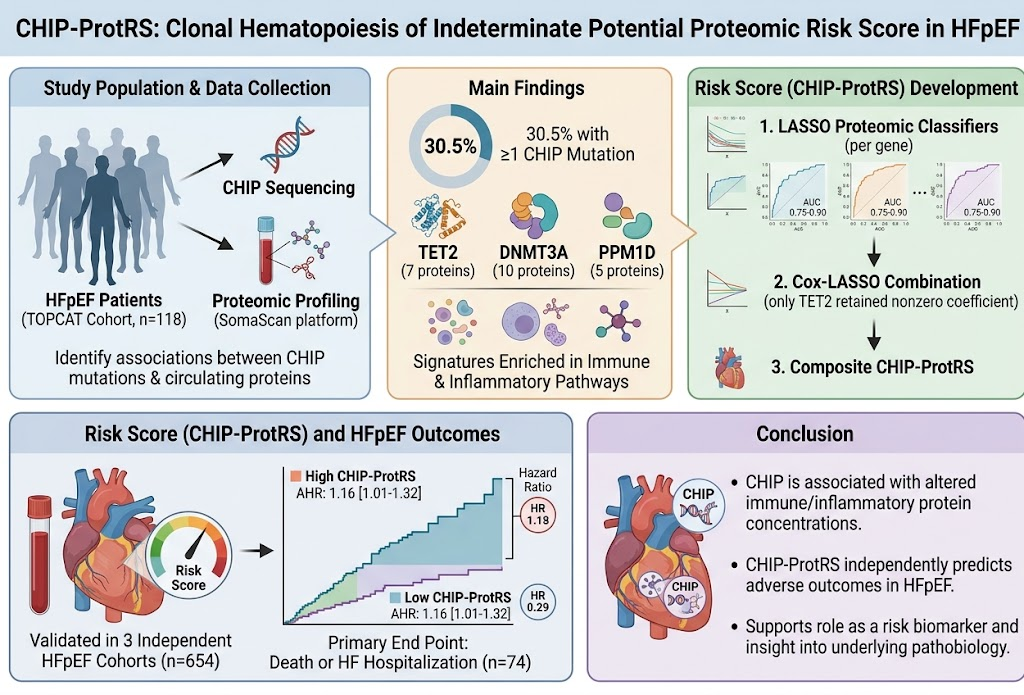
Clonal hematopoiesis of indeterminate potential (CHIP) is prevalent in patients with heart failure with preserved ejection fraction (HFpEF) and is associated with distinct plasma immune and inflammatory proteomic profiles. A novel CHIP-derived proteomic risk score (CHIP-ProtRS), particularly rooted in TET2 mutation signatures, independently predicts adverse clinical outcomes such as death and heart failure hospitalization across multiple HFpEF cohorts. This proteomic marker enhances risk stratification beyond established clinical indices, providing key biological insights into HFpEF pathogenesis and potential therapeutic targeting.
Study Background
Heart failure with preserved ejection fraction (HFpEF) comprises nearly half of all heart failure cases and is characterized by diastolic dysfunction with normal left ventricular ejection fraction. Despite its prevalence, therapeutic advances have been limited, partly due to the syndrome’s heterogeneity and incomplete understanding of its underlying mechanisms. Clonal hematopoiesis of indeterminate potential (CHIP), defined by acquired somatic mutations in hematopoietic stem cells without overt hematologic malignancy, has emerged as a significant risk factor for cardiovascular disease and mortality. CHIP driver mutations commonly affect genes such as TET2, DNMT3A, and PPM1D, leading to altered inflammatory immune pathways implicated in cardiovascular remodeling and dysfunction.
However, the relationship between CHIP mutations and circulating proteomic alterations in HFpEF remains poorly characterized. Additionally, the prognostic value of CHIP-related protein signatures in this population is unexplored. Addressing these gaps could provide novel biomarkers for risk stratification and deepen mechanistic understanding, potentially guiding personalized HFpEF interventions.
Study Design
This investigation derived its primary cohort from the TOPCAT trial, including 118 patients with HFpEF who underwent CHIP genetic sequencing alongside plasma proteomic profiling using the SomaScan platform. Gene-specific associations between CHIP mutations (primarily TET2, DNMT3A, and PPM1D) and circulating protein concentrations were identified via linear regression adjusted for age, with multiple testing correction.
Proteomic classifiers specific to each CHIP gene were developed employing nested cross-validated least absolute shrinkage and selection operator (LASSO) logistic regression to discriminate mutation carriers. Subsequently, a composite CHIP proteomic risk score (CHIP-ProtRS) was generated using LASSO Cox regression analysis to predict clinical outcomes.
Validation was conducted externally in a pooled dataset of three independent HFpEF cohorts totaling 654 patients. The primary endpoint combined all-cause mortality and heart failure hospitalization, critical clinical outcomes for HFpEF management.
Key Findings
CHIP mutations were identified in approximately 30.5% of the derivation cohort, reaffirming the prevalence of clonal hematopoiesis in HFpEF. Proteomic analyses revealed distinct circulating protein alterations linked to specific driver mutations: TET2 (7 proteins), DNMT3A (10 proteins), and PPM1D (5 proteins). These proteins predominantly involved immune regulation and inflammatory pathways, corroborating the notion that CHIP-driven immune dysregulation contributes to HFpEF pathogenesis.
The gene-specific proteomic classifiers demonstrated robust discriminative performance for detecting corresponding CHIP mutations with area under the receiver operating characteristic curves ranging from 0.752 to 0.898.
Evaluation of the clinical endpoint showed event rates of 28.0% in the derivation cohort and 34.7% in validation cohorts. Among all proteomic signatures, the TET2-derived signature alone retained a significant independent association within the composite CHIP-ProtRS, highlighting its paramount prognostic value in HFpEF.
Multivariable Cox regression confirmed that the CHIP-ProtRS independently predicted the composite outcome of death and heart failure hospitalization after adjusting for age, sex, the Meta-Analysis Global Group in Chronic Heart Failure (MAGGIC) risk score, NT-proBNP levels, and atrial fibrillation status. The adjusted hazard ratio was 1.42 (95% CI, 1.01–2.00) in the derivation and 1.16 (95% CI, 1.01–1.32) in the validation cohorts, underscoring the score’s reproducible prognostic performance.
Expert Commentary
This study elegantly bridges molecular hematology and cardiology by illuminating how somatic mutations in blood cells influence systemic proteomic landscapes and clinical outcomes in HFpEF. The focus on TET2 is consistent with prior mechanistic studies implicating TET2 deficiency in exacerbated inflammation and cardiac remodeling, while DNMT3A and PPM1D associations further enrich the understanding of CHIP’s heterogeneity.
The use of advanced proteomic platforms coupled with rigorous regression modeling offers a practical biomarker approach. Nonetheless, translating these findings calls for prospective validation in larger, more diverse HFpEF populations, and interrogation of whether CHIP-ProtRS modulation could stratify patients for novel anti-inflammatory or immunomodulatory therapies.
Limitations include the relatively small derivation cohort size and the observational design, which precludes causal inferences. Moreover, the clinical utility of proteomic risk scores versus genomic sequencing alone remains to be definitively established.
Conclusion
Clonal hematopoiesis significantly alters immune and inflammatory plasma proteins in patients with HFpEF, with distinct signatures based on mutation driver genes. The newly developed and validated CHIP proteomic risk score, driven principally by the TET2 mutation profile, independently forecasts adverse clinical outcomes beyond conventional risk factors. These findings could enhance personalized risk stratification and foster mechanistically targeted therapies in HFpEF, addressing a significant unmet need in cardiovascular medicine.
Funding and ClinicalTrials.gov
The study utilized participants from the TOPCAT trial and multiple independent HFpEF cohorts. Specific funding sources were not detailed in the abstract. TOPCAT is registered under ClinicalTrials.gov identifier NCT00094302.
References
Kim M, Subramanian V, Tavolinejad H, et al. Clonal Hematopoiesis of Indeterminate Potential Proteomic Risk Score for Predicting Clinical Outcome in Patients With Heart Failure With Preserved Ejection Fraction. Circulation Heart Failure. 2026 Sep 21:e014345. PMID: 42765309.
Jaiswal S, Ebert BL. Clonal Hematopoiesis in Human Aging and Disease. Science. 2019;366(6465). doi:10.1126/science.aaw7280
Shah S, Henry A, Roselli C, et al. Genome-wide association and Mendelian randomisation analysis provide insights into the pathogenesis of heart failure. Nat Commun. 2020;11(1):163. doi:10.1038/s41467-019-13690-8
Nagareddy PR, Murphy AJ, Stirzaker RA, et al. TET2 regulates inflammatory gene expression in pulmonary arterial hypertension and heart failure. J Clin Invest. 2021;131(20):e140704. doi:10.1172/JCI140704
Murthy VL, Bonow RO. Clonal Hematopoiesis and Cardiovascular Disease: When Blood is Not Just Blood. Circulation. 2021;143(20):1942-1945. doi:10.1161/CIRCULATIONAHA.121.054309