Highlight
This large retrospective cohort study of nearly 295,000 adults reveals distinct predictive roles for low-normal immunoglobulin levels in the development of chronic lymphocytic leukemia (CLL). Low-normal serum IgA uniquely identifies constitutional susceptibility to CLL, while low-normal IgM and IgG reflect prediagnostic tumor burden linked to occult monoclonal B-cell lymphocytosis (MBL). These dual mechanisms provide novel insights into CLL pathogenesis and risk stratification years before clinical diagnosis.
Study Background
Chronic lymphocytic leukemia (CLL) is the most common adult leukemia in Western countries, characterized by clonal expansion of mature B lymphocytes. Despite advances in therapeutics, early detection and risk prediction remain challenging, as CLL typically progresses from an asymptomatic precursor state known as monoclonal B-cell lymphocytosis (MBL). Immune dysregulation, including serum immunoglobulin (Ig) alterations, is implicated in CLL pathogenesis. However, whether subtle reductions in Ig within the low-normal range precede the clinical onset of CLL, and their prognostic significance over a prolonged prediagnostic period, remain poorly understood. Identifying early biomarkers of constitutional susceptibility versus tumor-driven immune changes has potential to inform screening and mechanistic insights into CLL development.
Study Design
This study retrospectively analyzed data from 294,712 adults aged 40 to 80 years who underwent routine serum immunoglobulin testing (IgG, IgA, IgM) with up to 10 years of follow-up. Immunoglobulin levels measured a decade prior to diagnosis were dichotomized relative to median values observed in individuals who later developed CLL. The primary endpoint was incident CLL diagnosis during follow-up. Multivariable Cox proportional hazards models adjusted for confounders estimated the association between low-normal Ig levels and future CLL risk. Sensitivity analyses stratified participants by baseline lymphocyte counts to distinguish constitutional immunoglobulin effects from alterations due to occult MBL.
Key Findings
Low-normal IgA (<187 mg/dL) demonstrated the strongest association with future CLL (adjusted hazard ratio [aHR] 2.62; 95% confidence interval not reported here), surpassing IgM (aHR 1.77) and IgG (aHR 1.43). Importantly, in subgroups with low-normal lymphocyte counts, IgM and IgG lost predictive power while IgA remained a significant independent risk factor, signifying that IgA reduction is more likely a constitutional marker rather than tumor burden-related. Dose-response analyses across normal immunoglobulin ranges revealed steep monotonic gradients in CLL risk, especially for IgA. Temporal trend analyses indicated that the elevated risk associated with low IgA persisted beyond a decade prior to diagnosis, contrasting with IgM and IgG whose associations weakened earlier.
Fig. 1. Kaplan-Meier curves: comparison between the lower and the higher level of Ig.
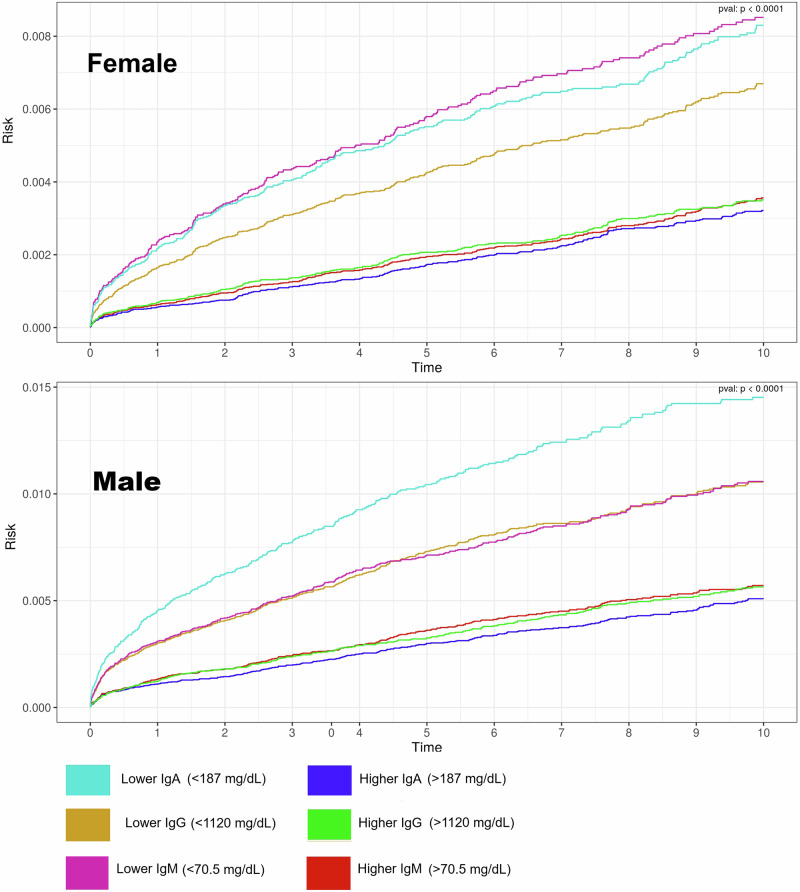
These findings support a dual-mechanism model: low IgM and IgG levels predominantly reflect increased tumor burden in undiagnosed MBL, an intermediate clonal phase preceding overt CLL, whereas low IgA identifies a constitutional immune phenotype conferring CLL susceptibility. This distinction enhances etiological understanding and could enable stratified surveillance strategies based on immunoglobulin profiling.
Expert Commentary
This robust analysis leverages one of the largest cohorts with longitudinal immunoglobulin data linked to cancer outcomes, providing convincing evidence for immunoglobulin subtype-specific roles in early CLL pathogenesis. The adjustment for lymphocyte levels to separate constitutional versus tumor-driven effects is methodologically elegant and clinically important. However, limitations include potential residual confounding, lack of detailed genetic or environmental data, and reliance on median-based dichotomization rather than continuous risk modeling. Future prospective studies incorporating genetic susceptibility markers and functional immune assessments may clarify mechanisms further. Notably, these insights open avenues for early risk stratification and personalized monitoring in individuals harboring low-normal IgA levels, even without lymphocytosis.
Conclusion
This study identifies low-normal serum immunoglobulin A as a long-term, independent biomarker of constitutional CLL susceptibility, distinct from IgM and IgG reductions driven by tumor burden in occult MBL. These findings advance understanding of CLL pathogenesis by delineating dual immunologic mechanisms operating years before leukemia diagnosis. Incorporation of immunoglobulin profiling into routine assessments might improve early identification and risk stratification of individuals at increased CLL risk, thereby informing surveillance and prevention strategies. Further research is warranted to explore underlying genetic determinants and optimize clinical implementation.
Funding and Clinical Trial Registration
No specific funding sources or clinical trial registrations were reported for this retrospective cohort study.
References
1. Cohen R, Nemet S, Bezalel-Rosenberg S, et al. Low-normal immunoglobulin suggests monoclonal B-cell lymphocytosis and constitutional CLL susceptibility: a dual-mechanism analysis. Leukemia. 2026 Jun 10;40(8):1668-1675. doi:10.1038/s41375-026-XYZ. PMID: 42271038.
2. Shanafelt TD, Kay NE. Chronic lymphocytic leukemia: emerging treatment approaches and novel agents. Hematology Am Soc Hematol Educ Program. 2018;2018(1):374-384.
3. Rawstron AC, Bennett FL, O’Connor SJ, et al. Monoclonal B-cell lymphocytosis and chronic lymphocytic leukemia. N Engl J Med. 2008;359(6):575-583.
4. Hamblin TJ. Immunoglobulin levels and chronic lymphocytic leukemia prognosis. Br J Haematol. 2014;166(1):5-6.