Study Background
Burn injuries represent a complex clinical condition associated with significant morbidity, including both acute and chronic physical sequelae. Among survivors, chronic pain and pruritus are common complications that can markedly impair quality of life and hinder functional recovery. Despite advances in burn care and rehabilitation, longitudinal data characterizing the trajectory of these symptoms remain limited. Furthermore, the interplay between psychological factors, such as post-traumatic stress disorder (PTSD), and somatic symptomatology after burns is an area of growing clinical interest. Understanding these relationships is vital to improving holistic care strategies for burn survivors.Study Design
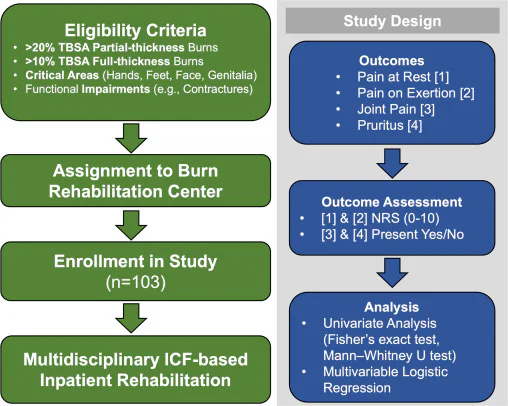
This investigation was a prospective multicenter cohort study conducted at specialized inpatient burn rehabilitation centers. The study population included 103 adult burn survivors undergoing burn-specific inpatient rehabilitation. The intervention consisted of standardized rehabilitation tailored to burn injury recovery. Main outcome measures focused on symptom burden at multiple time points: admission, discharge, and at 3- and 12-month follow-ups. Pain at rest and pain on exertion were quantified using Numeric Rating Scales (NRS), with a clinically significant threshold defined as NRS ≥4. Presence or absence of joint pain and pruritus was also recorded. Baseline PTSD symptoms were assessed to explore their predictive value for chronic pain and pruritus outcomes.Key Findings
At baseline (admission), a considerable proportion of patients reported symptoms: 17.5% experienced clinically significant pain at rest, 49.5% reported pain on exertion, 40% had joint pain, and 68% suffered from pruritus. Despite structured inpatient rehabilitation, symptom prevalence remained substantial at 12 months post-injury, with rates of 14.1% for pain at rest, 30.4% for pain on exertion, 34.8% for joint pain, and 51.1% for pruritus. Critically, baseline PTSD symptoms emerged as a consistent and strong independent predictor across all symptom domains. Statistical analyses demonstrated significantly elevated odds ratios (ORs) for patients with PTSD symptoms compared to those without: pain at rest (OR 23.8, 95% CI 3.58–347.0), pain on exertion (OR 10.5, 95% CI 3.56–36.7), joint pain (OR 12.9, 95% CI 4.24–47.3), and pruritus (OR 4.36, 95% CI 1.67–12.2). These relationships remained robust after correction for multiple testing. Additionally, longitudinal risk differences highlighted increased symptom burden associated with PTSD, specifically a 28.96% higher risk for joint pain and a 9.7% higher risk for pruritus over time. These results support the notion that PTSD is not merely a comorbid psychological condition but may actively modulate persistent physical symptoms following burn injury.Expert Commentary
The study by Klimitz et al. extends previous literature on burn sequelae by rigorously delineating symptom trajectories over a year and identifying PTSD as a crucial risk factor for chronic pain and pruritus. This aligns with broader evidence implicating psychological trauma in chronic pain syndromes, possibly through neuroimmune mechanisms and central sensitization. Clinically, these findings emphasize the importance of early and integrated assessment of mental health in burn rehabilitation programs. It suggests that targeted psychological interventions for PTSD might mitigate long-term somatic symptoms, improving overall recovery outcomes. However, the study has some limitations, including potential sample size constraints impacting the precision of estimates, and the observational design which precludes causality inference. Future investigations should aim to elucidate underlying pathophysiological links and assess efficacy of combined interdisciplinary interventions addressing both psychological and somatic dimensions.Conclusion
Chronic pain and pruritus are prevalent and persistent complications following burn injury, with a significant proportion of survivors experiencing these symptoms up to one year despite specialized rehabilitation. Baseline PTSD symptoms substantially increase the risk and severity of these symptoms, underscoring the need for comprehensive rehabilitation approaches that integrate psychological care with physical therapies. Optimizing burn survivor outcomes requires addressing both the mind and body to disrupt the cycle of pain, pruritus, and psychological distress.Funding and ClinicalTrials.gov
The report does not specify funding sources or clinical trial registration. Further transparency in these areas would enhance the appraisal of study validity.References
1. Klimitz FJ, Neubauer H, Stolle A, et al. Longitudinal Trajectories and Risk Factors for Post-traumatic Chronic Pain and Pruritus Following Burn Injuries: a Prospective Multicenter Cohort Study. Arch Phys Med Rehabil. 2026 Oct 31. PMID: 42966589. 2. Honari S, Pajevic S, Suman OE, et al. Pruritus and pain following burns: A temporal and mechanistic comparison. J Burn Care Res. 2017;38(1):e289-e295. 3. Ballantyne JC, Mao J. Neuropathic pain: Mechanisms and their clinical implications. BMJ. 2003;326(7394):200-204. 4. Meints SM, Edwards RR. Evaluating psychosocial contributions to chronic pain outcomes. Curr Pain Headache Rep. 2018;22(3):24. 5. Bryant RA, Harvey AG. Posttraumatic stress in adults after burns. Burns. 1995;21(1):10-13. The integration of mental health screening and management into burn rehabilitation pathways is vital to reduce long-term symptom burden and improve quality of life for this vulnerable population.Specialty calculators
For clinical reference; use professional judgment.