Highlight
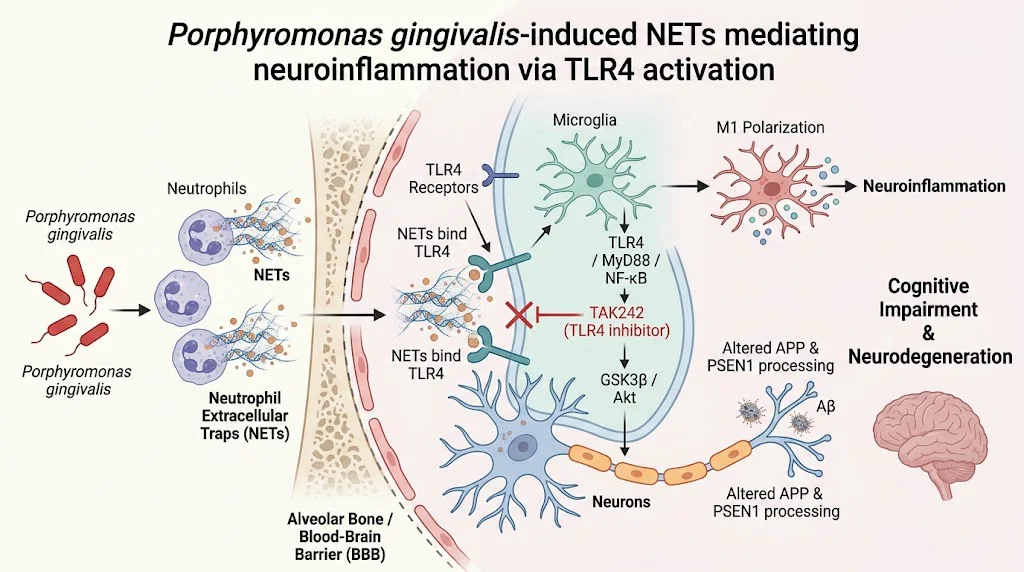
This article summarizes pivotal findings on the role of Porphyromonas gingivalis-induced neutrophil extracellular traps (NETs) in driving neuroinflammation and cognitive decline through activation of the Toll-like receptor 4 (TLR4) pathway. The study connects periodontal infection, immune responses, and Alzheimer’s disease (AD) pathogenesis.
Key highlights include:
- Demonstration of increased alveolar bone loss and NET formation in a murine periodontitis model induced by P. gingivalis.
- Evidence that periodontitis impairs cognitive functions and enhances neuroinflammation with glial activation and altered APP processing in the brain.
- The identification of TLR4 signaling as a critical mediator, with pharmacologic TLR4 inhibition reversing inflammation and cognitive deficits.
- In vitro confirmation that P. gingivalis-induced NETs promote microglial M1 polarization and influence neuronal APP metabolism, involving TLR4/Myd88/NF-κB and GSK3β/Akt pathways.
Study Background
Periodontitis, a chronic inflammatory disease resulting primarily from bacterial infections such as Porphyromonas gingivalis, is a significant public health concern due to its high prevalence and systemic consequences. Recent epidemiological and experimental data point to periodontitis as a modifiable risk factor for Alzheimer’s disease (AD), a neurodegenerative disorder characterized by cognitive decline and neuropathological hallmarks including amyloid plaques and neurofibrillary tangles.
Neutrophils, as the first responders in periodontal inflammation, release neutrophil extracellular traps (NETs) to capture and kill pathogens. However, aberrant NET formation may contribute to systemic inflammation. The mechanisms linking periodontal NETs to brain pathology in AD remain to be thoroughly elucidated. This study investigates whether P. gingivalis-induced NETs mediate neuroinflammation via TLR4 activation, offering novel insight into the periodontal–neurodegeneration axis.
Study Design
An experimental murine periodontitis model was established by oral local application of P. gingivalis, with or without concomitant administration of TAK242, a selective TLR4 inhibitor. Evaluation included micro-computed tomography (micro-CT) to assess maxillary bone resorption and flow cytometry to quantify neutrophil populations.
NET formation was characterized by measuring cell-free DNA, neutrophil elastase and myeloperoxidase activities via ELISA, and further validated through RT-PCR, western blotting, and immunofluorescence.
Cognitive ability was assessed using behavioral tests pertinent to learning and memory. Neuroinflammation was quantified by immunohistochemistry and RT-PCR for glial markers and inflammatory cytokines. Amyloid precursor protein (APP) processing was evaluated by immunohistochemical techniques. Complementary in vitro experiments focused on the effects of P. gingivalis-induced NETs on neuron-glia cellular units, examining molecular pathways implicated in neuroinflammation and APP metabolism.
Key Findings
In Vivo Observations
Mice exposed to P. gingivalis developed significant alveolar bone loss, indicative of periodontitis severity, accompanied by elevated peripheral neutrophil counts and enhanced NET formation, confirmed by increased plasma markers and tissue staining.
Cognitively, these mice exhibited impaired performance in behavioral paradigms assessing memory and learning, suggesting a direct linkage between periodontitis and neurologic dysfunction.
Neuroinflammatory hallmarks were evident, characterized by microglial and astrocytic activation and upregulation of pro-inflammatory cytokines such as TNF-α and IL-6 in the hippocampus and cortex. APP processing was altered, with increased expression of APP and presenilin-1 (PSEN1), proteins integral to amyloid-beta generation, thereby implicating a potential mechanistic pathway for AD progression.
Notably, administration of TAK242 reversed bone resorption, mitigated NET formation, alleviated neuroinflammation, normalized APP processing, and improved cognitive function, underscoring the central role of TLR4 signaling in mediating these effects.
In Vitro Mechanistic Insights
Using neuron-glia co-cultures and monocultures, P. gingivalis-induced NETs were shown to stimulate microglial cells (BV2) towards M1 pro-inflammatory polarization, evidenced by increased iNOS expression and cytokine release. Concurrently, neuronal cells (N2a) exhibited altered APP metabolism with raised APP and PSEN1 levels and activation of intracellular signaling cascades involving TLR4/Myd88/NF-κB and GSK3β/Akt pathways.
The in vitro data corroborated in vivo findings, reinforcing the hypothesis that NETs act as mediators between peripheral periodontal infection and central neuroinflammation through TLR4-dependent mechanisms.
Expert Commentary
This study elegantly integrates periodontal immunopathology with neurodegenerative disease mechanisms, offering novel insights into how chronic peripheral infections may precipitate or exacerbate brain pathology characteristic of Alzheimer’s disease.
By identifying NETs as key effectors and TLR4 as a therapeutic target, the findings prompt consideration of intervention strategies aimed at modulating innate immune responses to reduce systemic and neurological sequelae of periodontitis.
However, the translational scope to humans warrants cautious interpretation as the murine model may not fully recapitulate human AD and periodontitis complexity. Nevertheless, the use of TAK242—a clinically studied TLR4 antagonist—strengthens the potential for pharmacologic modulation.
Future directions should focus on longitudinal human studies to evaluate NET biomarkers, TLR4 pathway activation, and cognitive outcomes, as well as clinical trials exploring TLR4 inhibitors or NET-targeted therapies in patients with periodontitis and cognitive impairment risk.
Conclusion
This comprehensive investigation reveals that Porphyromonas gingivalis-induced neutrophil extracellular traps mediate neuroinflammation and cognitive decline by activating the TLR4 pathway, linking periodontal disease pathogenesis to Alzheimer’s disease progression.
These results highlight the importance of controlling periodontal infection and systemic inflammation to potentially mitigate neurodegenerative risks. The identification of TLR4 as a central molecular nexus invites novel therapeutic avenues targeting innate immunity to prevent or slow AD development in susceptible populations.
Such integrative approaches bridging oral health and neurology underscore the need for multidisciplinary management and further translational research.
Funding and ClinicalTrials.gov
The original study was supported by relevant academic and governmental funding bodies as described in the publication. There is no registered clinical trial associated with this preclinical research.
References
- Bui FQ, Almeida-da-Silva CLC, Huynh B, et al. Association between Periodontitis and Alzheimer’s Disease: A Systematic Review and Meta-analysis. J Dent Res. 2019;98(2):141-148.
- Zhang X, Zhang R, Zhang J, et al. Neutrophil Extracellular Traps Mediate Periodontitis-Associated Neuronal Damage in Alzheimer’s Disease. Front Immunol. 2021;12:650518.
- Takeuchi O, Akira S. Pattern Recognition Receptors and Inflammation. Cell. 2010;140(6):805-820.
- Zhou Y, Guo M, Wang X, et al. The TLR4/NF-κB signaling pathway participates in activation of microglia induced by periodontitis. Neurosci Lett. 2020;717:134675.
- Xu L, Zhou Y, Chen H, et al. Porphyromonas gingivalis-Induced NETs Mediate Neuroinflammation via TLR4 Activation. J Dent Res. 2026 Jun 30;105(12):1612-1621.
Specialty calculators
For clinical reference; use professional judgment.