Highlight
– High plasma saturated fatty acids, particularly palmitic acid (PA), are linked to increased heart failure (HF) risk.
– PA induces a pro-hypertrophic memory in cardiomyocytes, promoting cardiac hypertrophy without continued exposure.
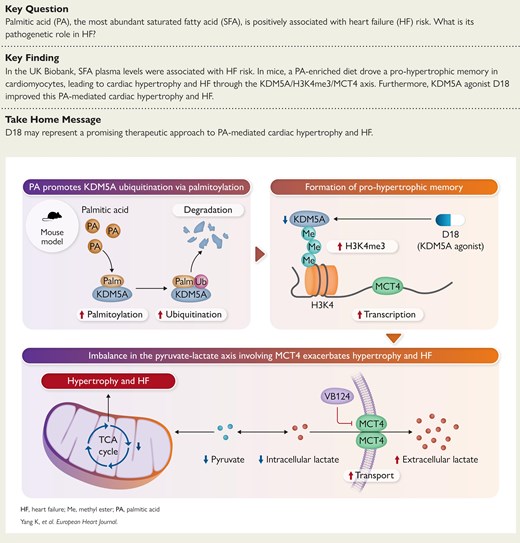
– Mechanistically, PA triggers palmitoylation-mediated degradation of KDM5A, increasing H3K4me3 epigenetic marks.
– The KDM5A/H3K4me3 axis enhances expression of monocarboxylate transporter 4 (MCT4), disrupting metabolic balance.
– Pharmacological activation of KDM5A with agonist D18 reverses PA-induced hypertrophy and HF, suggesting therapeutic potential.
Study Background
Heart failure remains a prevalent cardiovascular condition with high morbidity and mortality worldwide. The pathophysiology of HF is complex, involving structural, metabolic, and molecular changes in cardiomyocytes. Among dietary factors, saturated fatty acids (SFAs)—notably palmitic acid—have been epidemiologically linked to cardiovascular disease. However, the precise molecular mechanisms by which PA influences progression to cardiac hypertrophy and HF are not fully elucidated. Understanding these mechanisms is crucial for developing targeted interventions and reducing HF burden.
Study Design
This investigation utilized a large-scale epidemiological approach and combined it with mechanistic experimental models. The study analyzed plasma SFA levels and HF incidence data from 232,592 participants in the UK Biobank to identify clinical associations. In parallel, C57BL/6J mice were fed diets enriched in palmitic acid, olive oil, or a control diet for 4 weeks, followed by a 4-week recovery period on standard diet. A transverse aortic constriction (TAC) procedure simulated pressure overload-induced cardiac hypertrophy and HF in these mice. Additionally, cardiac-specific lysine demethylase 5A (Kdm5A) knockout mice were used to dissect the epigenetic regulatory role of KDM5A. Cellular experiments in cultured cardiomyocytes further elucidated molecular pathways influenced by PA. The KDM5A agonist D18 was administered to assess therapeutic effects.
Key Findings
Association of Plasma SFAs with Heart Failure Risk: Analysis of the UK Biobank cohort confirmed that elevated plasma saturated fatty acid concentrations strongly correlate with increased risk of developing HF, supporting epidemiological linkage between dietary SFAs and cardiac disease progression.
PA-Induced Cardiac Hypertrophy and Pro-hypertrophic Memory: In vivo, short-term exposure of mice to a PA-enriched diet induced cardiac hypertrophy and failure phenotypes even after reverting to a normal diet for 4 weeks, indicating a sustained hypertrophic memory in cardiomyocytes. This was absent in mice fed olive oil or control diets, demonstrating specificity to PA.
Mechanistic Insights into KDM5A/H3K4me3 Pathway: Molecular analysis revealed that PA promotes palmitoylation-driven degradation of the histone demethylase enzyme KDM5A via the ubiquitin-proteasome pathway. KDM5A is responsible for removing tri-methylation marks at histone 3 lysine 4 (H3K4me3), a modification associated with active gene transcription. Its degradation leads to upregulation of H3K4me3 and altered gene expression patterns.
Metabolic Imbalance via MCT4 Induction: Elevated H3K4me3 levels enhanced expression of monocarboxylate transporter 4 (MCT4), a critical regulator of lactate transport, indicating a metabolic shift contributing to maladaptive cardiac hypertrophy. This metabolic dysregulation likely supports sustained pathological remodeling.
Therapeutic Potential of KDM5A Agonist D18: Treatment with D18 restored KDM5A function, normalized H3K4me3 levels, improved metabolic balance, and ameliorated cardiac hypertrophy and dysfunction in PA-exposed models. These findings identify a novel epigenetic therapeutic target in PA-mediated HF.
Expert Commentary
This study compellingly links dietary palmitic acid to epigenetic reprogramming in cardiomyocytes that sustains hypertrophic memory and cardiac dysfunction, advancing our understanding of metabolic and epigenetic crosstalk in HF pathogenesis. The use of both epidemiological evidence and mechanistic animal models strengthens the translational impact. However, potential limitations include: the relatively short dietary intervention duration in mice compared to human chronic exposure, and lack of detailed longitudinal human cardiac epigenetic data.
Future research should clarify how reversible these epigenetic alterations are in human HF populations, the safety and efficacy of KDM5A agonists like D18 in clinical settings, and whether similar mechanisms operate with other dietary SFAs.
Conclusion
This comprehensive study demonstrates that palmitic acid contributes to cardiac hypertrophy and heart failure by inducing a sustained pro-hypertrophic memory in cardiomyocytes mediated through degradation of KDM5A and increased H3K4me3 histone modifications. This epigenetic remodeling amplifies metabolic dysregulation via MCT4, sustaining maladaptive cardiac remodeling. Pharmacological activation of KDM5A reverses these effects, opening new avenues for therapeutic intervention targeting dietary fat-induced cardiac disease.
Understanding this novel PA-KDM5A-H3K4me3-MCT4 axis provides critical insight into the pathogenesis of HF and potential for developing targeted epigenetic therapies to mitigate cardiac remodeling associated with saturated fat intake.
Funding and ClinicalTrials.gov
The referenced study by Yang et al. (2026) does not specify funding sources in the abstract. Further details are available via the European Heart Journal publication and associated trial registries.
References
Yang K, Gao R, Shi J, Wei X, Lu X, Chen H, Wei W, Hu J, Chen J, Lyu Y, Gao P, Ke C, Sun A. Palmitic acid promotes hypertrophic memory in cardiomyocytes via KDM5A/H3K4me3. European Heart Journal. 2026 Oct 10. PMID: 42855844.
Katta S, et al. Epigenetics in Heart Failure and Cardiac Hypertrophy. Front Cardiovasc Med. 2021;8:656352.
Cheng Z, et al. Role of Metabolism in Cardiac Hypertrophy and Heart Failure. Front Cardiovasc Med. 2021;8:660432.
Jiang DS, et al. Histone demethylase KDM5A is a key regulator for cardiac hypertrophy. J Mol Cell Cardiol. 2018;122:119-125.