Highlights
- OBVAM significantly enhances accommodative amplitude and facility in patients with concussion-related convergence insufficiency (CONC-CI) accompanied by accommodative dysfunction.
- Immediate initiation of OBVAM results in faster recovery versus delayed treatment, showing earlier resolution of accommodative insufficiency.
- After full treatment (16 sessions), both immediate and delayed groups achieve comparable accommodative outcomes, underscoring OBVAM efficacy regardless of timing.
- Complementary measurements of near and distance vergence facility provide comprehensive clinical insight to guide therapy and assessment in CONC-CI.
Background
Concussion, a mild traumatic brain injury commonly affecting adolescents and young adults, frequently leads to visual system impairments, including convergence insufficiency (CI) and accommodative dysfunction. CI manifests as an inability to maintain binocular alignment at near tasks, while accommodative dysfunction involves decreased amplitude and facility of focusing responses, contributing substantially to symptoms such as blurred vision, headaches, and difficulty with reading or screen use. These symptoms may persist weeks after injury, adversely impacting return to academic activities, sports, and quality of life. Despite recognition of CI as a treatable visual sequela of concussion, evidence-based approaches to address co-existing accommodative deficits have been limited.
Office-based vergence/accommodative therapy with movement (OBVAM) is a structured, clinician-guided rehabilitation program involving targeted eye movement and focusing exercises designed to improve convergence and accommodation. The CONCUSS randomized clinical trial, conducted in a medically diagnosed concussion cohort aged 11 to 25 years with symptomatic CONC-CI, provides the highest level of evidence regarding the timing and dosing effects of OBVAM on accommodative function alongside convergence improvements.
Key Content
Study Design and Population
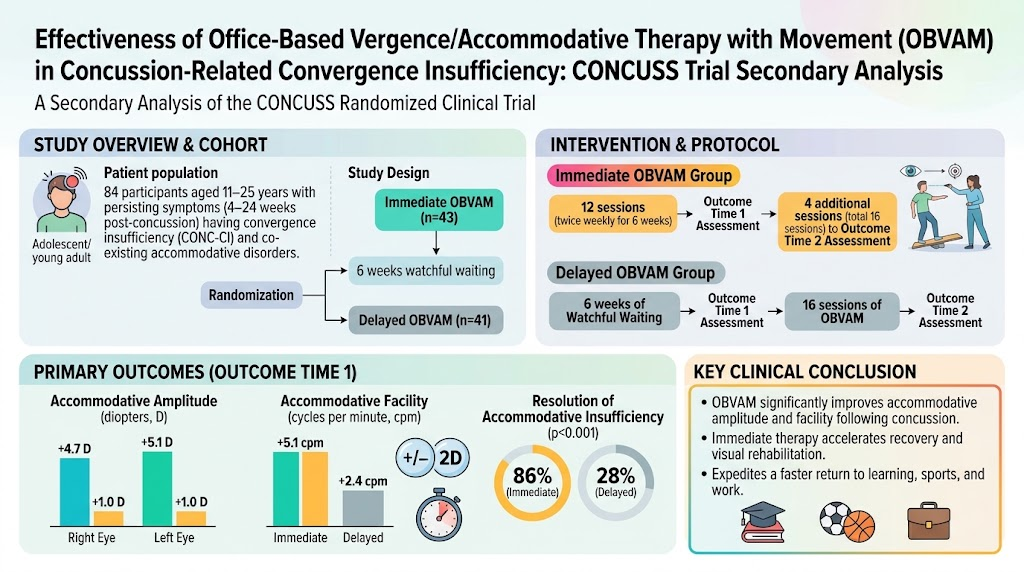
The CONCUSS trial enrolled 106 participants with persistent concussion symptoms between 4 and 24 weeks post-injury; 79% exhibited accommodative dysfunction in addition to convergence insufficiency. Participants were randomized to immediate OBVAM initiation (12 twice-weekly sessions) or delayed OBVAM following a 6-week watchful waiting period, allowing analyses of time-dependent effects. Subsequent OBVAM dosing consisted of additional sessions to reach a total of 16 per participant, with assessments at outcome time 1 (after 12 sessions or 6-week delay) and outcome time 2 (after 16 total sessions).
Effectiveness of OBVAM on Accommodative Function
At outcome time 1, the immediate OBVAM group demonstrated statistically and clinically significant improvements in monocular accommodative amplitude: right eye mean increase 4.7 diopters (95% CI 3.7–5.7), left eye 5.1 diopters (95% CI 4.0–7.1). By contrast, the delayed group showed minimal changes after watchful waiting alone (approximately 1 diopter increases). Similarly, accommodative facility, measured by cycles per minute (cpm) clearing +2D and −2D lenses, improved by 5.1 cpm (95% CI 2.7–7.5) in the immediate group versus 2.4 cpm (95% CI 0.3–4.5) in the delayed group.
Resolution rates of accommodative insufficiency were notably higher in the immediate group (86%) compared to the delayed group (28%) at this time point (p<0.001).
No significant difference in accommodative amplitude or facility was observed between outcome time 1 and 2 assessments in the immediate group, suggesting that additional sessions (from 12 to 16) did not yield incremental benefit. At outcome time 2, when both groups had completed 16 OBVAM sessions, accommodative function was equivalent, indicating that delayed therapy ultimately achieves similar results albeit with slower recovery.
Complementing Evidence on Convergence and Symptom Outcomes
Data from the primary CONCUSS trial publication confirm that OBVAM also markedly improves convergence parameters (near point of convergence and positive fusional vergence) and reduces symptoms measured by the Convergence Insufficiency Symptom Survey (CISS). Immediate therapy yielded faster symptomatic relief and greater functional gains, allowing expedited return to academic and sports activities.
A secondary CONCUSS analysis revealed discordance between near and distance vergence facility assessments, underscoring the need to evaluate both to gain a comprehensive understanding of oculomotor dysfunction in CONC-CI. Both near and distance vergence facilities improved post-OBVAM, further supporting therapy’s broad oculomotor benefits.
Methodological Strengths and Innovations
The CONCUSS trial incorporates rigorous randomization, a masked outcome assessment, a delayed treatment control arm, and standardized treatment protocols, minimizing bias. Objective measures of accommodation and convergence quantified functional gains. The inclusion of objective eye-tracking and neuroimaging outcomes (pending complete analyses) aims to elucidate underlying neuro-mechanisms, bridging clinical and basic research.
Expert Commentary
The CONCUSS trial represents a landmark investigation firmly establishing the efficacy of OBVAM for accommodative dysfunction co-existing with concussion-related convergence insufficiency. The large sample and robust methodology affirm that OBVAM facilitates meaningful recovery in visual function and symptom relief. Importantly, the trial clarifies treatment timing: while delayed therapy ultimately leads to comparable accommodative improvements, immediate therapy accelerates recovery, reducing the symptomatic period and enabling earlier return to learning and activities. This temporal benefit has practical and psychosocial implications for patient management.
The lack of incremental benefit beyond 12 therapy sessions suggests that a 12-session OBVAM course may be sufficient for accommodative outcomes in this population, though clinicians may still consider individual variability. The demonstrated discordance between near and distance vergence facility testing highlights the complex nature of oculomotor dysfunction post-concussion and supports multipoint clinical assessments for tailored interventions.
Mechanistically, OBVAM’s combined vergence and accommodative exercises likely drive neuroplasticity involving brainstem and cortical oculomotor control centers, facilitating recalibration of linked motor responses corrupted by concussion injury. Pending neuroimaging correlations from CONCUSS may yield deeper insights into brain-behavior relationships underpinning recovery.
Some limitations include the age-restricted cohort (11–25 years), limiting generalizability to younger children or older adults, and the study’s duration without long-term follow-up data on sustained effects or relapse. Future research should explore integration of home-based exercises and telehealth modalities to enhance therapy access.
Current clinical guidelines advocating vision rehabilitation post-concussion should integrate these findings, endorsing early assessment and initiation of OBVAM upon identification of accommodative or convergence deficits to optimize recovery trajectories.
Conclusion
The secondary analysis of the CONCUSS trial provides compelling evidence that office-based vergence/accommodative therapy with movement substantially improves accommodative dysfunction in concussion-related convergence insufficiency. Immediate therapy accelerates recovery and promotes earlier functional return compared to delayed treatment, while full-course therapy yields equivalent accommodative gains. Incorporating comprehensive assessment of both accommodative and vergence functions, including near and distance vergence facility, facilitates diagnosis and monitors therapeutic progress.
Clinicians caring for concussion patients with persistent visual symptoms should consider prompt OBVAM to expedite rehabilitation, supporting return to academic, athletic, and occupational demands. Ongoing trials elucidating neurophysiological mechanisms will enable refinement and personalization of vision therapy.
References
- Scheiman M, Alvarez TL, Hajebrahimi F, et al; CONCUSS Investigator Group. Effectiveness of office-based vergence/accommodative therapy with movement for accommodative dysfunction in concussion-related convergence insufficiency: a secondary analysis of the CONCUSS randomised clinical trial. Br J Sports Med. 2026 Oct 9;60(19):1475-1485. doi:10.1136/bjsports-2025-111200. PMID: 42392844.
- Scheiman M, Alvarez TL, Hajebrahimi F, et al; CONCUSS Investigator Group. CONCUSS randomised clinical trial of vergence/accommodative therapy for concussion-related symptomatic convergence insufficiency. Br J Sports Med. 2026 Mar 12;60(5):340-354. doi:10.1136/bjsports-2025-109807. PMID: 41033748.
- Scheiman M, Master C, Alvarez TL, et al. Near and distance vergence facility provides complementary clinical information in concussion-related convergence insufficiency: secondary analysis of the CONCUSS trial. Optom Vis Sci. 2026 Sep;103(9):e70097. doi:10.1002/ovs2.70097. PMID: 42717267.
- Scheiman M, Master C, Alvarez TL, et al. Effectiveness of treatment for concussion-related convergence insufficiency: The CONCUSS study protocol for a randomized clinical trial. PLoS One. 2024 Nov 15;19(11):e0314027. doi:10.1371/journal.pone.0314027. PMID: 39546477.