Highlights
- The twiist automated insulin delivery (AID) system lowers HbA1c by approximately 0.7% and increases time-in-range by 16% over 13 weeks in insulin-treated adults with type 2 diabetes.
- Safety profiles are favorable, with low hypoglycemia incidence and only one diabetic ketoacidosis event reported among over 300 participants.
- Clinical benefits of twiist AID are consistent across diverse patient subgroups, including those using adjunctive GLP-1 receptor agonists or SGLT2 inhibitors.
- Real-world evidence supports sustained glycemic improvements with implantable CGM integration and high user adherence to the AID system.
Background
Type 2 diabetes mellitus (T2DM) poses a significant global health challenge, with many patients requiring insulin therapy to achieve glycemic targets. Despite advances, insulin management remains complex due to hypoglycemia risk, dosing challenges, and patient adherence issues. Automated insulin delivery (AID) systems, leveraging continuous glucose monitoring (CGM) and algorithmic insulin dosing, have revolutionized type 1 diabetes care and are increasingly investigated for efficacy and safety in insulin-treated T2DM. The twiist system integrates automated insulin delivery with real-time CGM to optimize insulin dosing, addressing unmet needs in T2DM management. This review synthesizes evidence from the pivotal twiist-T2D trial and related studies to contextualize the clinical impact of twiist AID in adult patients with insulin-treated T2DM.
Key Content
Clinical Evaluation of twiist Automated Insulin Delivery: The twiist-T2D Pivotal Trial
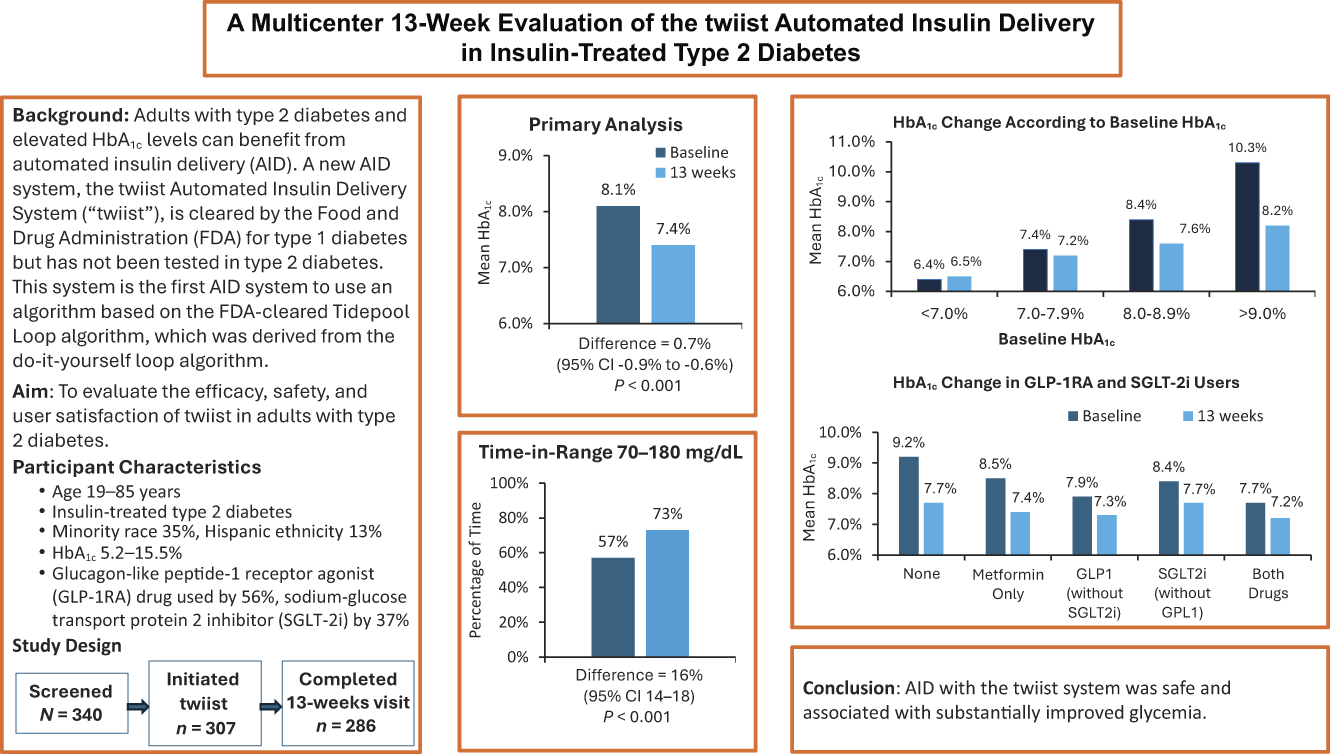
Levy et al. conducted a multicenter, single-arm trial with 307 adults aged 19–85 years treated with insulin for T2DM. After a baseline CGM data collection, participants initiated twiist AID use for 13 weeks. The primary endpoint was the change in HbA1c from baseline.
The twiist system led to a significant HbA1c reduction of 0.7% (from 8.1% ± 1.5% to 7.4% ± 0.9%; 95% CI, -0.9 to -0.6; P < 0.001) meeting criteria for both noninferiority and superiority. Improvement was most pronounced in those with baseline HbA1c ≥9.0%. CGM-measured time-in-range (70–180 mg/dL) increased from 57% ± 26% to 73% ± 17% (mean change 16%, 95% CI 14–18; P < 0.001). Metrics reflecting hyperglycemia also improved significantly.
Safety outcomes were reassuring; hypoglycemia frequency remained low without severe events. One diabetic ketoacidosis event was reported. Participant satisfaction significantly increased compared to prestudy insulin delivery methods (P < 0.001), with concurrent improvements in sleep quality.
Integration with Contemporary Therapies and Subpopulations
Notably, twiist AID demonstrated additive HbA1c reductions when combined with established therapies such as glucagon-like peptide 1 receptor agonists (GLP-1 RA) and sodium-glucose cotransporter 2 (SGLT2) inhibitors. Subgroup analyses from related studies affirm glycemic benefits independent of C-peptide status, underscoring twiist’s broad applicability.
Comparison with Other Automated Insulin Delivery Systems in Type 2 Diabetes
Randomized controlled trials (RCTs) such as the 2IQP study involving Control-IQ+ technology show congruent findings with twiist, reporting HbA1c reductions around 0.6–0.9%, increased time-in-range by approximately 14–16%, and low hypoglycemia rates over similar durations. Safety and efficacy are consistent across age, race, and baseline glycemic control levels.
Single-arm studies and real-world evidence reinforce these findings. The MiniMed 780G advanced hybrid closed-loop system yielded HbA1c reductions (~0.7%) and high time-in-range (~81%) with no significant safety concerns in insulin-requiring T2DM over 3 months.
Real-World Utilization and Adherence Data
The Eversense 365 implantable CGM system, integrated with the twiist AID pump, demonstrated sustained glycemic control over a full year in real-world settings, with median transmitter wear time approximately 93%, and high time-in-range (~66% open loop, increasing to 76% with twiist AID). These data highlight clinical feasibility and adherence potential for long-term management.
Automated Insulin Delivery and Safety Considerations
Automated insulin delivery systems significantly reduce hyperglycemia and maintain a low hypoglycemia risk profile, as confirmed in multiple trials and meta-analyses. Diabetic ketoacidosis remains rare but emphasizes the importance of patient education, particularly sick-day management and ketone monitoring, especially relevant given reports of DKA in patients employing SGLT2 inhibitors.
Evidence in complicated populations, such as those with advanced chronic kidney disease, suggests that AID systems improve glycemic metrics safely, supporting utility across diverse T2DM cohorts.
Expert Commentary
The twiist-T2D trial robustly supports the clinical efficacy and safety of automated insulin delivery in insulin-treated T2DM, demonstrating meaningful reductions in HbA1c and improved glucose variability without increased hypoglycemia risk. The greatest glycemic benefits in patients with markedly elevated baseline HbA1c suggest that AID systems can potentially mitigate therapeutic inertia and improve outcomes in those struggling with control.
The trial’s single-arm design without a concurrent control group limits attribution of effects solely to the device; however, the magnitude and consistency of improvements align with outcomes from contemporaneous controlled trials.
Integration of AID with adjunctive therapies such as GLP-1 RAs underscores the capacity for multimodal optimization of T2DM management. Translational implications include the potential for personalized insulin delivery adjustments based on real-time CGM data, reducing patient burden and clinician workload.
Challenges remain in equitable access and technology adoption, as social determinants influence diabetes technology uptake. Future directions should focus on strategies to expand access, enhance patient education, and optimize device algorithms tailored to specific patient phenotypes and comorbidities.
Conclusion
Automated insulin delivery using the twiist system represents a transformative advancement in insulin-treated type 2 diabetes management, offering significant glycemic improvements, safety, and enhanced patient satisfaction over a 13-week period. Complementary data from randomized trials and real-world studies corroborate these findings, advocating for broader adoption of AID technology. Further research is warranted to assess long-term outcomes, cost-effectiveness, and integration with other therapeutic innovations.
References
- Levy CJ, Kanapka L, Graham TE, et al. A Multicenter 13-Week Evaluation of the twiist Automated Insulin Delivery in Insulin-Treated Type 2 Diabetes: The twiist-T2D Pivotal Trial. Diabetes Care. 2026 Oct 7;dc261270. PMID: 42844027.
- Beck RW, Bailey RA, Blevins T, et al. A Randomized Trial of Automated Insulin Delivery in Type 2 Diabetes. N Engl J Med. 2025 May 8;392(18):1801-1812. PMID: 40105270.
- Levy CJ, Kanapka L, Bailey RA, et al. Consistent Benefit of Control-IQ+ Automated Insulin Delivery Across a Range of Characteristics of Adults with Type 2 Diabetes. Diabetes Technol Ther. 2026 Aug;28(8):792-807. PMID: 41574573.
- Ly T, Banerji MA, Stewart ZA, et al. Safety and Effectiveness of MiniMed 780G Advanced Hybrid Closed-Loop Insulin Intensification in Adults with Insulin-Requiring Type 2 Diabetes. Diabetes Technol Ther. 2025 May;27(5):366-375. PMID: 39912797.
- Wood EJ, Wang Y, Lettner A, et al. Real-World Data from U.S. Commercial Users of the 365-Day Implantable Eversense Continuous Glucose Monitoring System, Including with the Twiist Automated Insulin Delivery System Integration. Diabetes Technol Ther. 2026 Sep 8;15209156261486125. PMID: 42711848.
- Chung ST, Balo AK, Roy A, et al. Effectiveness and safety of automated insulin delivery in type 2 diabetes: a meta-analysis. Diabetol Metab Syndr. 2025 Nov 18;17(1):433. PMID: 41254762.