Highlight
- Ovarian tissue cryopreservation (OTC) is traditionally performed before gonadotoxic treatments such as HSCT to preserve fertility in young females.
- HSCT is associated with significant ovarian reserve reduction, indicated by elevated FSH, diminished AMH, reduced ovarian volume, and lower follicle counts post-transplant.
- This prospective study involving 142 patients demonstrates OTC after HSCT as a feasible salvage option in carefully selected girls and young women.
- Long-term follow-up is essential to identify suitable candidates and optimize fertility preservation strategies post-HSCT.
Study Background
Hematopoietic stem cell transplantation (HSCT) is a curative therapy for various hematological malignancies and disorders but often results in premature ovarian failure due to the gonadotoxic effects of conditioning regimens. Preservation of fertility is a critical consideration in pediatric and young adult female patients undergoing HSCT. Ovarian tissue cryopreservation (OTC) before HSCT has emerged as a valuable fertility preservation approach; however, its feasibility and efficacy post-HSCT in females who did not have prior fertility preservation remain underexplored. Identifying viable options for fertility preservation after HSCT could expand reproductive possibilities for cancer survivors, improving quality of life during survivorship.
Study Design
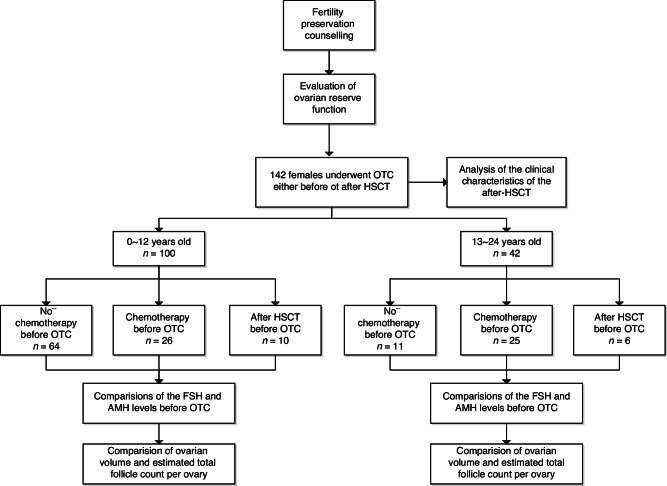
This observational study enrolled 142 girls and young women scheduled for OTC. Participants were divided into three groups based on timing of OTC relative to HSCT and prior chemotherapy exposure: (1) after HSCT group (n=16), (2) no-chemotherapy pre-HSCT group (n=75), and (3) chemotherapy pre-HSCT group (n=51). The after HSCT cohort had a mean age of 12.06 years at OTC, with approximately half being prepubertal.
Serum follicle-stimulating hormone (FSH), anti-Müllerian hormone (AMH) levels, ovarian volume per ovary, and histologically estimated total follicle count per ovary were measured and compared across groups and age strata (0-12 years and 13-24 years). These parameters were used as surrogate markers of ovarian reserve and fertility potential.
Key Findings
The study found significant disparities in ovarian reserve markers between the after HSCT group and the pre-HSCT cohorts. Compared to the no-chemotherapy pre-HSCT group, the after HSCT group exhibited:
– Significantly elevated serum FSH levels across all age groups, indicating diminished ovarian function.
– Markedly reduced AMH levels, reflective of decreased primordial follicle pool.
– Significantly smaller ovarian volumes per ovary, suggesting ovarian atrophy post-treatment.
– Lower histological follicle counts per ovary, particularly pronounced in the younger (0-12 years) after HSCT group compared both to no-chemotherapy and chemotherapy pre-HSCT groups.
These findings confirm that HSCT and prior chemotherapy have deleterious effects on ovarian reserve. Nevertheless, OTC performed after HSCT yielded sufficient ovarian tissue containing follicles, indicating feasibility.
The comparative analyses underscore that pre-HSCT OTC remains the optimal fertility preservation timing. However, OTC post-HSCT remains a possible salvage approach for selected patients, especially those without prior fertility preservation or relapse of disease, permitting potential future autotransplantation or in vitro follicle maturation.
Expert Commentary
The clinical challenge lies in managing fertility preservation in pediatric and adolescent females undergoing HSCT, a group at high risk for premature ovarian insufficiency (POI). This study provides critical evidence supporting OTC after HSCT, though with diminished ovarian reserve compared to pre-HSCT patients. The elevated FSH and reduced AMH levels post-HSCT are consistent with substantial ovarian follicle loss documented in previous reports (Anderson et al., 2015).
Despite smaller ovarian volumes and reduced follicle counts, the presence of viable follicles suitable for cryopreservation post-HSCT is promising. This aligns with recent data suggesting that OTC can be effective even after gonadotoxic therapy, expanding fertility options (Meirow et al., 2019).
Limitations include the small sample size of the after HSCT group and lack of longitudinal fertility outcome data post-transplantation of thawed ovarian tissue. Future studies should focus on reproductive outcomes and the safety of reimplantation with respect to potential malignancy reintroduction risk. Additionally, stratification by conditioning regimens and detailed chemotherapy exposure could enhance understanding of factors influencing residual fertility.
Conclusion
OTC before HSCT remains the gold standard fertility preservation strategy for girls and young women undergoing HSCT. Nevertheless, OTC after HSCT is feasible and may serve as a salvage fertility preservation option in carefully selected patients without prior ovarian tissue banking.
Long-term follow-up and prospective registries are required to identify optimal candidates and refine clinical protocols. Expanding fertility preservation modalities post-HSCT may significantly improve quality of life and reproductive autonomy in cancer survivorship care.
Funding and ClinicalTrials.gov
Information regarding funding sources or clinical trial registration was not specified in the published report.
References
1. Anderson RA, Rosendahl M, Kelsey TW, Telfer EE. The importance of integrating basic scientific knowledge of ovarian physiology into the management of gonadotoxic treatments. Hum Reprod Update. 2015;21(3):331-349.
2. Meirow D, Ra’anani H, Shapira M, et al. Transplantation of cryopreserved ovarian tissue in a series of malignancies: an update on reproductive outcome and safety. Reprod Biomed Online. 2019;38(5):625-632.
3. Cheng J, Du J, Gu M, et al. The feasibility of ovarian tissue cryopreservation in selected females after hematopoietic stem cell transplantation. Bone Marrow Transplant. 2026;61(8):1063-1072. PMID: 42315952.