Background: Immune Landscape in Pancreatic Ductal Adenocarcinoma
Pancreatic ductal adenocarcinoma (PDAC) remains one of the deadliest malignancies worldwide, with a five-year survival rate below 10%. A formidable challenge in PDAC treatment is its highly immunosuppressive tumor microenvironment (TME), marked by dense desmoplasia and infiltration of immunosuppressive cell types such as tumor-associated macrophages (TAMs). Although immune checkpoint blockade (ICB) therapies have revolutionized treatment for several cancers, PDAC exhibits notable resistance, underscoring a critical need to understand mechanisms driving immune evasion in this disease.
RNA modifications, particularly 5-methylcytosine (m5C) on RNA, have recently emerged as important post-transcriptional epigenetic regulators affecting gene expression and cellular behavior. However, the role of m5C methyltransferases in modulating the TME and antitumor immunity in PDAC has been largely unexplored.
Study Design and Methods
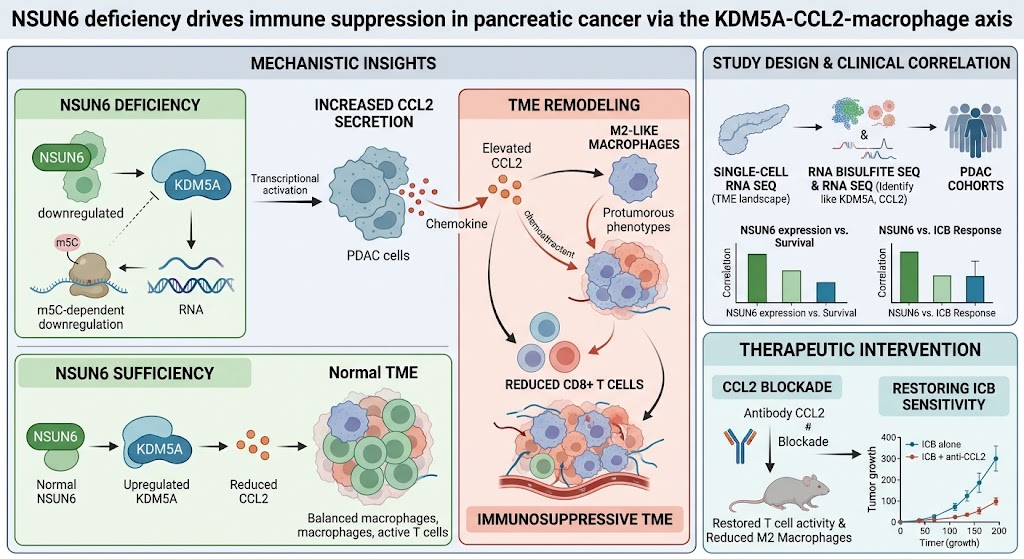
This investigation focused on NOP2/Sun RNA methyltransferase 6 (NSUN6), an m5C methyltransferase, to delineate its role in shaping the PDAC TME and its impact on immune responses. Clinical relevance was assessed by analyzing NSUN6 expression in human PDAC cohorts. Functional studies were conducted in murine PDAC models to evaluate NSUN6’s impact on antitumor immunity.
Key experimental techniques included:
– Single-cell RNA sequencing to characterize TME cellular composition alterations due to NSUN6 deficiency.
– RNA bisulfite sequencing and RNA sequencing to identify transcriptome-wide m5C modifications and downstream targets regulated by NSUN6.
– Intervention studies testing combined blockade of CCL2 and ICB therapy in NSUN6-deficient PDAC mouse models.
Key Findings
NSUN6 deficiency was found to have profound effects on the TME and immune responses in PDAC:
1. Enhanced Immunosuppressive Macrophage Infiltration: Loss of NSUN6 significantly increased accumulation and polarization of macrophages towards immunosuppressive phenotypes. These TAMs contribute to tumor progression by suppressing cytotoxic CD8+ T cell responses critical for tumor clearance.
2. Mechanistic Insights: m5C-KDM5A-CCL2 Axis: Mechanistically, NSUN6 deficiency led to downregulation of KDM5A, a histone demethylase, via reduced m5C modification on its RNA. Reduced KDM5A subsequently drove transcriptional activation of CCL2, a chemokine pivotal for monocyte/macrophage recruitment and polarization.
3. Immune Checkpoint Blockade Resistance and Therapeutic Targeting: Elevated CCL2 levels contributed to an immunosuppressive TME resistant to ICB therapy. Importantly, pharmacological blockade of CCL2 in NSUN6-deficient PDAC models decreased protumorous macrophage infiltration and restored sensitivity to ICB, underscoring a potential combinational therapeutic approach.
4. Clinical Correlations: Analysis of PDAC patient cohorts treated with ICB revealed a positive correlation between NSUN6 expression and effective immune responses, reinforcing the clinical relevance of this pathway.
Expert Commentary
This study provides compelling evidence linking RNA epigenetic modifications to immune regulation within the PDAC microenvironment. The identification of an m5C-dependent mechanism involving NSUN6 and KDM5A that governs CCL2-mediated macrophage recruitment advances our understanding of immune suppression in PDAC.
While current immunotherapies show limited efficacy in PDAC, targeting NSUN6 deficiency-driven pathways may enhance antitumor immunity and sensitize tumors to ICB. It remains to be seen whether NSUN6 expression status could serve as a predictive biomarker for response to immunotherapy in PDAC.
Limitations include the need for broader validation in diverse PDAC patient populations and exploration of off-target effects of CCL2 blockade. Additionally, dissecting the interplay between NSUN6-dependent RNA modifications and other immunosuppressive pathways could reveal further targets.
Conclusion
NSUN6 deficiency promotes immune evasion in pancreatic cancer by enhancing immunosuppressive macrophage infiltration via the m5C-KDM5A-CCL2 axis, thereby impairing CD8+ T cell antitumor activity and causing resistance to ICB. Targeting the NSUN6-CCL2 axis offers a promising strategy to remodel the PDAC tumor microenvironment and improve the efficacy of immunotherapy.
Continued investigation into RNA modification enzymes like NSUN6 will expand the horizons for epigenetic-based precision immunotherapy in pancreatic cancer and other malignancies with poor immune responsiveness.
Funding and Clinical Trials
Details on funding sources and relevant clinical trial registrations were not specified in the original publication.
References
1. Zeng L, Liu S, Peng X, et al. NSUN6 deficiency drives immune suppression in pancreatic cancer via the KDM5A-CCL2-macrophage axis. Gut. 2026 Aug 6;75(9):1753-1770. PMID: 41571445.
2. Binnewies M, et al. Understanding the tumor immune microenvironment (TIME) for effective therapy. Nat Med. 2018;24(5):541-550.
3. Chen DS, Mellman I. Elements of cancer immunity and the cancer-immune set point. Nature. 2017;541(7637):321-330.
4. Li Y, et al. Epitranscriptomic m5C RNA methylation in cancer progression. Front Oncol. 2021;11:635732.
5. Mantovani A, et al. Tumor-associated macrophages as treatment targets in oncology. Nat Rev Clin Oncol. 2017;14(7):399-416.