Combining conscious sedation, transversus abdominis plane (TAP) block, and tumescent anesthesia enables lipoabdominoplasty to be safely performed in an outpatient setting.
Postoperative pain is well controlled, with most patients experiencing minimal to moderate pain and limited opioid requirement.
Low incidence of nausea and rapid discharge times enhance patient recovery and satisfaction.
Integration of multimodal analgesia supports early ambulation and minimizes risks such as deep vein thrombosis (DVT).
Study Background
Lipoabdominoplasty, a common aesthetic surgical procedure aimed at contouring the abdomen, is typically performed under general anesthesia. However, postoperative pain often hampers early mobilization, increases the risk of complications such as deep vein thrombosis (DVT), and may reduce overall patient satisfaction. Traditional reliance on opioids for managing postoperative pain brings risks of nausea, sedation, and delayed recovery. Multimodal analgesia strategies, including regional nerve blocks such as the transversus abdominis plane (TAP) block, have increasingly been investigated to improve pain relief while minimizing opioid use. Tumescent anesthesia, involving the infiltration of large volumes of diluted local anesthetics, further contributes to analgesia and reduces intraoperative blood loss. This study assesses whether lipoabdominoplasty can be safely and effectively performed in an outpatient setting using conscious sedation combined with TAP block and tumescent anesthesia, potentially reducing hospital resource use and accelerating recovery.
Study Design
This single-center prospective case series enrolled all consecutive patients undergoing lipoabdominoplasty from December 2020 through June 2025. The intervention consisted of surgery performed under conscious sedation, anesthesia via ultrasound-guided TAP block, and tumescent infiltration anesthesia. No general endotracheal anesthesia was used. Patient demographics, concomitant procedures (notably breast surgery in nearly half of cases), and intraoperative and postoperative management were systematically recorded.
Outcome measures included patient-reported pain using the International Pain Outcome (IPO) questionnaire, nausea incidence, opioid usage, time to discharge, and satisfaction with analgesia and surgical results assessed via standardized tools including BodyQ and Patient and Observer Scar Assessment Scale (POSAS).
Key Findings
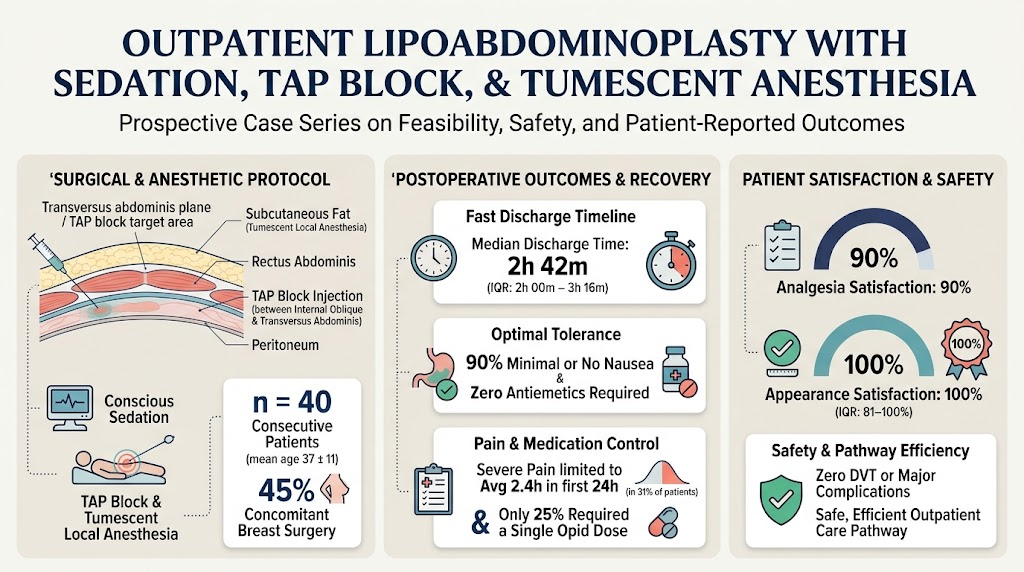
Forty patients with mean age 37 ± 11 years underwent outpatient lipoabdominoplasty under the described anesthetic protocol. Notably, 45% underwent combined breast surgeries.
Pain control was predominantly effective: 31% experienced at least one episode of severe pain in the first postoperative 24 hours, with a median cumulative duration of 2.4 hours of severe pain. Despite this, analgesia satisfaction was high at 90%, supported by minimal opioid consumption—only 25% required a single opioid dose postoperatively.
The incidence of nausea was minimal, with 90% reporting none or minimal nausea; no patients required antiemetics or other nausea treatments. Rapid metabolic recovery was reflected by median discharge times under 3 hours (2:42 h; IQR 2:00–3:16), which is notably shorter than typical inpatient stays.
Patient satisfaction regarding the aesthetic outcomes was excellent, with median appearance satisfaction at 100% and IQR from 81 to 100% on standardized scales.
No significant adverse events or complications related to anesthesia were reported.
Expert Commentary
This study underscores the translational potential of multimodal analgesia combining conscious sedation with regional nerve blocks and tumescent infiltration for outpatient plastic surgery. The TAP block, by anesthetizing the nerves supplying the anterior abdominal wall, mitigates somatic pain effectively while sparing motor function. Conscious sedation avoids the risks associated with general anesthesia, such as airway compromise and delayed recovery.
The low opioid requirement and minimal nausea favor fast-track discharge protocols, reducing healthcare costs and hospital bed utilization without compromising patient care. Early mobilization minimizes the risk of DVT, a key concern in abdominal surgeries.
Limitations include the single-center design and relatively small sample size, which may affect generalizability. Further randomized controlled trials comparing this approach to general anesthesia and other analgesic regimens would strengthen evidence. Additionally, long-term outcomes such as scar quality and functional recovery warrant further investigation.
Conclusion
The combination of sedation, TAP block, and tumescent anesthesia constitutes a safe, effective, and feasible anesthetic strategy for outpatient lipoabdominoplasty. This approach provides sufficient pain control with low opioid use and minimal side effects, facilitating rapid recovery and high patient satisfaction. Moving forward, adopting such multimodal analgesia protocols could optimize resource utilization in plastic surgery and improve patient-centered outcomes.
Funding and Registration
The article does not specify funding sources nor clinical trial registration.
References
1. Blanco R. TAP block under ultrasound guidance: the description of a new technique. Reg Anesth Pain Med. 2007;32(2):130.
2. Siddiqui MR, Sajid MS, Uncles DR, Cheek L. A meta-analysis on the analgesic efficacy of transversus abdominis plane block. J Clin Anesth. 2011;23(1):7-14.
3. Keaney TC, Priti S, Kaye AD. Multimodal analgesia: A review. Trends Anesth Crit Care. 2019;25:21-26.
4. Rohrich RJ, Abraham MH, Kenkel JM. Predictors of patient satisfaction following aesthetic abdominoplasty: operative technique, risk reduction, and outcomes. Plast Reconstr Surg. 2007;120(1):22-27.
5. Pollock H, Pollock T. Tumescent technique for liposuction and abdominoplasty. Plast Reconstr Surg. 2019;144(2):395-400.