Highlight
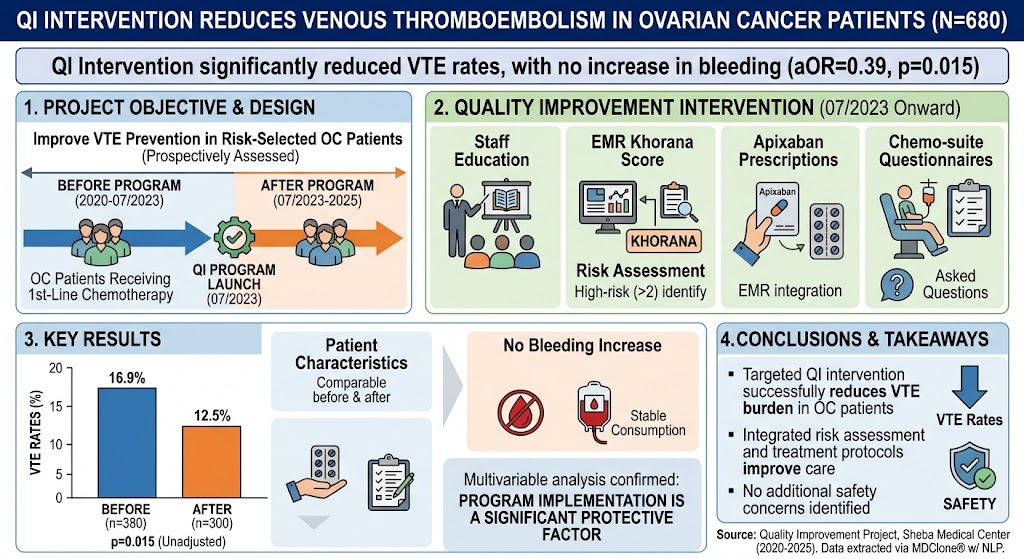
– Implementation of an oral anticoagulation quality improvement (QI) program significantly reduced VTE rates in ovarian cancer (OC) patients undergoing first-line chemotherapy.
– The program integrated Khorana risk scoring and apixaban prescriptions within the electronic medical record (EMR) alongside staff education.
– VTE incidence decreased from 16.9% pre-intervention to 12.5% post-intervention without an increase in bleeding or blood product use.
– Multivariable analysis demonstrated that the QI intervention independently protected against VTE with adjusted odds ratio 0.39 (95% CI 0.17–0.81, p=0.015).
Study Background
Venous thromboembolism (VTE) is a critical complication affecting patients with metastatic cancers, leading to significant morbidity and mortality. Among solid tumors, ovarian cancer (OC) often presents at advanced stages requiring systemic chemotherapy, which further compounds VTE risk through multiple pathophysiological mechanisms including hypercoagulability, endothelial damage, and immobility. Although VTE prophylaxis benefits are documented in selected cancer populations, identifying OC patients who would benefit most and the efficacy of oral anticoagulants in this group remain insufficiently studied. This gap poses a clinical challenge as VTE incidence among newly diagnosed OC patients undergoing chemotherapy reportedly reaches high levels, adversely impacting treatment continuity and survival outcomes.
Study Design
This prospective quality improvement (QI) project, conducted at Sheba Medical Center from 2020 to 2025, targeted patients receiving first-line chemotherapy for ovarian cancer. The intervention, initiated in July 2023, involved a multifaceted approach to optimize thromboprophylaxis practices. Key components included educational sessions for healthcare providers, incorporation of the validated Khorana risk score directly into the EMR for systematic VTE risk stratification, streamlined electronic prescribing of the oral anticoagulant apixaban, and targeted questionnaires administered in chemotherapy suites to reinforce risk assessment and patient adherence.
Clinical data were extracted retrospectively and prospectively using MDClone® software with natural language processing to accurately identify VTE events documented in imaging reports. The primary endpoint was the rate of objectively confirmed VTE during chemotherapy. Secondary endpoints encompassed bleeding events and transfusion requirements, serving as safety indicators. Statistical comparisons utilized descriptive statistics and multivariable logistic regression to adjust for potential confounders influencing VTE occurrence.
Key Findings
Patient demographic and clinical characteristics were balanced between the pre- and post-intervention groups, ensuring comparability. Prior to the implementation of the QI program, the cohort exhibited a notably high VTE incidence of 16.9%. Following the initiative, the VTE rate was reduced to 12.5%, marking a clinically meaningful reduction.
Importantly, no statistically significant increase in clinically relevant bleeding episodes or blood product transfusions was observed, corroborating the safety of the oral anticoagulation protocol in this high-risk oncologic population. Multivariate logistic regression analysis demonstrated that participation in the QI program was independently associated with a significantly decreased risk of VTE (adjusted odds ratio of 0.39, 95% confidence interval 0.17 to 0.81; p=0.015), after controlling for other known risk factors such as tumor burden, prior thrombotic history, and performance status.
Expert Commentary
These findings underscore the therapeutic potential of oral direct factor Xa inhibitors, notably apixaban, as effective prophylactic agents to mitigate VTE risk in ovarian cancer patients receiving chemotherapy. The integration of Khorana scoring within the EMR enhances systematic risk stratification, facilitating targeted thromboprophylaxis rather than universal anticoagulation, which could increase bleeding risks. This pragmatic approach aligns with emerging guidelines emphasizing personalized VTE prevention strategies in oncology.
However, several considerations warrant attention. The single-center nature and QI project design preclude direct causality inferences but provide valuable real-world evidence supporting clinical implementation. Long-term outcomes and cost-effectiveness analyses are necessary next steps. Additionally, refining risk models specific to ovarian cancer, incorporating biomarkers alongside clinical scores, may further optimize anticoagulation candidacy.
Conclusion
The implementation of a multidisciplinary oral anticoagulation QI program notably reduced VTE incidence among ovarian cancer patients on first-line chemotherapy without compromising safety. These findings advocate for the integration of systematic risk assessment and oral anticoagulant prophylaxis as standard components in the clinical management of this vulnerable population. Continued research should focus on enhancing predictive algorithms to individualize thromboprophylaxis, thus maximizing benefit and minimizing adverse events in ovarian cancer care.
Funding and Trial Registration
The study was conducted at Sheba Medical Center with institutional support. No specific external funding or clinical trial registration was reported.
References
Helpman L, Josephy D, Toderis L, et al. Oral anticoagulants reduce venous thromboembolism rates in patients on 1st-line treatment for ovarian Cancer- A quality improvement project. Gynecol Oncol. 2026 Aug 6;212:57-63. doi:10.1016/j.ygyno.2026.06.012. PMID: 42561468.
Khorana AA, Kuderer NM, Culakova E, Lyman GH, Francis CW. Development and validation of a predictive model for chemotherapy-associated thrombosis. Blood. 2008 May 15;111(10):4902-7.
Carrier M, et al. Apixaban to Prevent Venous Thromboembolism in Patients with Cancer. N Engl J Med. 2019 Aug 8;381(6):1415-1424.