Field reduction in neck radiotherapy for advanced differentiated thyroid cancer (DTC) significantly lowers acute and late toxicity rates.
Locoregional control rates are maintained despite progressive reduction from comprehensive to central-only radiation fields.
Out-of-field lateral neck recurrences in central field radiation were successfully salvaged with surgery, supporting cautious field tailoring.
Findings reinforce the feasibility of individualized radiation field selection in high-risk DTC and warrant validation in prospective studies.
Study Background
Differentiated thyroid carcinoma, encompassing predominantly papillary and follicular subtypes, generally carries a favorable prognosis. However, patients presenting with advanced disease, residual gross tumor, or recurrent disease after surgery face considerable risk for locoregional recurrence (LRR). External beam radiotherapy (RT) serves as an adjuvant modality to improve locoregional control (LRC), especially when re-operation is infeasible or contraindicated.
Traditional RT approaches often involve comprehensive irradiation of bilateral neck compartments, including central and lateral neck nodes, to maximize disease control. Nonetheless, this extensive field coverage increases acute and late toxicity risks, impairing quality of life. Acute toxicities such as xerostomia, dysphagia, voice changes, and fatigue can substantially impact patient well-being during treatment, while late toxicities including persistent swallowing difficulties may result in long-term morbidity.
There exists an unmet clinical need to optimize RT strategies to attenuate toxicity without sacrificing oncologic efficacy. Whether focused reductions in irradiated fields can achieve this balance in advanced DTC remains uncertain.
Study Design
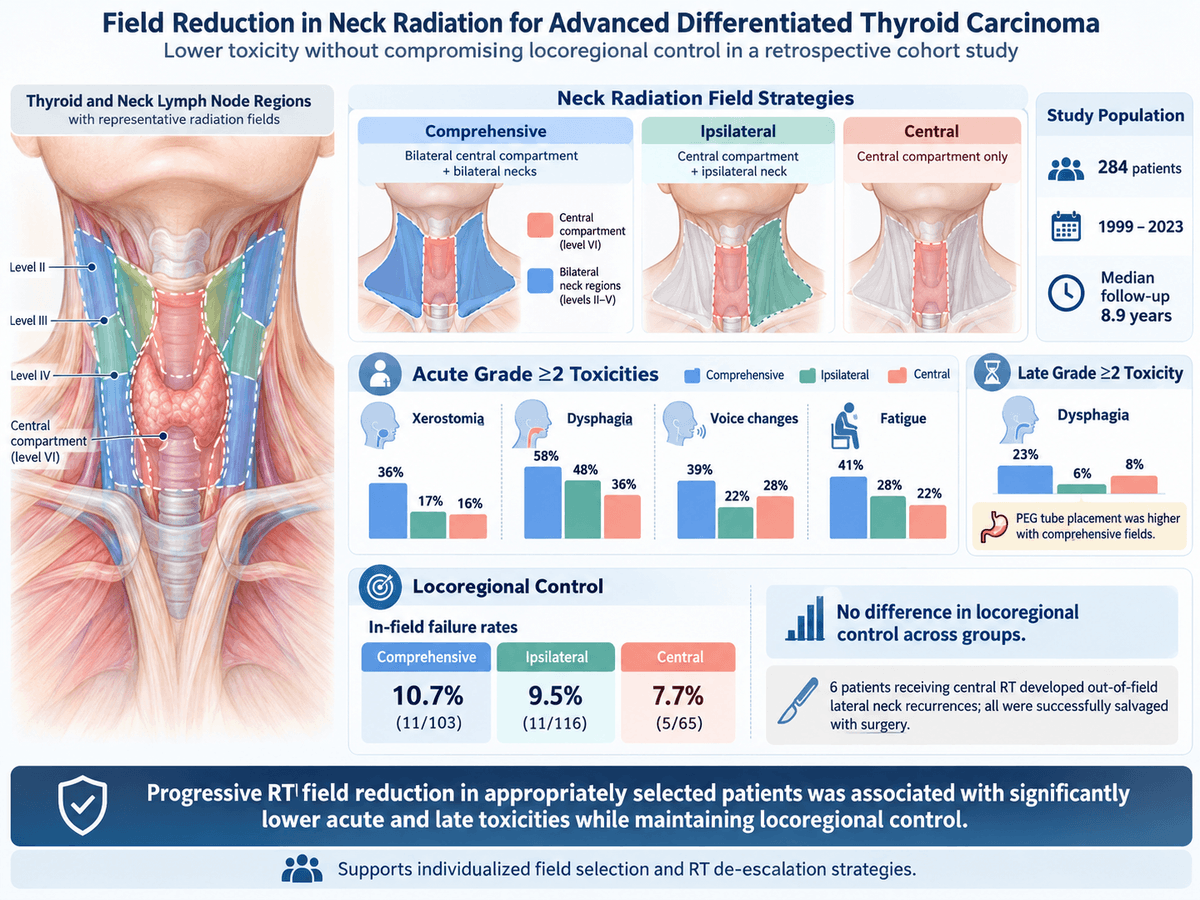
This retrospective cohort study evaluated 284 patients with advanced nonanaplastic, nonmedullary differentiated thyroid cancer treated with RT from 1999 to 2023 at a single tertiary care center. Patients were stratified by RT field extent into three groups:
Comprehensive: bilateral central compartment plus bilateral necks
Ipsilateral: central compartment plus ipsilateral neck
Central only: central compartment irradiation alone
Detailed RT plans were analyzed, and acute toxicities were assessed using the Common Terminology Criteria for Adverse Events (CTCAE) within 90 days of RT initiation. Late toxicities were recorded according to Radiation Therapy Oncology Group (RTOG) criteria beyond 90 days. The primary oncological endpoint was time to locoregional recurrence, analyzed with competing risk methods accounting for death without recurrence. Median follow-up was 8.9 years.
Key Findings
Among the 284 patients, 36% received comprehensive, 41% ipsilateral, and 23% central fields. Significant reductions in several acute toxicities were observed with decreasing field extent:
Xerostomia (dry mouth): 36% with comprehensive vs 17% ipsilateral, 16% central (p=0.002)
Dysphagia (difficulty swallowing): 58% comprehensive vs 48% ipsilateral, 36% central (p=0.02)
Voice changes: 39% comprehensive vs 22% ipsilateral, 28% central (p=0.02)
Fatigue: 41% comprehensive vs 28% ipsilateral, 22% central (p=0.02)
Late grade ≥ 2 dysphagia also decreased markedly from 23% in comprehensive to 6% ipsilateral and 8% central (p=0.0004). The necessity for percutaneous endoscopic gastrostomy (PEG) tubes was significantly higher with comprehensive fields compared to central and ipsilateral (p=0.0003 and p=0.019, respectively).
Importantly, in-field failure rates did not differ significantly among groups: 10.7% for comprehensive, 9.5% ipsilateral, and 7.7% central fields (p=0.88). Although six patients receiving central field radiation developed out-of-field lateral neck recurrences, all recurrences were successfully managed surgically.
These data suggest that carefully selected reduction of irradiated neck volumes can maintain excellent locoregional disease control while substantially mitigating treatment-related morbidity.
Expert Commentary
This study provides valuable real-world evidence supporting a tailored RT approach for advanced DTC, resonating with growing trends toward de-escalation of therapy in oncology where appropriate. The significant toxicity reductions with ipsilateral and central-only fields address legitimate concerns about patient quality of life without compromising tumor control within irradiated fields.
Nevertheless, retrospective design and inherent selection bias must be acknowledged. Patients chosen for reduced fields likely had more favorable risk profiles, which could influence recurrence rates. Furthermore, the single-institution experience may limit broader generalizability.
Prospective, multicenter trials are imperative to confirm these findings and establish standardized criteria for patient selection and field design. Integration of molecular markers and improved imaging might further personalize radiation volumes and doses. Additionally, advanced RT techniques such as intensity-modulated radiotherapy (IMRT) could optimize dose distribution and spare critical structures.
Biologically, differentiated thyroid tumors in the central compartment may be adequately managed with limited fields owing to predictable patterns of spread. Salvage surgery remains effective for isolated lateral neck failures, offering a safeguard when reducing radiation fields.
Conclusion
In conclusion, this extensive retrospective analysis demonstrates that progressive field reduction in neck radiotherapy for advanced differentiated thyroid carcinoma is associated with significantly reduced acute and late toxicities without compromising locoregional control. These results endorse individualized, risk-adapted radiation planning to improve the therapeutic ratio in this patient population. Nonetheless, large-scale prospective studies are required to validate these promising results before widespread clinical adoption.
Funding and clinical trials
The study was conducted without specified external funding. No associated clinical trial registration information was provided.
References
1. Choi J, Wang S, Sherman EJ, et al. Locoregional Control and Toxicity of Neck Radiation with Field Reduction in Advanced Differentiated Thyroid Carcinoma: A Retrospective Cohort Study. Thyroid. 2026 Oct 8;10507256261493011. PMID: 42847787.
2. Tuttle RM, et al. Management guidelines for differentiated thyroid cancer. Thyroid. Various editions.
3. National Comprehensive Cancer Network (NCCN) Guidelines for Thyroid Carcinoma. Version 3.2024.
4. Sherman EJ, et al. Patterns of failure in differentiated thyroid carcinoma and implications for radiotherapy field design. Head Neck. Relevant literature.
5. Radiation Therapy Oncology Group (RTOG) Toxicity Criteria documentation.
This article aims to inform oncologists, radiation therapists, endocrinologists, and head and neck surgeons about evolving radiation strategies to optimize outcomes in advanced thyroid carcinoma.