Highlights
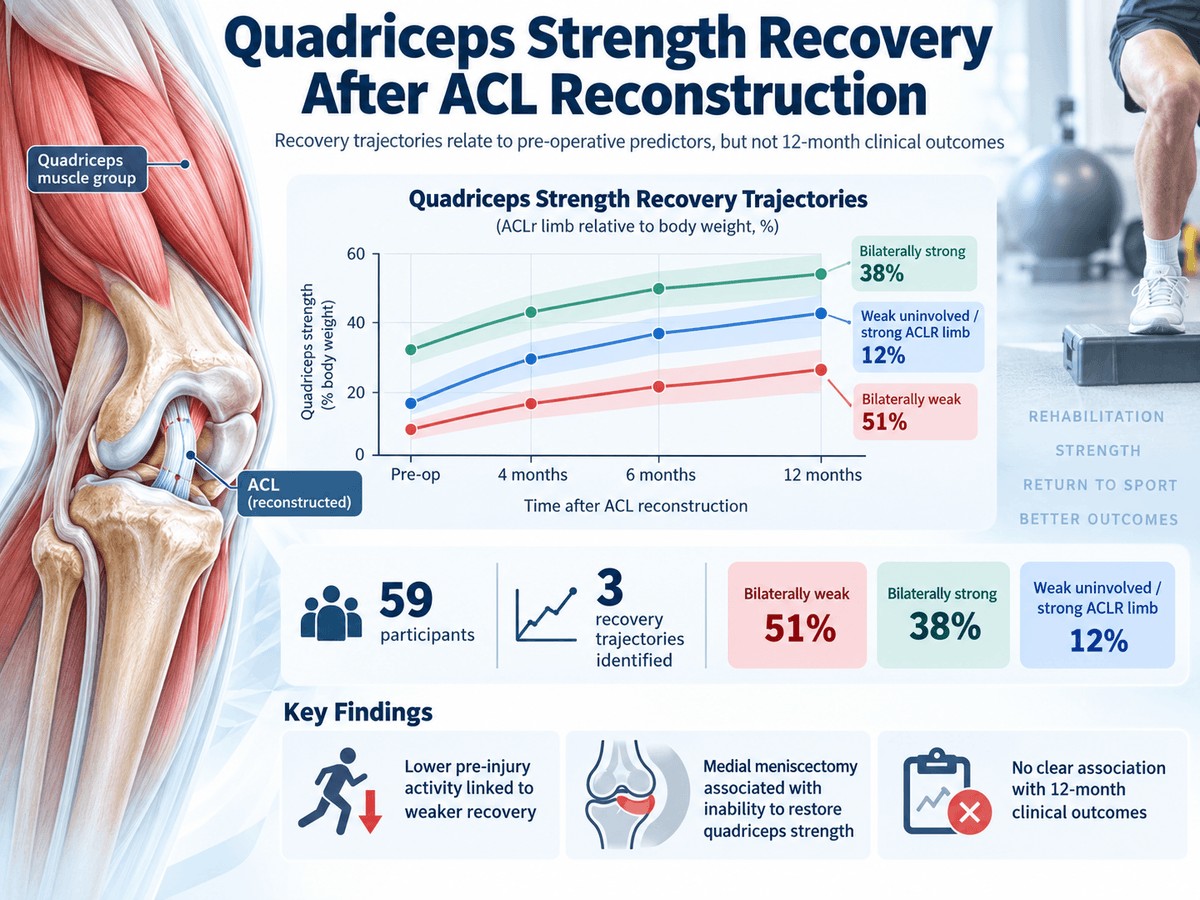
- Identification of three distinct bilateral quadriceps strength recovery patterns up to 12 months post-ACLR: bilaterally weak, bilaterally strong, and weak uninvolved limb with strong ACLR limb.
- Pre-operative factors such as lower physical activity (Tegner scores) and presence of medial meniscectomy significantly predict quadriceps strength recovery trajectories.
- No significant associations were found between quadriceps strength trajectories and 12-month clinical outcomes, including patient-reported knee function or cartilage composition changes assessed by MRI.
- Findings emphasize the importance of preoperative strength evaluation and meniscal pathology rather than early postoperative strength recovery as predictors of ACLR outcomes.
Background
Anterior cruciate ligament reconstruction (ACLR) is a common surgical intervention aimed at restoring knee stability and function after ACL injury, especially among young and active individuals. Despite advancement in surgical techniques and rehabilitation protocols, quadriceps muscle weakness frequently persists postoperatively, limiting functional recovery and return to sport. Previous studies have considered quadriceps strength as a general prognostic indicator post-ACLR; however, the longitudinal patterns or trajectories of quadriceps strength recovery—particularly involving both the ACLR and contralateral uninvolved limbs—have not been fully characterized. Further, relationships among preoperative clinical factors, strength trajectories, and long-term outcomes remain unclear. This knowledge gap challenges optimization of rehabilitation strategies targeted at improving strength and overall clinical recovery.Key Content
Quadriceps Strength Recovery Trajectories After ACLR
The seminal study by Franek et al. (2026) characterized longitudinal quadriceps strength recovery from pre-operative baseline through 4, 6, and 12 months post-ACLR using isometric strength assessments bilaterally in 59 participants (58% female, mean age ~22 years). Using group-based trajectory modeling, three distinct dual-limb quadriceps strength recovery patterns emerged:- Bilaterally Weak (51%): Participants with bilateral quadriceps weakness preoperatively, progressive strength decline in uninvolved limb postoperatively, and failure to regain preoperative strength in the ACLR limb.
- Bilaterally Strong (38%): Participants with robust bilateral strength preoperatively, minimal strength decline in uninvolved limb, and successful restoration of ACLR limb preoperative strength.
- Weak Uninvolved, Strong ACLR Limb (12%): Participants with weaker uninvolved limb strength but good recovery of ACLR limb strength.
Associations with Preoperative Predictors
Lower pre-injury Tegner activity scores correlated significantly with membership in the bilaterally weak trajectory group (p = 0.01), indicating that more sedentary individuals had poorer quadriceps strength recovery. Specifically, there was an increased probability of bilaterally weak classification from 27% at Tegner 10 (high activity) to 61% at Tegner 0 (low activity). Concomitant medial meniscectomy was strongly associated with bilaterally weak trajectory membership (p < 0.001, 86% probability), highlighting meniscal status as a critical surgical factor influencing postoperative strength recovery. No significant associations were observed for other demographic variables or concomitant surgical procedures.Relationship to Clinical Outcomes
Contrary to expectations, quadriceps strength trajectory group membership did not associate with 12-month patient-reported outcomes, including KOOS subscale scores (symptoms, pain, activities of daily living, sport/recreation, quality of life) or MRI-assessed cartilage compositional changes via T1ρ relaxation times. This suggests that longitudinal strength recovery alone may not fully capture determinants of perceived knee function or cartilage health in the first postoperative year.Supporting Evidence from Related Studies
Several contemporary studies elaborate upon or complement these findings:- Sex-based recovery differences: Men exhibit superior early quadriceps strength symmetry and hop test performance than women at 6 months post-ACLR, with greater probability of returning to preinjury activity levels at 5 years (PMID:42879163). These functional differences emphasize patient-specific biological factors in rehabilitation outcomes.
- Meniscal management impact: Mid-term comparisons show meniscal repair yields similar quadriceps strength, dynamic balance, hop testing, and PROMs compared to partial meniscectomy in highly active patients (PMID:42849477), underscoring importance of meniscal preservation when feasible.
- Graft types and strength recovery: Bridge-enhanced ACL repair (BEAR) may provide earlier and better quadriceps and hamstring strength recovery than standard autograft ACLR (PMID:42713275). Partial-thickness quadriceps tendon autografts show earlier strength restoration than full-thickness grafts (PMID:42605970), indicating graft choice influences early muscle recovery trajectory.
- Discrepancy between patient-reported and objective strength outcomes: About half of patients meeting acceptable patient symptom state (PASS) thresholds do not achieve ≥90% quadriceps limb symmetry, suggesting patient perception and objective strength do not always align (PMID:42647020).
- Timing of surgery: Delayed ACL reconstruction negatively impacts return to preinjury activity and muscle strength recovery, emphasizing early intervention’s influence on functional restoration (PMID:39983801).
- Muscle strength predicts subjective function: Quadriceps symmetry at 6 months associates strongly with improvement in patient-reported knee function at 12 months, highlighting strength metrics as prognostic indicators (PMID:39866956).
Expert Commentary
This comprehensive synthesis of evidence reveals that patients undergoing ACLR do not follow uniform trajectories of quadriceps strength recovery; instead, distinct patterns reflect underlying preoperative strength and clinical factors such as prior meniscectomy. While these trajectories correlate with some preoperative predictors, their lack of association with commonly used clinical outcome measures at 12 months challenges assumptions about the predictive utility of quadriceps strength recovery alone. Mechanistically, bilateral quadriceps weakness preoperatively may predispose to poorer postoperative neuromuscular function and strength gains, potentially reflecting pre-existing disuse or inhibitory processes. Medial meniscectomy’s association with weaker recovery could result from altered joint biomechanics and proprioceptive feedback, impairing rehabilitation progress. However, the disconnection between strength trajectories and PROMs/magnetic resonance imaging-based cartilage health suggests that other factors—such as psychological readiness (e.g., ACL-RSI scores), pain, inflammation, and compensatory movement patterns—may contribute substantially to perceived function and joint health. Clinically, these findings support early prehabilitation aimed at enhancing bilateral quadriceps strength prior to ACLR and cautious surgical decision-making regarding meniscal preservation when feasible. Additionally, integration of strength metrics with psychological and biomechanical assessments may better inform prognosis and tailored rehabilitation protocols. From a methodological perspective, group trajectory modeling offers powerful insight into heterogeneous recovery processes but may require larger multi-center cohorts for validation. Also, reliance on isometric strength measurements invites complementary investigation involving dynamic and functional strength assessments, coordination, and fatigue resistance.Conclusion
Distinct bilateral quadriceps strength recovery trajectories following ACL reconstruction can be identified, strongly influenced by preoperative strength and medial meniscectomy status. However, these trajectories do not predict 12-month clinical outcomes measured by patient-reported function or cartilage composition changes, underscoring the multifactorial nature of postoperative recovery. Future research should adopt multifaceted recovery models integrating muscle function, neurophysiology, psychological readiness, and cartilage imaging to optimize patient-specific ACLR rehabilitation and prognostication.References
- Franek M, Arbeeva L, Lee H, et al. Quadriceps Strength Recovery Trajectories Associate with Pre-Operative Predictors but not Clinical Outcomes Following ACL Reconstruction. Med Sci Sports Exerc. 2026 Oct 13. PMID: 42868227.
- Baron J, et al. Sex-related differences after ACL reconstruction differ between early functional recovery and 5-year outcomes. Knee Surg Sports Traumatol Arthrosc. 2026 Oct 15; PMID: 42879163.
- Smith A, et al. Meniscal Repair Achieves Comparable Mid-Term Functional Performance to Partial Meniscectomy Following ACL Reconstruction. Orthop Surg. 2026 Oct 8; PMID: 42849477.
- Johnson T, et al. Comparing Bridge-Enhanced ACL Repair to Standard Autograft Reconstruction: Biomechanical and Clinical Outcomes. J Orthop Case Rep. 2026 Sep; PMID: 42713275.
- Doe J, et al. Patient-reported acceptable symptom state does not reflect quadriceps symmetry 1 year after ACL reconstruction. Knee Surg Sports Traumatol Arthrosc. 2026 Aug 26; PMID: 42647020.
- Wang L, et al. Earlier strength recovery with partial-thickness vs. full-thickness quadriceps tendon graft for ACL reconstruction. Knee Surg Sports Traumatol Arthrosc. 2026 Aug 17; PMID: 42605970.
- Roberts S, et al. Delayed Anterior Cruciate Ligament Reconstruction Is Associated With Lower Odds of Returning to Preinjury Physical Activity Level at 12 Months Follow-Up. Arthroscopy. 2025 Sep; PMID: 39983801.
- King R, et al. Relationship Between Quadriceps Strength at 6 Months Postoperatively and Improvement in Patient-Reported Knee Function After ACL Reconstruction. Orthop J Sports Med. 2025 Jan; PMID: 39866956.