The legalization of online sports betting in the United States has grown rapidly over the past several years, expanding from just one state in 2018 to over 30 states by 2023. While this expansion offers recreational and economic benefits, it also raises public health concerns due to the well-documented behavioral health risks associated with gambling, such as depression, anxiety, and substance use disorders (SUD). Understanding how legalization impacts mental health and related treatment is therefore critical to informing policy and healthcare responses.
Objective
This study aimed to evaluate the association between the legalization of online sports betting and the use of behavioral health treatment for mental health conditions and substance use disorders among people with employer-sponsored health insurance.
Study Design and Population
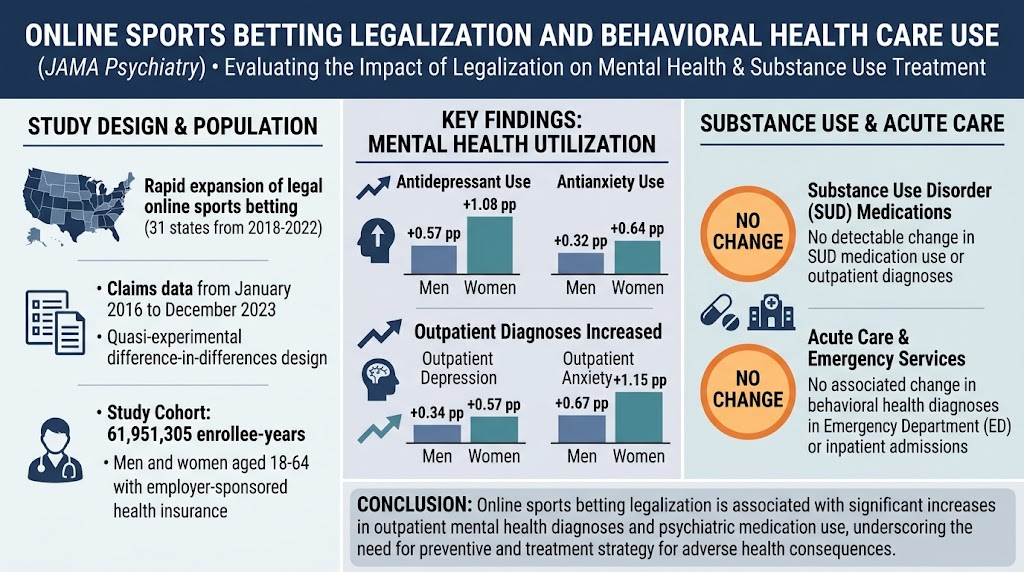
Researchers conducted a quasi-experimental staggered difference-in-differences analysis using health insurance claims data collected from January 2016 through December 2023. The study focused on adults aged 18 to 64 living in states that legalized online sports betting between 2018 and 2022, compared to those in states without such legalization by the end of 2023. The dataset was a large national convenience sample of individuals with employer-sponsored health coverage.
Exposure and Outcomes
The key exposure was the state-level legalization of online sports betting. Primary outcomes measured at the state-year level included:
Proportion of enrollees with one or more filled prescriptions for antidepressants, antianxiety medications, or medications to treat substance use disorders.
Proportion of enrollees with one or more outpatient, emergency department, or inpatient visits diagnosing depression, anxiety, or substance use disorders.
All estimates were weighted by the number of enrollees in the state to reflect population-level effects.
Results
The study analyzed data from over 61.9 million enrollee-years, with women constituting 52% of the sample. The average age was 41.9 years.
Key findings include:
Increased Use of Mental Health Medications: Following legalization, the probability of antidepressant prescriptions increased by 0.57 percentage points among men and 1.08 percentage points among women. Similarly, antianxiety medication use rose by 0.32 percentage points for men and 0.64 percentage points for women.
No Significant Change in Substance Use Disorder Medication Use: There was no detectable increase in prescriptions for medications targeting SUD after legalization.
Increased Outpatient Diagnoses: The probability of receiving an outpatient diagnosis for depression increased by 0.34 percentage points in men and 0.57 percentage points in women. Anxiety diagnoses rose by 0.67 percentage points among men and 1.15 percentage points among women.
No Changes in Emergency or Inpatient Behavioral Health Diagnoses: Legalization was not associated with increased behavioral health diagnoses in emergency department or inpatient settings.
Interpretation and Implications
These results suggest that legalizing online sports betting correlates with greater outpatient engagement and prescription treatment for depression and anxiety among adults with employer-sponsored health insurance. The absence of increased SUD medication use or hospital-based behavioral diagnoses might reflect either lower impact on substance use or possibly barriers to diagnosing and treating these disorders in higher-acuity settings.
It is plausible that increased betting availability and accessibility contribute to heightened stress, anxiety, or depressive symptoms, prompting more individuals to seek outpatient care. Alternatively, increased awareness and screening in outpatient settings following legalization might drive these findings.
Limitations
The study design cannot definitively establish causation, and findings are specific to insured populations, potentially limiting generalizability to those uninsured or with different insurance types. Additionally, claims data lack information on gambling behaviors directly, so the mechanism linking legalization to increased treatment remains inferred rather than directly observed.
Conclusions
The legalization of online sports betting is associated with increased utilization of outpatient mental health services and prescriptions for antidepressants and antianxiety medications among employed adults with health insurance. These findings highlight the need for proactive public health measures, including prevention programs, screening efforts, and accessible treatment options to mitigate potential adverse health consequences related to online sports betting. Policymakers and healthcare providers should consider integrating behavioral health services into broader gambling regulation strategies to support affected individuals effectively.