Highlight
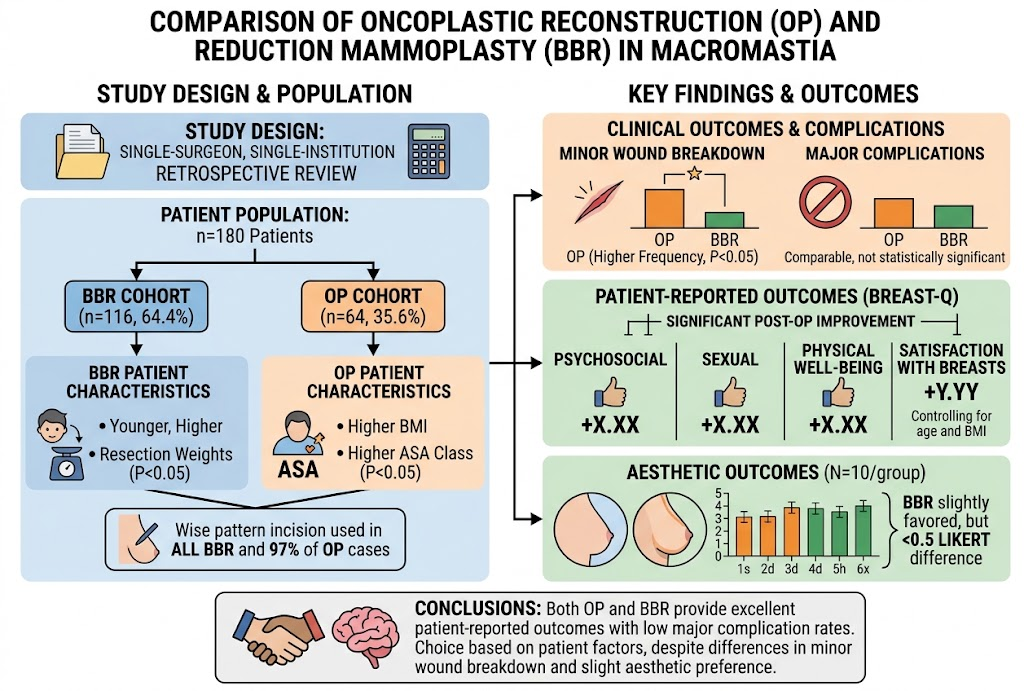
This study compares oncoplastic breast reconstruction (OP) and standard bilateral breast reduction (BBR) for macromastia management in women undergoing breast conservation surgery, assessing clinical safety, patient-reported quality of life, and aesthetic outcomes. OP shows comparable major complication rates to BBR, offers significant improvements in psychosocial, sexual, and physical well-being, and yields similarly high aesthetic satisfaction.
Study Background
Macromastia, characterized by excessively large breasts, often leads to physical discomfort, psychosocial distress, and can complicate breast cancer surgical management when breast-conserving surgery (lumpectomy) is indicated. Traditional bilateral breast reduction (BBR) has long been established to alleviate macromastia symptoms and improve quality of life by reducing breast volume symmetrically. Oncoplastic breast reconstruction (OP) represents an innovative approach that combines tumor excision with simultaneous volume reduction and soft tissue rearrangement. This approach aims not only to treat breast cancer but also to relieve macromastia symptoms and optimize breast symmetry and cosmetic outcomes after surgery. Despite the growing adoption of OP, limited data directly compares its clinical safety, patient-reported outcomes (PROs), and aesthetics with standard BBR in women with macromastia undergoing breast conservation.
Study Design
This retrospective cohort study was conducted at a single institution by a single experienced surgeon, including patients who underwent either oncoplastic reconstruction (OP) or bilateral breast reduction (BBR) from April 2022 to May 2025. The inclusion criteria centered on women with symptomatic macromastia, either with breast cancer requiring lumpectomy (OP group) or for symptomatic relief without cancer (BBR group). Clinical data extracted included demographics, operative details, complications, and postoperative follow-up. Patient-reported outcomes were measured using the BREAST-Q survey, encompassing psychosocial well-being, sexual well-being, physical well-being, and satisfaction with breasts. Aesthetic outcomes were independently evaluated in subsets of 10 patients per group using validated scales assessing six different aesthetic domains. Statistical analyses comprised univariate testing and analysis of covariance (ANCOVA) controlling for potential confounders such as age and body mass index (BMI).
Key Findings
The study cohort consisted of 180 patients, with 116 (64.4%) undergoing BBR and 64 (35.6%) undergoing OP. Patients in the BBR group were generally younger and had greater breast tissue resection weights, whereas the OP group exhibited higher BMI and American Society of Anesthesiologists (ASA) physical status classification, indicating a higher baseline surgical risk profile.
Clinical Safety: Wise pattern incision was used for the majority of cases — universally in BBR and 97% in OP. While minor wound breakdown was statistically more frequent in the OP group, potentially reflecting the more complex oncologic and reconstructive nature of the surgery, major complication rates did not differ significantly between groups. These findings highlight that OP, despite involving tumor excision, maintains an acceptable safety profile comparable to standard BBR.
Patient-Reported Outcomes: Both groups experienced significant postoperative improvements on the BREAST-Q across psychosocial, sexual, and physical well-being domains, as well as satisfaction with breast appearance. Importantly, after adjustment for age and BMI, these increases were comparable between OP and BBR cohorts, suggesting that the therapeutic benefits of breast tissue reduction extend similarly to patients undergoing oncologic reconstruction.
Aesthetic Outcomes: Aesthetic assessment in a selected subset revealed that BBR was marginally favored over OP across six evaluated aesthetic criteria, but the difference was less than 0.5 points on a Likert scale. This minimal difference suggests that OP achieves nearly equivalent cosmetic results, reflecting successful integration of tumor resection and breast reshaping techniques.
Expert Commentary
The integration of oncologic resection and plastic surgical principles inherent to oncoplastic reconstruction is a paradigmatic shift in breast cancer surgery, aiming to maintain oncologic safety while optimizing cosmesis and patient satisfaction. This study robustly supports OP as a safe and effective alternative to standard bilateral breast reduction in women with macromastia undergoing breast conservation. The finding of comparable major complications affirms the importance of surgical expertise in reducing adverse outcomes, particularly given the higher ASA scores in the OP cohort.
Minor wound issues being more frequent in OP might reflect the complexity of combining cancer surgery with reconstruction, underscoring the need for meticulous perioperative care. The equivalence in patient-reported outcomes across domains is encouraging, emphasizing that addressing both oncologic and symptomatic needs can substantially enhance quality of life. The near equivalence in aesthetics reflects advancements in oncoplastic techniques, allowing surgeons to preserve breast shape and symmetry effectively.
Limitations include the retrospective design, single-institution and surgeon experience, and relatively small sample for aesthetic comparison, which may limit generalizability. Future prospective, multicenter studies could validate these findings and explore long-term oncologic outcomes in larger, more diverse populations.
Conclusion
This study demonstrates that oncoplastic breast reconstruction, when integrated with lumpectomy in women with macromastia, offers significant improvements in quality of life comparable to those achieved by bilateral breast reduction. It maintains a favorable safety profile with similar major complication rates and yields high patient satisfaction and aesthetic results nearly equivalent to BBR. These findings support the expanding role of OP as a preferred reconstructive option in breast cancer patients requiring volume reduction, facilitating symptom relief without compromising oncologic or cosmetic outcomes.
Funding and ClinicalTrials.gov
No specific funding information or clinical trial registration was provided in the study abstract.
References
1. Oh SJ, Rodriguez J, Hu K, Allam O, Sullivan J, Glaspy J, Tannenbaum E, Berger ER, Butler PD. Comparing Clinical, Patient-Reported, and Aesthetic Outcomes of Oncoplastic Reconstruction Versus Reduction Mammoplasty in Macromastia. Plastic and reconstructive surgery. 2026 Aug 24. PMID: 42636447.
2. Clough KB, Kaufman GJ, Nos C, et al. Improving breast cancer surgery: a classification and quadrant per quadrant atlas for oncoplastic surgery. Ann Surg Oncol. 2010 May;17(5):1375-91.
3. Mansell J, Jallali N. Oncoplastic breast surgery: principles and practice. Breast 2010;19(5):368-71.