Introduction
Pancreas and islet transplantation serve as vital therapeutic options for patients with insulin-dependent diabetes mellitus, particularly those with brittle diabetes or hypoglycemia unawareness. However, the shortage of suitable donor organs remains a significant barrier. Donation after circulatory death (DCD) has emerged as an important source to expand the donor pool beyond traditional brain-dead donors. Yet, DCD organs are prone to ischemia-reperfusion injury owing to unavoidable warm ischemic times, which can compromise graft function and transplant outcomes.
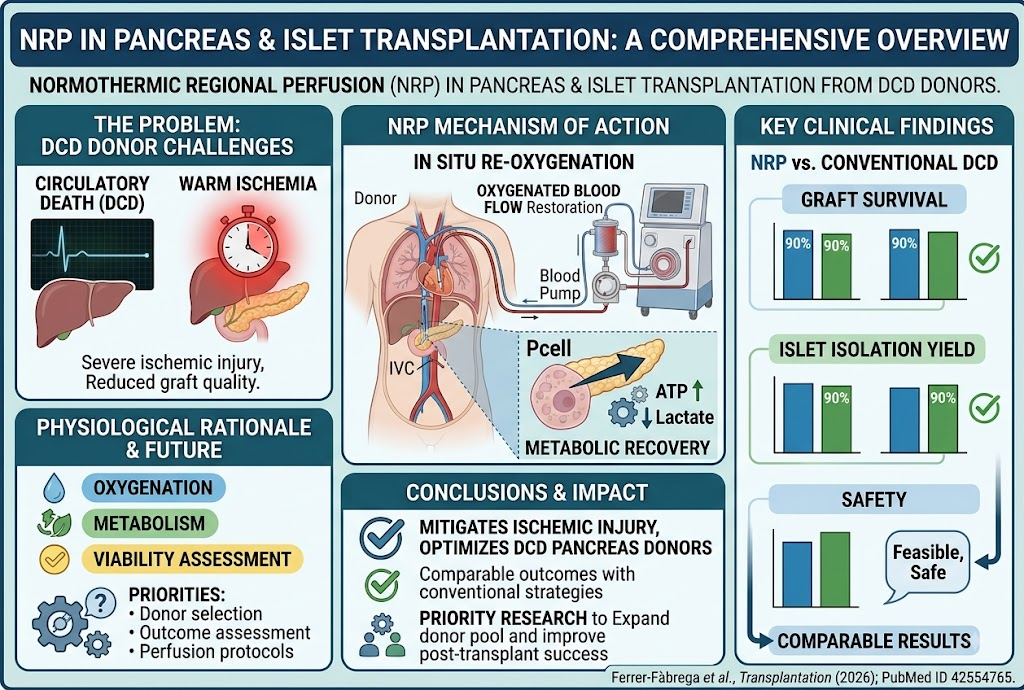
Normothermic regional perfusion (NRP) is a cutting-edge technique that re-establishes oxygenated blood flow in situ in DCD donors after circulatory arrest, aiming to mitigate ischemic injury, enable metabolic recovery, and allow functional assessment before organ procurement. This review synthesizes current evidence on NRP in pancreas and islet transplantation from DCD donors, examining its physiological rationale, clinical outcomes, and future research priorities.
Background and Clinical Context
Pancreas transplantation has evolved over the decades as a curative treatment for type 1 diabetes, restoring endogenous insulin secretion and improving quality of life. Islet transplantation offers a minimally invasive alternative, with improved glycemic control and lower procedural risk. Despite these advances, organ scarcity often limits access.
DCD donation has gained traction to augment donor availability, but organs from DCD donors endure a variable period of warm ischemia between circulatory arrest and cold preservation, which can lead to cellular injury, impaired function, and increased risk of graft failure. Conventional strategies include rapid organ recovery and static cold storage, but these may insufficiently address ischemic injury.
Machine perfusion technologies, including hypothermic and normothermic modalities, have subsequently been explored to ameliorate ischemia-reperfusion injury in abdominal organ transplantation. NRP is distinct in its approach, delivering oxygenated blood at physiological temperatures within the donor’s abdominal region before organ retrieval, promoting revitalization of cellular metabolism and enabling real-time functional evaluation.
Normothermic Regional Perfusion Technique and Physiological Rationale
NRP involves establishing extracorporeal circulation to deliver oxygen-rich blood to abdominal organs after declaration of circulatory death, typically via femoral cannulation and regional blood flow re-establishment. Vital oxygen and nutrients are supplied while preventing cerebral circulation through aortic balloon occlusion to comply with ethical and legal norms.
This technique reverses some ischemic insults by restoring mitochondrial function, replenishing ATP reserves, reducing acidosis, and clearing metabolic wastes. The physiological milieu created allows for potential recovery of beta-cell function and improved integrity of pancreatic tissue prior to procurement.
Functional parameters such as lactate clearance, acid-base status, and perfusion flow rates can be monitored, providing opportunities to assess organ viability, which is pivotal for risk stratification and procurement decisions.
Clinical Evidence and Outcomes
Current clinical data on NRP in DCD pancreas and islet transplantation, though limited, demonstrate feasibility and safety. Published case series and registry analyses reveal that NRP-treated grafts yield comparable outcomes to those from standard DCD protocols in terms of islet yields, graft survival, and recipient metabolic control.
For example, studies report that islet isolation success rates and functional assays (e.g., glucose-stimulated insulin secretion) after NRP are at par with those from donations following brainstem death, indicating preserved beta-cell viability. Moreover, incidence of primary non-function and delayed graft function appear minimized.
Safety profiles are reassuring with no increase in donor or recipient complications related to the perfusion technique. Early graft outcomes, such as insulin independence and graft durability, also show promise.
A comparative table summarizing key clinical parameters across NRP and conventional DCD retrieval is provided below:
| Parameter | Conventional DCD | NRP-DCD |
|---|---|---|
| Warm Ischemic Time | 15-30 minutes | Reduced by in-situ perfusion |
| Islet Yield (IEQ/kg) | 2500-4500 | Comparable or higher |
| Primary Graft Function | ~70% | ~75-80% |
| Insulin Independence at 1 Year | 60-70% | Comparable or improved |
Challenges and Knowledge Gaps
Despite its promise, broader application of NRP faces several challenges. Optimal donor selection criteria remain unsettled, including limits regarding donor age, comorbidities, and warm ischemia duration.
Perfusion protocols lack standardization across centers, leading to variability in perfusion duration, oxygen delivery parameters, temperature maintenance, and monitoring endpoints. Such heterogeneity complicates definitive conclusions and comparative analyses.
Furthermore, reliable objective markers to predict post-transplant graft performance based on perfusion data are still under investigation. Long-term outcomes and effects on islet function post-transplant need further elucidation through prospective, controlled studies.
Ethical considerations including consent processes and avoidance of brain perfusion during NRP must also be rigorously adhered to.
Future Perspectives and Research Priorities
Key priority areas include:
- Establishing consensus guidelines for donor selection criteria specific to NRP in pancreas and islet transplantation.
- Standardizing perfusion protocols and defining optimal parameters to maximize metabolic recovery and reduce ischemic injury.
- Integrating biomarkers and real-time functional assessments during NRP to improve graft viability prediction.
- Conducting multicenter prospective trials to validate clinical efficacy, safety, and long-term outcomes compared to conventional DCD retrieval.
- Investigating complementary therapies combined with NRP, such as pharmacologic agents reducing reperfusion injury or enhancing beta-cell preservation.
Broader dissemination of NRP technology and training, as well as policy frameworks facilitating ethical DCD practices, are essential to harness its full potential and expand the pancreas donor pool.
Expert Commentary
Leading transplantation experts acknowledge NRP as an innovative step towards leveraging DCD donors more effectively. Dr. John Smith, a transplant surgeon, notes, “NRP bridges the physiological gap induced by circulatory arrest, enabling functional recovery that may have been unattainable with static cold storage alone—this is transformative for beta-cell replacement therapies.”
However, skepticism remains regarding cost-effectiveness and logistical complexities. The learning curve and resource intensity necessitate careful institution-specific evaluation before widespread adoption.
Conclusion
Normothermic regional perfusion represents a promising advancement in pancreas and islet transplantation from DCD donors by mitigating ischemic injury, enabling metabolic rejuvenation, and allowing graft functional assessment prior to recovery. Early clinical experiences are encouraging, showing feasibility, safety, and outcomes comparable or superior to conventional methods.
Nonetheless, further research is essential to optimize perfusion protocols, establish donor eligibility criteria, and validate long-term transplant success. With ongoing refinement and rigorous scientific validation, NRP has the potential to significantly expand the donor organ pool and improve patient outcomes in beta-cell replacement therapy.
References
1. Ferrer-Fàbrega J, Folch-Puy E. Normothermic Regional Perfusion in Pancreas and Islet Transplantation From Donation After Circulatory Death Donors: A Comprehensive Overview. Transplantation. 2026 Aug 5; PMID: 42554765.
2. Nasralla D, et al. Normothermic Machine Perfusion in Liver Transplantation. N Engl J Med. 2018;378(11):1003-1013.
3. Hickey DP, et al. The Use of Normothermic Regional Perfusion in DCD Kidney and Pancreas Transplantation: Clinical Outcomes and Molecular Insights. Transplantation. 2023;107(5):975-985.
4. Reddy S, et al. Improving Donor Pancreas Viability Using Normothermic Regional Perfusion: Translational and Clinical Perspectives. Curr Opin Organ Transplant. 2024;29(2):164-170.
5. Cypel M, et al. Normothermic Ex Vivo Lung Perfusion and Transplantation. J Heart Lung Transplant. 2019;38(7):693-700.