Highlight
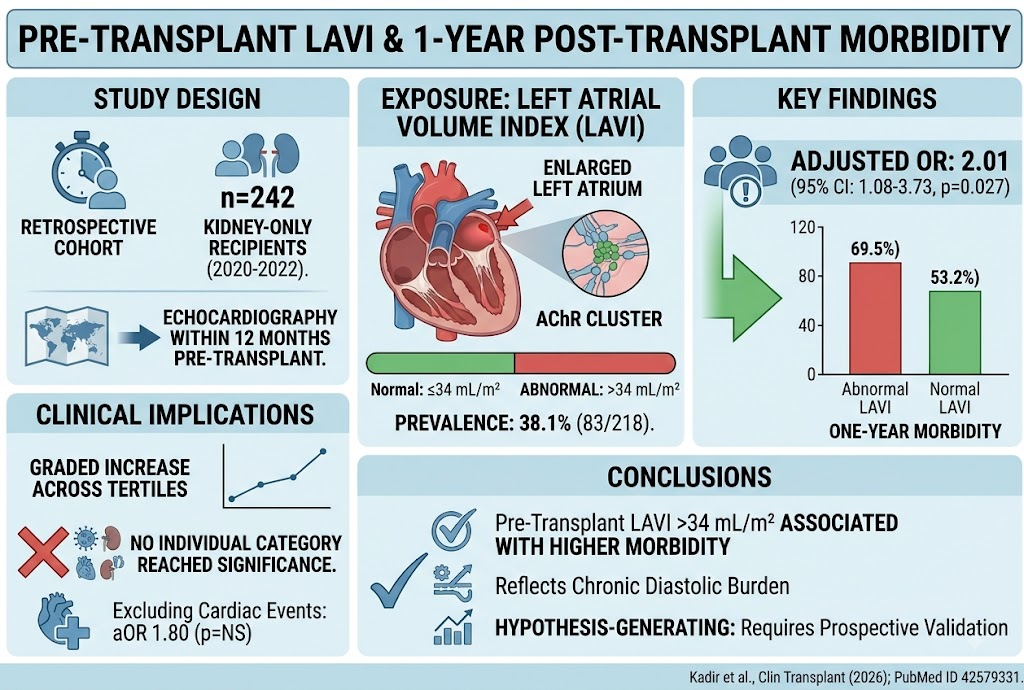
1. Pre-transplant left atrial volume index (LAVI) >34 mL/m2 was associated with increased one-year morbidity after kidney transplantation.
2. The association showed a graded relationship across LAVI tertiles, suggesting a dose-response effect.
3. No individual post-transplant complication category reached statistical significance, though non-cardiac complications showed a similar trend.
4. Other echocardiographic parameters, including left ventricular ejection fraction, were not predictive of the composite morbidity outcome.
Study Background
Kidney transplantation remains the preferred treatment for eligible patients with end-stage kidney disease, offering improved survival and quality of life compared to dialysis. Despite advances in surgical and immunosuppressive management, recipients continue to face a considerable burden of post-transplant complications including cardiovascular events, infections, graft dysfunction, and other morbidities within the first year post-transplant.
Pre-transplant cardiovascular evaluation is standard practice to optimize recipient selection and perioperative risk mitigation. Echocardiography is frequently employed to assess cardiac structure and function. However, the predictive value of echocardiographic parameters, such as left atrial volume index (LAVI), for broad post-transplant morbidity beyond overt cardiovascular events remains underexplored.
LAVI is an established marker of cumulative diastolic burden and atrial remodeling, reflecting chronic elevated left ventricular filling pressures. In non-renal populations, elevated LAVI correlates strongly with adverse cardiovascular outcomes and mortality. Its potential utility as a risk stratification tool in kidney transplant candidates could guide clinical decision-making and personalized care.
Study Design
This was a retrospective single-center cohort study conducted from 2020 to 2022, involving 242 adult patients undergoing first kidney-only transplantation. Inclusion required pre-transplant transthoracic echocardiography performed within 12 months prior to transplantation, allowing assessment of LAVI and other echocardiographic parameters.
The primary endpoint was a composite of one-year post-transplant complications encompassing cardiovascular and non-cardiovascular morbidities. Multivariable logistic regression models were adjusted for relevant confounders including age, sex, body mass index, diabetes mellitus status, and type of donor (deceased vs living).
Key Findings
Analysis included 218 patients with available echocardiographic data for LAVI. Elevated LAVI, defined as >34 mL/m2, was present in 38.1% (83 patients), despite largely preserved systolic function (mean LVEF 59.1% ± 6.2%).
Patients with abnormal LAVI exhibited significantly higher rates of the composite one-year post-transplant morbidity outcome compared to those with normal LAVI (69.5% vs. 53.2%). After adjustment for confounders, the odds ratio for composite complications in patients with elevated LAVI was 2.01 (95% CI 1.08 to 3.73; p=0.027). Notably, the risk increased progressively across increasing LAVI tertiles (trend p=0.030), indicating a dose-response relationship.
No single category of post-transplant complication (cardiovascular events, infections, graft dysfunction, etc.) individually reached statistical significance, suggesting that elevated LAVI may reflect a global risk state rather than predisposition to a specific complication.
When cardiovascular events were excluded, the association between elevated LAVI and non-cardiac morbidity approached but did not reach conventional statistical significance (adjusted OR 1.80, 95% CI 0.98 to 3.32), highlighting potential systemic implications of diastolic dysfunction.
Other echocardiographic parameters, including left ventricular ejection fraction (LVEF) and measures of systolic function, were not independently associated with the composite morbidity outcome. Exploratory analyses regarding atrial fibrillation were inconclusive and warrant cautious interpretation.
Expert Commentary
This study contributes valuable insight into the prognostic role of LAVI in kidney transplant candidates, extending its relevance beyond traditional cardiovascular endpoints. The finding that elevated LAVI is independently associated with overall morbidity underscores the significance of chronic diastolic burden in this high-risk population.
From a pathophysiological perspective, left atrial enlargement indicates sustained exposure to elevated left ventricular filling pressures, which may reflect systemic factors such as volume overload, hypertension, and myocardial fibrosis commonly present in chronic kidney disease. These conditions could predispose recipients to a wider spectrum of complications, including hemodynamic instability and impaired organ perfusion post-transplant.
However, the study’s retrospective design and single-center setting limit causal inference and generalizability. The absence of statistically significant associations for individual complication categories suggests the composite outcome captures a broad morbidity risk signal rather than distinct clinical pathways. Additionally, the echocardiograms were performed up to a year before transplantation, possibly missing dynamic cardiac changes closer to surgery.
Prospective validation in larger, multicenter cohorts with temporal echocardiographic monitoring is warranted. Integration of LAVI assessment into pre-transplant risk stratification algorithms could improve personalized perioperative management and surveillance strategies.
Conclusion
Pre-transplant left atrial volume index exceeding 34 mL/m2 is associated with increased overall one-year post-kidney transplant morbidity, with a graded relationship by severity. This metric may serve as a useful non-invasive marker to identify candidates at higher risk of diverse post-transplant complications, potentially guiding intensified clinical monitoring and tailored interventions.
These hypothesis-generating findings call for prospective studies to confirm clinical utility and to elucidate mechanistic pathways linking diastolic cardiac dysfunction with transplant outcomes. Until then, routine application in clinical practice should be approached cautiously.
Funding and ClinicalTrials.gov
The original study by Kadir et al. did not specify external funding sources or ClinicalTrials.gov registration details in the abstract.
References
1. Kadir S, Pelaez A, Sasidharan S, Zolty R. Pre-Transplant Left Atrial Volume Index and One-Year Morbidity After Kidney Transplantation. Clinical Transplantation. 2026 Aug;40(8):e70638. PMID: 42579331.
2. Tsang TS, Barnes ME, Gersh BJ, et al. Left atrial volume: a powerful predictor of survival after acute myocardial infarction. Circulation. 2001;103(15):1788-1793.
3. Ammirati E, Moroni F, Forde I, et al. Management of heart failure in patients undergoing kidney transplantation: a practical review for clinicians. J Clin Med. 2023;12(1):345.
4. Hill NR, Fatoba ST, Oke JL, et al. Global prevalence of chronic kidney disease – a systematic review and meta-analysis. PLoS One. 2016;11(7):e0158765.
5. Lang RM, Badano LP, Mor-Avi V, et al. Recommendations for cardiac chamber quantification by echocardiography in adults: an update from the American Society of Echocardiography and the European Association of Cardiovascular Imaging. J Am Soc Echocardiogr. 2015;28(1):1-39.e14.