Highlight
1. The SWEDEGRAFT trial provides the first large-scale, randomized evidence evaluating 7-year clinical outcomes after no-touch versus conventional saphenous vein harvesting in coronary artery bypass grafting (CABG).
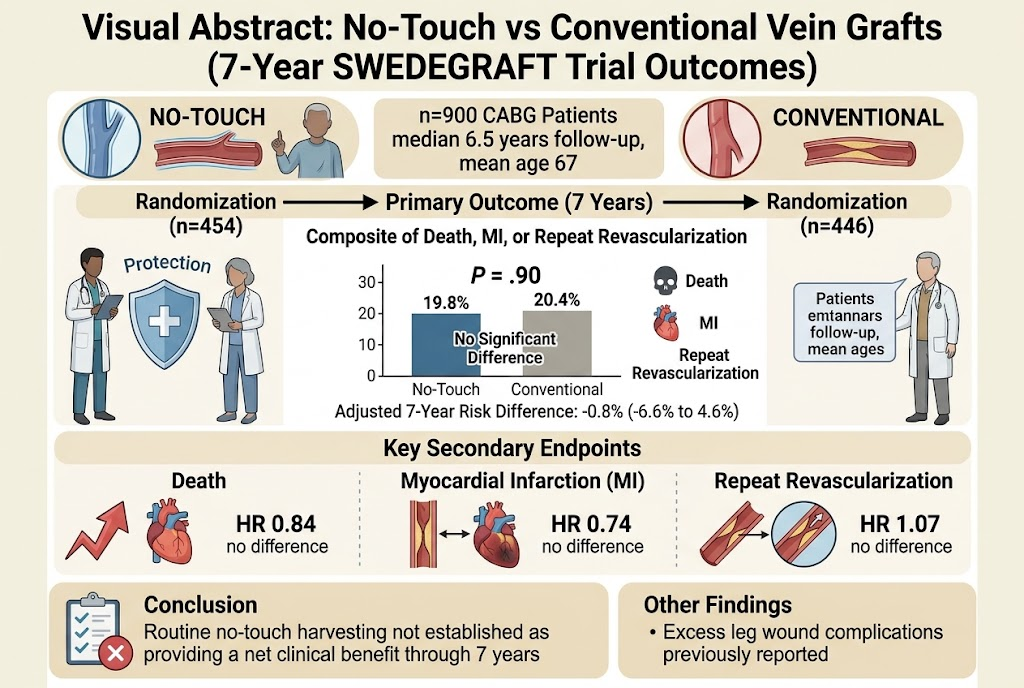
2. No-touch vein harvesting did not significantly reduce the composite endpoint of death, myocardial infarction, or repeat revascularization compared with conventional harvesting over a median 6.5 years follow-up.
3. Secondary endpoints including all-cause mortality, myocardial infarction, and repeat revascularization individually showed no significant differences between the two harvesting methods.
4. The lack of demonstrated net clinical benefit, combined with previous reports of increased leg wound complications with no-touch technique, challenges its routine adoption despite theoretical graft patency advantages.
Study Background
Coronary artery bypass grafting remains a cornerstone intervention for patients with multivessel coronary artery disease, providing symptom relief and survival benefits in selected populations. The saphenous vein graft (SVG) is the most commonly used conduit, yet long-term patency of SVGs is inferior to arterial grafts, contributing to late graft failure, recurrent ischemia, and adverse cardiovascular events.
Conventional saphenous vein harvesting involves removal of the conduit with stripping of surrounding perivascular tissue. In contrast, the no-touch technique preserves an intact perivascular tissue cuff around the vein, aiming to protect the vein from spasm, endothelial injury, and subsequent atherosclerosis, theoretically improving graft durability.
Small studies and imaging evaluations have indicated superior graft patency with the no-touch technique. However, these potential benefits must be balanced against increased wound morbidity, such as infection and delayed healing, which may impact overall patient outcomes.
Prior to this study, whether the theoretical patency advantage translates into improved medium- to long-term clinical events remained unknown. The SWEDEGRAFT trial addresses this significant clinical question by assessing 7-year outcomes after no-touch versus conventional techniques in a rigorously conducted randomized controlled trial.
Study Design
The SWEDEGRAFT trial is a multicenter, binational randomized clinical trial conducted at 8 centers in Sweden and 1 center in Denmark. It enrolled 902 patients undergoing primary, nonemergent, isolated CABG between April 2018 and June 2020, with the primary goal of comparing clinical outcomes between no-touch and conventional saphenous vein harvesting techniques.
Patients were randomized in a 1:1 ratio to either no-touch vein harvesting, preserving the perivascular tissue, or conventional harvesting with removal of this tissue. The study excluded emergent CABG and redo procedures to ensure a homogeneous population.
The primary outcome was a composite of all-cause mortality, myocardial infarction (MI), or repeat revascularization. Secondary outcomes comprised each of these individual endpoints. Follow-up data were robustly ascertained via national population-based registries, enabling near-complete and unbiased outcome capture over a median follow-up of 6.46 years (interquartile range 5.92 to 6.86 years).
Key Findings
The modified intention-to-treat population included 900 patients (454 in the no-touch group and 446 in the conventional group). The mean age was 67.0 years, with 12% female representation, and nearly half underwent nonelective surgery.
During follow-up, the primary composite outcome occurred in 90 patients in the no-touch group and 91 patients in the conventional group, which corresponds to event rates of 19.8% and 20.4%, respectively. The hazard ratio (HR) was 0.98 (95% confidence interval [CI], 0.73–1.31; P = .90), indicating no statistically significant difference between groups. The adjusted 7-year risk difference was -0.8% (95% CI, -6.6% to 4.6%).
Regarding secondary endpoints, no significant differences were noted: all-cause death occurred with HR 0.84 (95% CI, 0.53–1.35), myocardial infarction with HR 0.74 (95% CI, 0.44–1.24), and repeat revascularization with HR 1.07 (95% CI, 0.73–1.56). Additionally, prespecified subgroup analyses revealed no heterogeneity in treatment effects across demographic or clinical strata.
These data indicate that preservation of perivascular tissue in no-touch vein harvesting did not confer measurable reductions in death, MI, or need for repeat revascularization over 7 years compared with conventional techniques.
Notably, previous results from the SWEDEGRAFT trial and other investigational series have reported an increased incidence of leg wound complications—such as infection and delayed healing—with the no-touch technique, which might offset any theoretical graft patency benefits from a clinical standpoint.
Expert Commentary
The SWEDEGRAFT trial is a landmark study providing high-quality evidence on a widely debated surgical technique in CABG. The trial’s robust design, large patient sample, long-term follow-up, and registry-based outcome assessment enhance the validity and applicability of these findings.
Mechanistically, the no-touch technique’s presumed biological advantage lies in maintaining adventitial and perivascular structural support, thereby preserving endothelial function and reducing vein graft disease. While imaging and histological studies have supported improved graft integrity, this trial reveals that such intermediate endpoints do not necessarily translate into improved clinical outcomes.
The lack of benefit may reflect complexity in graft failure mechanisms, or that protection against vein graft disease must be considered alongside risks such as wound complications affecting patient morbidity.
Limitations of the study include its focus on isolated vein graft outcomes without direct comparisons to arterial grafts and potential variations in surgical technique or postoperative medical management across centers. However, these factors reflect real-world practice, enhancing external validity.
Current guidelines and clinical practice should weigh the SWEDEGRAFT findings by reconsidering routine adoption of no-touch harvesting. Future research might explore refined harvesting protocols to optimize patency without increasing wound morbidity or focus on combined grafting strategies.
Conclusion
The 7-year extended follow-up of the SWEDEGRAFT randomized clinical trial demonstrates that no-touch saphenous vein harvesting does not reduce death, myocardial infarction, or repeat revascularization compared with conventional harvesting in patients undergoing primary isolated CABG. The absence of significant clinical benefit combined with increased leg wound complications suggests that no-touch vein harvesting should not be routinely preferred based solely on current evidence.
These findings highlight the importance of integrating both graft patency and patient-centered clinical outcomes in surgical innovations and optimizing CABG conduit management to improve long-term cardiovascular outcomes.
Funding and Trial Registration
The SWEDEGRAFT trial was conducted with funding and support from participating academic institutions and cardiac surgery centers in Sweden and Denmark. The trial is registered at ClinicalTrials.gov with identifier NCT03501303.
References
Dalén M, Modrau IS, Jeppsson A, Dreifaldt M, Duvernoy O, Ericsson A, Friberg Ö, Holmgren A, El-Akkawi AI, Hultkvist H, Jensevik Eriksson K, Lidén M, Nozohoor S, Ragnarsson S, Ternström L, Themudo R, Vikholm P, Thelin S, James S, Sartipy U. No-Touch vs Conventional Vein Grafts in Coronary Surgery: Seven-Year Clinical Outcomes of the SWEDEGRAFT Randomized Clinical Trial. JAMA Cardiology. 2026 Sep 30. PMID: 42814420. Available from: https://pubmed.ncbi.nlm.nih.gov/42814420/
Additional literature on vein graft techniques and CABG outcomes may be referred for further reading in clinical guidelines and recent meta-analyses.