Highlights
- Over 70% of patients hospitalized for heart failure exhibit two or more overlapping cardiovascular-kidney-metabolic (CKM) conditions including atherosclerotic cardiovascular disease, chronic kidney disease, diabetes, and obesity.
- The burden of CKM multimorbidity is highest in patients with heart failure with preserved ejection fraction (HFpEF), yet the prognostic impact on mortality and readmission is most pronounced in heart failure with reduced ejection fraction (HFrEF).
- Increasing number of CKM conditions independently associates with stepwise increases in in-hospital mortality and 1-year postdischarge all-cause mortality and heart failure readmissions, with significant heterogeneity across ejection fraction phenotypes.
- These findings highlight the importance of comprehensive multimorbidity assessment and integrated management across the cardiovascular-kidney-metabolic axis in heart failure care.
Background
Heart failure (HF) affects millions worldwide and represents a leading cause of hospitalization, morbidity, and mortality. Contemporary HF populations frequently present with multiple comorbid conditions, particularly involving the cardiovascular, kidney, and metabolic systems—a cluster herein termed cardiovascular-kidney-metabolic (CKM) multimorbidity. Although individual CKM conditions (e.g., chronic kidney disease [CKD], diabetes mellitus, obesity, and atherosclerotic cardiovascular disease [ASCVD]) are well-established contributors to HF pathophysiology and outcomes, the prevalence and prognostic implications of their overlap in hospitalized HF patients remain incompletely characterized.
The heterogeneity of HF, classified by left ventricular ejection fraction (LVEF) into HFrEF (<40%), HF with mildly reduced EF (HFmrEF; 41-49%), and HFpEF (≥50%), further complicates prognostic stratification, as CKM multimorbidity prevalence and impact vary across these phenotypes. Understanding this interplay is imperative to guide risk stratification and support precision medicine in HF management.
Key Content
Prevalence and Distribution of CKM Multimorbidity in HF
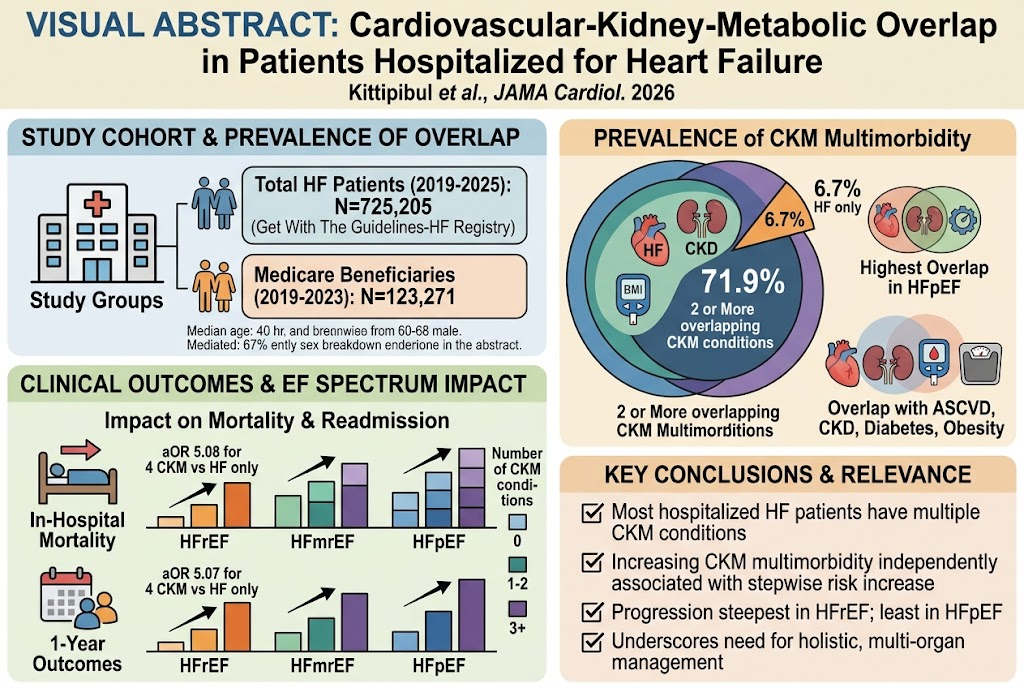
The comprehensive retrospective cohort study by Kittipibul et al. (2026) analyzed 725,205 HF hospitalizations from the GWTG-Heart Failure registry across U.S. hospitals between 2019 and 2025, supplemented with 123,271 Medicare beneficiaries hospitalized for HF from 2019-2023. They evaluated four CKM conditions: ASCVD, CKD, diabetes, and obesity (BMI ≥30). Their findings revealed that 71.9% of patients had 2 or more overlapping CKM conditions, while only 6.7% had HF alone without any of these conditions.
CKM overlap was disproportionally higher in HFpEF (a phenotype known for its high multimorbidity burden and systemic inflammatory milieu) compared to HFrEF and HFmrEF. This aligns with prior epidemiological studies indicating that HFpEF patients are older, more often female, and carry a higher burden of metabolic and renal comorbidities, which complicates management and worsens outcomes.
Impact of CKM Multimorbidity on In-Hospital and Postdischarge Outcomes
The study demonstrated a clear, stepwise relationship between the number of CKM conditions and increased risk of adverse outcomes, assessed by in-hospital mortality, 1-year all-cause mortality after discharge, and HF readmission rates. Notably, the magnitude of risk increase was greatest in HFrEF:
- In-hospital mortality adjusted odds ratio (aOR) for 4 CKM conditions in HFrEF was 5.08 (95% CI, 4.43-5.83), compared with 2.37 (1.68-3.34) in HFmrEF and 2.05 (1.77-2.38) in HFpEF.
- One-year postdischarge adjusted hazard ratios (aHR) for all-cause mortality and HF readmission similarly increased with CKM multimorbidity, peaking in HFrEF with aHR of 2.10 and 2.33 respectively for 4 CKM conditions.
This heterogeneity by LVEF phenotype may be explained by differing pathophysiology and therapeutic responsiveness. HFrEF remains highly influenced by myocardial injury and remodeling, which may be exacerbated by CKM comorbidities. Conversely, although CKM burden is high in HFpEF, its relatively modest prognostic implications could reflect complex systemic inflammatory and microvascular mechanisms less amenable to current treatments.
Pathophysiological and Mechanistic Insights
The interaction between cardiovascular, kidney, and metabolic systems in HF is multifaceted and bidirectional:
- Chronic kidney disease (CKD) contributes to fluid overload, neurohormonal activation (renin-angiotensin-aldosterone system), and toxin accumulation, exacerbating HF progression and increasing mortality risk.
- Diabetes mellitus induces microvascular dysfunction, advanced glycation end-products, and metabolic derangements, promoting myocardial fibrosis and impaired myocardial relaxation often seen in HFpEF.
- Obesity increases cardiac workload, causes systemic inflammation, and alters adipokine signaling, which may worsen HF symptoms and outcomes.
- Atherosclerotic cardiovascular disease (ASCVD) underpins ischemic cardiomyopathy and recurrent ischemic events, contributing to HF with reduced ejection fraction.
Together, these CKM conditions synergistically impair cardiac structure/function and systemic homeostasis, highlighting the importance of their integrated assessment.
Integration with Existing Literature
Previous clinical trials and meta-analyses have underscored the negative prognostic role of individual CKM conditions in HF. However, Kittipibul et al.’s large-scale registry data provide novel quantification of combined multimorbidity effects and LVEF-specific risk profiles. This complements guideline-directed HF management frameworks (e.g., 2022 AHA/ACC/HFSA HF guidelines) which recommend targeted therapies but often lack detailed stratification based on multimorbidity patterns.
Moreover, recent trials such as EMPEROR-Preserved and DELIVER have shown SGLT2 inhibitors reducing HF hospitalization risk across CKD and diabetic HFpEF subgroups, suggesting multimorbidity-targeted pharmacotherapy as a promising approach. However, the real-world burden and its impact revealed by this study emphasize gaps in translating trial efficacy into population impact.
Expert Commentary
This landmark study advances understanding by highlighting the pervasive and prognostically significant CKM multimorbidity in hospitalized HF populations. Clinicians should recognize that most HF patients do not present with “pure” cardiac dysfunction but rather a constellation of overlapping systemic conditions that modify risk and therapeutic response.
The stronger association of CKM burden with adverse outcomes in HFrEF suggests that aggressive management of comorbidities, alongside standard HF therapies (ARNI, beta-blockers, MRAs, SGLT2i), could yield meaningful outcome improvements. Conversely, the higher prevalence but weaker relative risk in HFpEF indicates a need for refined phenotyping and multimodal approaches, incorporating metabolic, renal, and inflammatory pathways.
Limitations include the retrospective design and reliance on registry data, which may impose residual confounding and incomplete comorbidity ascertainment. Nonetheless, the large sample size, robust statistical adjustment, and EF stratification enhance validity. Future prospective research should evaluate interventions explicitly designed to target CKM multimorbidity clusters and assess their impact on HF outcomes.
Conclusion
Integrated cardiovascular-kidney-metabolic multimorbidity is highly prevalent and independently related to adverse short- and long-term outcomes in patients hospitalized for heart failure across the LVEF spectrum. The findings underscore the urgent need for comprehensive multimorbidity assessment and holistic, phenotype-guided management strategies in HF care paradigms. Tailoring interventions to the burden and pattern of CKM conditions may optimize outcomes, reduce readmissions, and inform future clinical trial designs focusing on multimorbidity clusters within HF populations.
References
- Kittipibul V, Ayodele I, Fonarow GC, et al. Cardiovascular-Kidney-Metabolic Overlap in Patients Hospitalized for Heart Failure. JAMA Cardiol. 2026;PMID:42814450. https://pubmed.ncbi.nlm.nih.gov/42814450/
- Shah SJ, et al. Phenotype-Specific Treatment of Heart Failure With Preserved Ejection Fraction: Targeting the Underlying Pathophysiology. Circulation. 2020;141(5):338-353. PMID: 31837070
- Bozkurt B, et al. 2022 AHA/ACC/HFSA Guideline for the Management of Heart Failure: Executive Summary. Circulation. 2022;doi:10.1161/CIR.0000000000001073
- Anker SD, et al. Empagliflozin in Heart Failure with a Preserved Ejection Fraction. N Engl J Med. 2021 Jul 15;385(16):1451-1461. PMID: 34260846
- Fang J, et al. The Interplay of Cardiovascular and Renal Disease: Advances in Cardiorenal Syndrome. Cardiorenal Med. 2023;13(2):133-146. PMID: 36478915