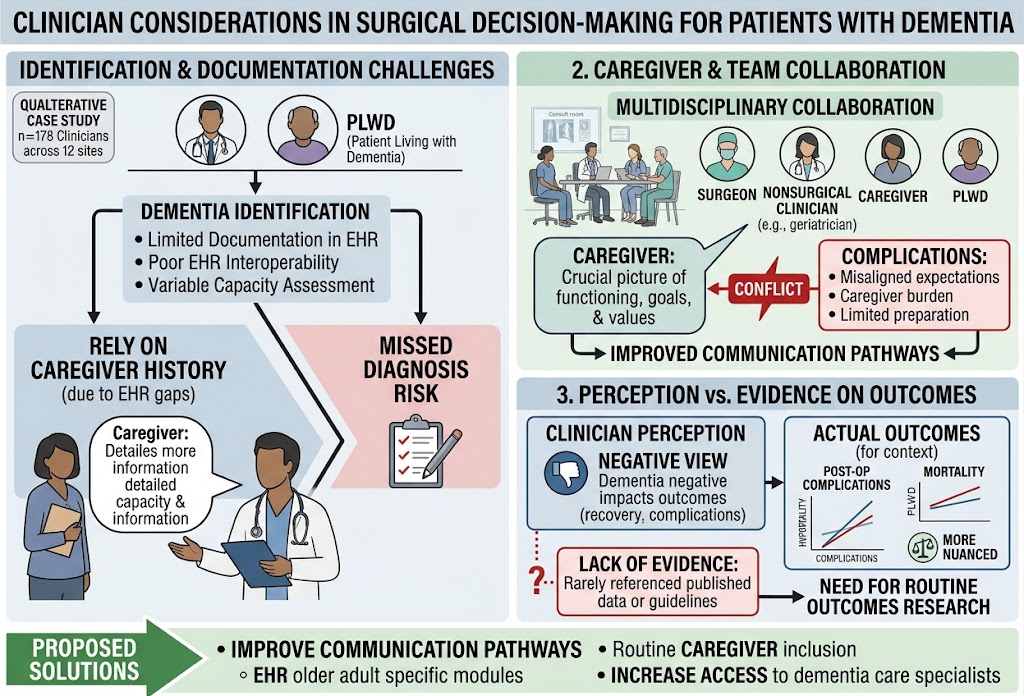
Highlight
- Clinicians often struggle to identify dementia and assess decision-making capacity in surgical settings due to limited documentation and resource constraints.
- Caregivers and nonsurgical clinicians are crucial partners in the surgical decision process, yet mismatched expectations and caregiver burden complicate outcomes.
- There is widespread clinician perception of dementia adversely impacting surgical outcomes, despite limited reliance on evidence or clinical guidelines during decision-making.
- Improved EHR documentation, interdisciplinary coordination, and caregiver inclusion are recommended to optimize surgical care for people living with dementia (PLWD).
Study Background
The rising global prevalence of dementia poses significant challenges across healthcare domains, including surgical care. People living with dementia (PLWD) often require surgical interventions, yet cognitive impairment complicates risk assessment, consent processes, and postoperative recovery. Clinicians, caregivers, and patients face complex clinical, ethical, and psychosocial dilemmas weighing surgical benefits against potential harms amid cognitive decline. Despite this clinical imperative, little research has addressed how dementia influences surgical decision-making from the clinician’s perspective, nor how systems might better support these high-stakes decisions.
Study Design
This qualitative study synthesized data from interviews, surveys, and resource reviews involving 178 clinicians (64 surgeons, 100 nonsurgical clinicians, and 14 hospital leaders) across 12 diverse healthcare sites. Interviews were conducted from November 2021 to May 2023, with data analysis extending through December 2024. The primary focus was to explore clinicians’ experiences when making surgical decisions involving patients with dementia. The exposure of interest was participation in a single semi-structured interview designed to elicit themes around dementia recognition, caregiver involvement, decision capacity assessment, and outcome considerations in the surgical context.
Key Findings
Three principal themes emerged from analysis:
1. Challenges in Dementia Identification and Capacity Assessment
Clinicians reported significant barriers to identifying dementia reliably in surgical settings. Key issues included inconsistent or absent documentation of cognitive status within electronic health records (EHRs), and poor interoperability between different health systems’ records. These gaps hinder clinicians’ ability to ascertain dementia diagnosis or assess decisional capacity prior to surgery. Without standardized cognitive assessments or clear documentation, surgical teams often rely on informal clinical impressions, increasing uncertainty in risk-benefit deliberations.
2. The Central Role and Complexities of Caregiver Involvement
Given the documentation limitations, caregivers and nonsurgical clinicians were frequently essential informants on patients’ cognitive and physical functioning, as well as their personal values and treatment preferences. However, clinicians noted challenges with caregiver involvement, including misalignment about surgical goals, caregiver burden, and a lack of preparation or support for caregivers participating in complex decision discussions. Moreover, variability in caregiver availability or engagement affected the quality of shared decision-making.
3. Variable Perceptions of Dementia’s Impact on Surgical Outcomes
Clinician attitudes toward dementia broadly influenced surgical decision-making. Most participants viewed dementia as detrimental to postoperative recovery and overall outcomes but seldom referenced published data or formal guidelines to support these views. This suggests that clinical practice relies heavily on experiential judgment rather than standardized evidence-based frameworks when assessing surgical suitability for PLWD. Consequently, decisions may be inconsistently applied and potentially biased by subjective clinician perceptions.
Expert Commentary
The study underscores that the clinical management of PLWD facing surgery is hampered by systemic, informational, and interpersonal gaps. Effective surgical decision-making requires accurate diagnosis and capacity assessment, yet these remain inadequately supported in many institutions. The reliance on caregivers as essential sources of insight highlights the need to formally integrate caregiver perspectives while providing them with education and psychosocial support to mitigate burden.
Moreover, the disconnect between clinician beliefs about dementia and surgical risk and the limited use of evidence-based protocols suggests an urgent need for development and dissemination of clear guidelines. Such guidelines could standardize risk stratification and optimize surgical candidacy assessments.
Interdisciplinary collaboration involving geriatricians, neurologists, surgeons, anesthesiologists, and primary care providers is a promising approach to improving care coordination and decision-making. Incorporating cognitive assessments routinely within perioperative workflows and enhancing EHR documentation interoperability would also facilitate more informed care planning.
Conclusion
This qualitative study reveals considerable challenges clinicians face when making surgical decisions for patients with dementia. These challenges stem from poor recognition and documentation of dementia, variable involvement of caregivers, and reliance on subjective clinical judgment in the absence of robust evidence. Addressing these issues requires systemic improvements: better EHR interoperability and cognitive assessment integration, structured inclusion of caregivers, access to dementia care specialists, and clear evidence-based surgical decision support tools. Advancing these interventions will promote more informed, ethical, and patient-centered surgical care for the growing population of PLWD.
Funding and ClinicalTrials.gov
No specific funding information or clinical trial registration was reported for this qualitative study.
References
1. Adler RR, Chunga RE, Centracchio JA, et al. Clinician Considerations Regarding Surgical Decision-Making in the Context of Dementia. JAMA Surg. Published online August 19, 2026. doi:10.1001/jamasurg.2026.16509
2. Bellelli G, et al. Delirium and cognitive screening among older surgical patients. J Am Geriatr Soc. 2019;67(7):1344-1350.
3. Dressler D, Martin FC. Surgery in older patients with dementia: challenges and solutions. Clin Interv Aging. 2020;15:193-202.
4. Hubbard RE, O’Mahony MS, Savva GM. Systems approaches to reduce risks for delirium in surgical patients with dementia. Age Ageing. 2020;49(3):369-375.
5. American Geriatrics Society. Surgical decision-making in older adults with cognitive impairment: clinical guidelines, 2023.