Highlight
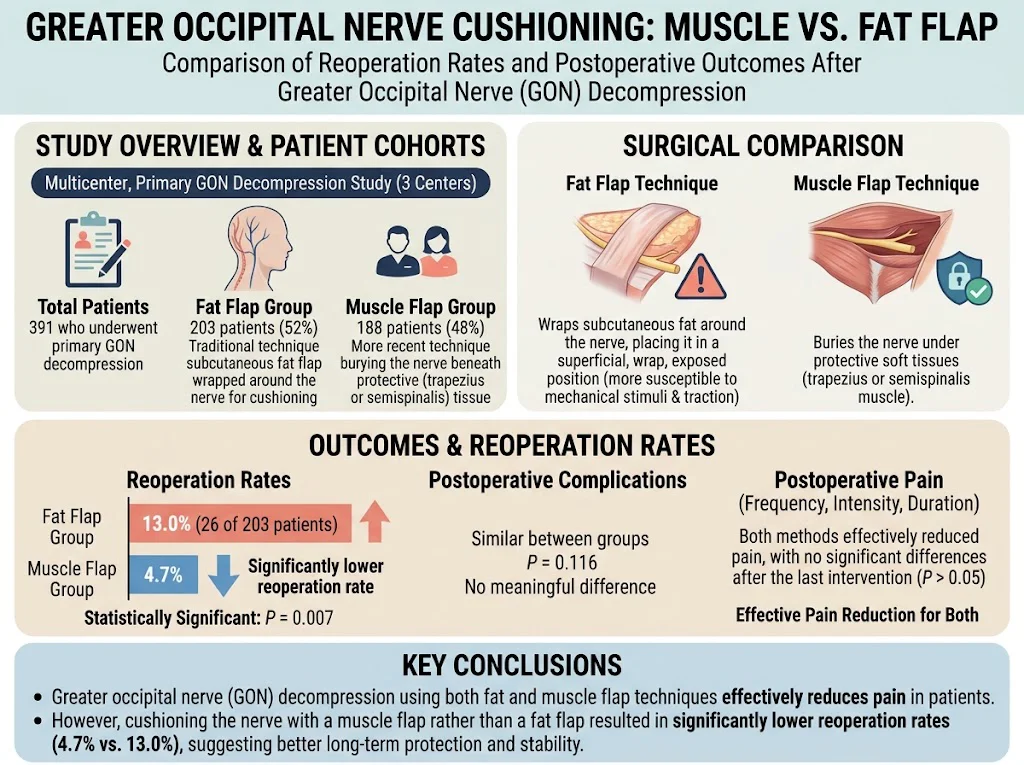
This multicenter study compares greater occipital nerve (GON) decompression using two different cushioning techniques: a traditional subcutaneous fat flap versus a muscle flap to position the nerve beneath protective soft tissues. Both approaches effectively reduced pain intensity, frequency, and duration postoperatively. However, the muscle flap technique was associated with a significantly lower reoperation rate (4.7%) compared to the fat flap group (13%), without differences in complication rates. These findings suggest superior long-term outcomes with muscle flap cushioning in GON decompression surgery.
Study Background
Chronic occipital headaches and occipital neuralgia present significant clinical challenges due to refractory pain caused by compression or irritation of the greater occipital nerve (GON). Surgical decompression is an established intervention for appropriately selected patients. The technique, initially described with a subcutaneous fat flap wrapped around the nerve to provide cushioning against mechanical irritation, has been utilized extensively. Nonetheless, this approach exposes the nerve closer to the skin surface, possibly increasing susceptibility to mechanical traction or repetitive trauma, which may lead to persistent or recurrent symptoms necessitating reoperation.
Emerging techniques advocate for positioning the GON underneath muscular structures such as the trapezius or semispinalis muscles to safeguard the nerve under more protective soft tissue layers. This anatomical repositioning theoretically reduces mechanical stress and improves outcomes. Despite these conceptual advantages, comparative data on clinical efficacy, safety, and reoperation rates between fat versus muscle flap coverage in GON decompression remains sparse.
Study Design
This study prospectively evaluated 391 patients undergoing primary GON decompression across three centers. Two groups were identified based on intraoperative technique: 203 patients received traditional nerve cushioning with a subcutaneous fat flap, while 188 had the nerve buried and cushioned under a muscle flap involving the trapezius or semispinalis muscle. Data on preoperative and postoperative pain parameters—frequency, intensity, and duration—were collected prospectively, alongside retrospective manual chart review to identify surgical complications and reoperation rates.
The primary endpoint focused on comparing reoperation rates, with secondary endpoints including postoperative pain characteristics and complication incidence. Statistical analyses were conducted to assess significance and clinical relevance of observed differences.
Key Findings
Both fat and muscle flap groups demonstrated effective pain relief following GON decompression, with no significant differences in postoperative pain intensity, frequency, or duration at final follow-up (P > 0.05). Importantly, the overall complication rate did not differ significantly between the two groups (P = 0.116), affirming comparable procedural safety.
A statistically significant difference was observed in the reoperation rate: 13% (26/203) in the fat flap group compared to 4.7% (9/188) in the muscle flap group (P = 0.007). This suggests that muscle flap cushioning may confer more durable nerve protection and reduce the likelihood of recurrent symptoms or complications necessitating further surgery.
The lower reoperation rate in the muscle flap cohort likely reflects anatomical and biomechanical advantages. By positioning the nerve beneath robust muscle layers, the nerve is shielded from external mechanical stimuli, minimizing traction and repetitive injury compared to a more superficial fat flap placement.
Expert Commentary
The findings provide valuable clinical insight into optimizing surgical technique for GON decompression. While fat flap wrapping remains an effective approach, the reduced reoperation rate with muscle flap cushioning addresses a crucial clinical concern—long-term durability of nerve protection. This study underscores the importance of considering not only immediate pain relief but also the biomechanical environment surrounding the decompressed nerve.
However, limitations include the observational design, potential selection biases due to surgical preference and expertise, and lack of long-term follow-up beyond immediate postoperative outcomes. Future randomized controlled trials with extended follow-up would strengthen evidence and further elucidate the relative benefits of these techniques. Additionally, mechanistic studies using imaging or intraoperative nerve monitoring may clarify how muscle coverage affects nerve resilience.
Conclusion
For patients undergoing greater occipital nerve decompression, cushioning the nerve with a muscle flap positioned beneath the trapezius or semispinalis muscle yields comparable pain relief to traditional fat flap techniques but significantly lowers reoperation rates. These data support adopting the muscle flap approach as a preferred surgical strategy to enhance long-term outcomes and reduce the need for additional interventions. Surgeons should weigh anatomical considerations and patient-specific factors when choosing the optimal cushioning technique for GON decompression.
Specialty calculators
For clinical reference; use professional judgment.