Study Background
Psoriasis is a chronic inflammatory skin disease often requiring systemic immunomodulatory therapies, including biologics targeting interleukin-17 and interleukin-23. While such therapies have revolutionized psoriasis management, their immunosuppressive effects raise concerns about latent tuberculosis infection (LTBI) reactivation, particularly in regions with a high tuberculosis burden such as China. Current expert guidelines, including the 2022 North American Psoriasis Foundation (NPF)/International Psoriasis Council (IPC) statement, recommend against routine TB screening for IL-17/IL-23 inhibitors in low-TB-burden settings, given the low risk and costs involved. However, in high-burden countries, routine elimination of tuberculosis screening may not be safe, necessitating strategies to identify psoriasis patients at elevated risk for latent or active TB prior to biologic therapy initiation.Study Design
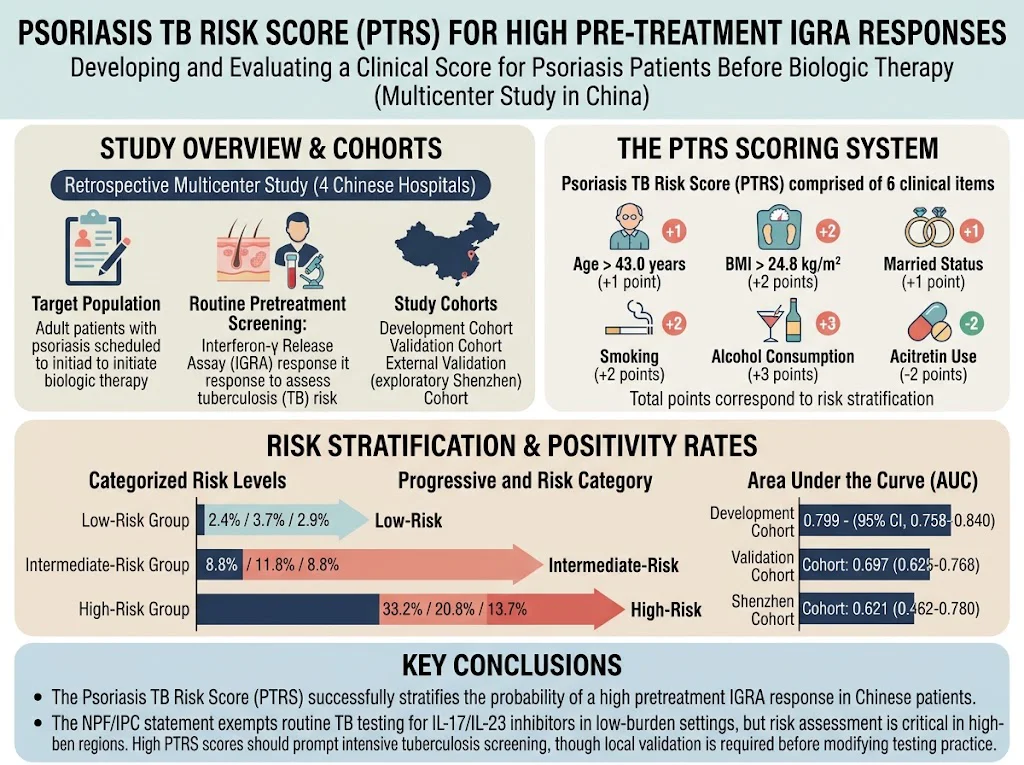
This multicenter retrospective study was conducted across four Chinese hospitals, enrolling adult patients diagnosed with psoriasis who were scheduled to begin biologic therapy and had undergone pretreatment tuberculosis screening using interferon-gamma release assays (IGRAs). The objective was to develop and externally validate a clinical risk score estimating the probability of a high pretreatment IGRA response, an indicator of latent TB infection. Logistic regression modeling identified clinical factors associated with high IGRA positivity and informed score development. Separate cohorts were used for development, internal validation, and external validation, including a geographically distinct Shenzhen cohort to test the score’s generalizability.Key Findings
The study developed the Psoriasis TB Risk Score (PTRS) incorporating six predictive clinical variables: 1. Age >43 years (+1 point) 2. Body Mass Index (BMI) >24.8 kg/m2 (+2 points) 3. Married status (+1 point) 4. Smoking (+2 points) 5. Alcohol consumption (+3 points) 6. Acitretin use (-2 points) The PTRS demonstrated good discriminatory ability in the development cohort with an area under the receiver operating characteristic curve (AUC) of 0.799 (95% confidence interval [CI], 0.758–0.840). In internal validation cohorts, the AUC was slightly lower, at 0.697 (95% CI, 0.625–0.768), and further declined to 0.621 (95% CI, 0.462–0.780) in the external Shenzhen cohort, indicating some limitation in geographic generalizability. Using established PTRS cut-offs, patients were stratified into low-, intermediate-, and high-risk groups, correlating with increasing rates of high IGRA positivity: – Development cohort: 2.4%, 8.8%, and 33.2%, respectively – Internal validation cohort: 3.7%, 11.8%, and 20.8%, respectively – External validation cohort: 2.9%, 8.8%, and 13.7%, respectively These findings indicated that the PTRS could effectively stratify Chinese psoriasis patients by their likelihood of latent TB infection as measured by IGRA positivity prior to biologic therapy initiation.Expert Commentary
The PTRS represents a practical clinical tool addressing a significant gap in managing psoriasis patients in high TB burden regions. By integrating accessible clinical variables with a weighted scoring system, the PTRS enables clinicians to identify patients most likely to have a high IGRA response and thus warrant thorough TB screening and potential prophylaxis before starting biologics. However, several limitations warrant consideration. The retrospective design precludes causal inference and outcomes assessment regarding actual TB reactivation rates post-biologic therapy. Furthermore, the decline in performance in the external Shenzhen cohort suggests regional variability in TB epidemiology and host factors, reinforcing the need for local validation before widespread clinical adoption. Additionally, while the PTRS includes acitretin use as a negative predictor, the biological rationale of this finding requires further investigation. Current international guidelines may not fully account for regional burden and risk factors; tools like the PTRS could enhance personalized medicine approaches in dermatology and infectious disease management. Prospective studies assessing whether PTRS-guided screening modifies TB reactivation outcomes are needed.Conclusion
The Psoriasis TB Risk Score (PTRS) developed and externally validated in this Chinese multicenter study offers a novel clinical approach to stratify psoriasis patients by risk of significant latent TB infection, as indicated by IGRA positivity, prior to initiation of biologic therapies. Its implementation could optimize TB screening resource allocation in high-burden areas, potentially improving patient safety. Nonetheless, local validation is crucial due to geographic variability, and prospective longitudinal data are needed to confirm the clinical utility of PTRS-guided strategies in preventing TB reactivation in psoriasis patients under biologic immunomodulation.Funding and Trial Registration
The original article did not report specific funding details or clinical trial registration numbers.References
1. Xu Z, Wang J, Chen W, et al. Development and External Evaluation of a Clinical Score for High Pretreatment Interferon-γ Release Assay Responses in Psoriasis: A Multicenter Study in China. J Am Acad Dermatol. 2026 Nov 2. PMID: 42971476. 2. Singh JA, et al. 2022 NPF/IPC Consensus: Tuberculosis Screening and Treatment Prior to Biologic Therapy in Psoriasis. J Am Acad Dermatol. 2023;88(3):555-566. 3. World Health Organization. Global Tuberculosis Report 2023. Geneva: WHO; 2023. 4. Al Janahi NA, et al. Safety of IL-17 and IL-23 inhibitors in patients with latent tuberculosis: A Systematic Review. Dermatol Ther. 2022;35(1):e15112. 5. Kim JH, et al. Interferon-Gamma Release Assays for Latent Tuberculosis Screening in Patients with Immune-Mediated Inflammatory Diseases: A Meta-Analysis. Clin Infect Dis. 2021;73(3):528-537.Specialty calculators
For clinical reference; use professional judgment.