Highlight
- Facility-level ICU patient volume correlates inversely with in-hospital mortality when focusing on patients with higher severity of illness.
- This inverse volume-outcome relationship becomes stronger as the severity threshold measured by SOFA scores increases.
- Overall ICU patient volume, without stratifying by severity, shows no significant impact on mortality.
- Implications suggest that higher experience and resources at centers treating more critically ill patients contribute to better survival outcomes.
Study Background
The burden on intensive care units (ICUs) continues to increase worldwide due to rising numbers of critically ill patients with complex medical needs. Prior research generally suggests that hospitals with higher ICU patient volumes tend to achieve better clinical outcomes, possibly due to greater provider expertise, protocols, and resources. However, these studies often consider overall ICU volume without adequately stratifying by patient severity, which can drive prognosis. The Sequential Organ Failure Assessment (SOFA) score is a well-established tool to quantify severity of organ dysfunction in critically ill patients and predict mortality. Understanding how ICU volume interacts with patient severity as measured by SOFA score is critical to optimizing care delivery models and improving survival. This study addresses the gap by evaluating the relationship between facility-level ICU volume and in-hospital mortality, stratified by varying patient severity thresholds using SOFA scores.Study Design
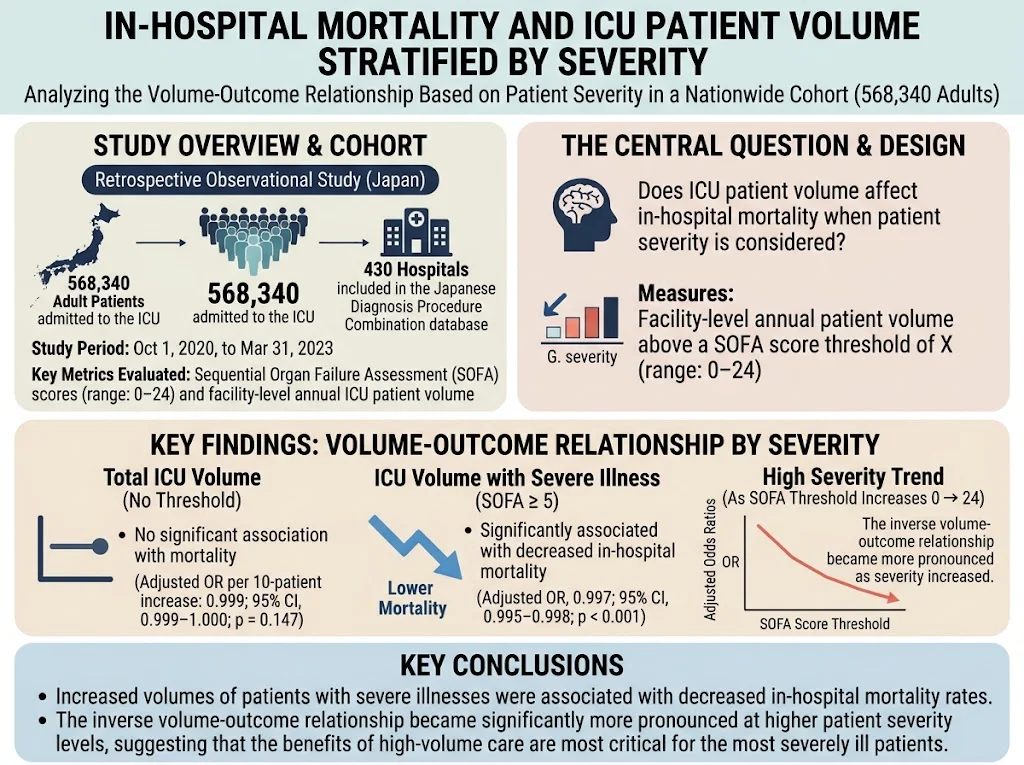
This retrospective observational study utilized a large, nationwide Japanese Diagnosis Procedure Combination inpatient database from October 1, 2020, to March 31, 2023. The cohort included 568,340 adult patients admitted to ICUs across 430 hospitals in Japan. No interventions were introduced as this was an observational data analysis. Primary outcome assessed was in-hospital mortality. The facility-level annual patient volume was calculated using SOFA score thresholds ranging from 0 to 24, representing increasing illness severity. Using multilevel mixed-effects logistic regression models, the authors examined associations between patient volumes above each SOFA score cutoff and mortality, adjusting for patient-level factors and hospital clustering effects.Key Findings
The study revealed that total ICU patient volume, when not stratified by severity, had no statistically significant association with in-hospital mortality (adjusted odds ratio [OR] per 10-patient increase: 0.999, 95% confidence interval [CI]: 0.999–1.000; p=0.147). However, when focusing on patients with SOFA scores above a threshold of 5, increasing facility-level ICU volume was significantly associated with decreased mortality (OR 0.997, 95% CI 0.995–0.998; p<0.001). Notably, as the SOFA threshold increased, the strength of this inverse volume-outcome relationship intensified; adjusted ORs progressively decreased, indicating that hospitals managing a higher volume of more severely ill patients tend to have better survival outcomes. This pattern suggests that the beneficial effect of patient volume on mortality is most pronounced among critically ill patients with substantial organ dysfunction, consistent with the hypothesis that experience and resource concentration improve care quality in this subgroup.Expert Commentary
These findings provide important evidence for healthcare policy and hospital ICU management strategies. While volume-outcome associations have been noted previously, this study refines understanding by incorporating patient severity, indicating that high ICU volume is particularly advantageous in managing very sick patients. This could reflect more specialized staffing, better multidisciplinary teams, and established protocols tailored to manage severe organ failures effectively. However, limitations intrinsic to retrospective database studies apply, including residual confounding and inability to assess detailed clinical management factors that may mediate outcomes. Further prospective studies validating these findings and exploring specific processes driving improved outcomes in higher-volume centers would be valuable. Additionally, the study’s generalizability outside Japan may require consideration given differences in healthcare systems. Despite these caveats, the graded volume-effect relationship stratified by SOFA score provides a compelling rationale for centralizing care of severely ill patients to higher volume ICUs when feasible.Conclusion
This large-scale nationwide study demonstrates that increasing ICU patient volume correlates with reduced in-hospital mortality, notably among patients with higher SOFA scores indicating greater severity of illness. The strength of the inverse relationship escalates with increasing severity threshold, emphasizing the importance of experience and resource allocation in managing critically ill populations. These findings support healthcare strategies that focus on concentrating care for the sickest ICU patients in higher-volume centers to optimize survival outcomes.Funding and Clinical Trials Registration
No specific funding or clinical trial registration was reported for this observational database study.References
1. Sato T, Sasabuchi Y, Miyamoto Y, et al. Association Between In-Hospital Mortality and ICU Patient Volume at the Facility-Level Stratified by Severity. Crit Care Med. 2026;54(11):2847-2855. PMID: 42554605. 2. Vincent JL, Moreno R, Takala J, et al. The SOFA (Sepsis-related Organ Failure Assessment) score to describe organ dysfunction/failure. Intensive Care Med. 1996;22(7):707-10. 3. Wunsch H, Angus DC, Harrison DA, et al. Variation in Critical Care Services Across North America and Western Europe. Crit Care Med. 2008;36(10):2787-93. 4. Kahn JM, Goss CH, Heagerty PJ, et al. Hospital volume and the outcomes of mechanical ventilation in the United States. Am J Respir Crit Care Med. 2006;174(10):1197-204. 5. British Thoracic Society. Guidelines on the management of intensive care units. BMJ. 2011;343:d6701.Specialty calculators
For clinical reference; use professional judgment.