Highlight
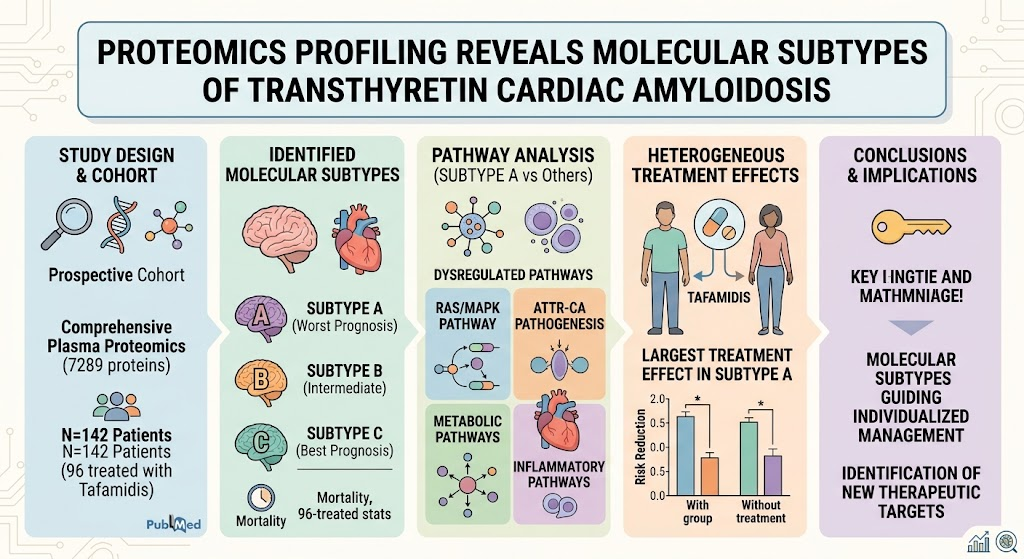
- Identification of three distinct molecular subtypes of transthyretin cardiac amyloidosis (ATTR-CA) via plasma proteomics.
- These subtypes show differential survival risks independent of traditional clinical staging.
- Tafamidis treatment efficacy varies significantly across subtypes, with greatest benefit in the worst prognosis group.
- Molecular pathways implicated include Ras/MAPK signaling and metabolic-inflammation dysregulation, suggesting pathogenetic heterogeneity.
Study Background
Transthyretin cardiac amyloidosis (ATTR-CA) is an underdiagnosed, progressive infiltrative cardiomyopathy caused by deposition of misfolded transthyretin protein fibrils in the myocardium. The resulting cardiac dysfunction leads to heart failure with preserved ejection fraction and arrhythmias, imposing a significant clinical burden especially in the elderly population. Therapeutic advances, notably the disease-modifying agent tafamidis, which stabilizes transthyretin tetramers to prevent amyloid formation, have improved outcomes but clinical responses vary substantially. This suggests underlying biological heterogeneity in ATTR-CA pathogenesis and disease progression that remains poorly characterized. Such heterogeneity could inform personalized management strategies including risk stratification and optimizing tafamidis use. The study’s aim was to define molecular subtypes of ATTR-CA through unbiased plasma proteomic profiling and evaluate subtype-specific prognosis and response to tafamidis in a well-phenotyped prospective cohort.
Study Design
This investigation analyzed plasma samples from 142 prospectively enrolled patients with ATTR-CA at Columbia University, with comprehensive follow-up (median 5.2 years). Proteomic profiling measured 7,289 plasma proteins via high-throughput platforms. Unsupervised machine learning techniques clustered patients based on their plasma proteomic signatures into molecular subtypes, independent of clinical parameters or traditional staging systems. Clinical data including age, sex, TTR genotype (hereditary vs wild type), medication exposures, and survival were rigorously collected. Ninety-six patients received tafamidis as treatment. The primary endpoint was all-cause mortality risk across subtypes. Secondary analyses included estimating tafamidis treatment effect within each subtype after adjusting for confounders. Pathway enrichment analyses compared protein expression profiles of the worst prognosis subtype against others to elucidate underlying pathogenic mechanisms.
Key Findings
The proteomic data segregated the cohort into three distinct molecular subtypes, designated A (n=49), B (n=38), and C (n=55). These subtypes did not differ significantly by conventional clinical staging or demographic factors, highlighting the added granularity of proteomics classification.
Survival analysis revealed significant heterogeneity: subtype A exhibited the highest mortality risk, followed by subtype B and then subtype C (log-rank P=0.035). Adjusted hazard ratios for mortality showed subtype A had nearly double the risk compared to subtype C (HR 1.95, 95% CI 1.03–3.66; P=0.04).
Critically, tafamidis treatment effect was not uniform across subtypes. The greatest survival benefit was observed in subtype A, with tafamidis associated with a 76% reduction in mortality risk compared to no treatment within this group (adjusted HR 0.24, 95% CI 0.10–0.55). Interaction testing confirmed a significant heterogeneity of treatment response (P=0.001). This differential effect suggests baseline molecular milieu modulates tafamidis efficacy.
Pathway analyses identified that subtype A was characterized by dysregulated Ras/MAPK signaling, metabolic disturbances, and inflammatory pathways previously implicated in ATTR-CA pathogenesis. These insights suggest that this subtype reflects a biologically aggressive and potentially tafamidis-responsive phenotype.
Expert Commentary
This study represents a pioneering application of large-scale plasma proteomics integrated with advanced machine learning to dissect molecular heterogeneity in ATTR-CA. Prior classification systems relied heavily on clinical staging and genotype; however, these lack precision to predict treatment response effectively.
The discovery of three molecular subtypes unveils a new dimension of biological stratification that could transform clinical risk assessment and therapeutic decisions. Particularly noteworthy is the identification of subtype A as both high risk and highly amenable to tafamidis, emphasizing the clinical imperative to identify such phenotypes early.
Mechanistically, the involvement of Ras/MAPK and inflammatory pathways aligns with emerging evidence on the complex network of signaling disruptions contributing to amyloidogenesis and myocardial injury. These findings invite exploration of adjunctive pathway-modulating therapies tailored to specific molecular profiles.
Limitations include the moderate sample size and single-center design, which may affect generalizability. Additionally, proteomic profiling was performed at a single time point, and dynamic changes with disease progression or therapy require further study. Confirmation of these molecular subtypes and treatment heterogeneity in larger, multi-ethnic cohorts and in randomized controlled settings is warranted.
Conclusion
Comprehensive plasma proteomics profiling identified distinct molecular subtypes of transthyretin cardiac amyloidosis that predict differential prognosis and response to tafamidis treatment beyond conventional clinical staging. The high-risk subtype with activated Ras/MAPK and inflammatory/metabolic pathways demonstrated the greatest survival benefit from tafamidis, underscoring the potential for personalized medicine approaches in ATTR-CA. Future integration of molecular subtype classification into clinical practice could optimize risk stratification and guide therapeutic selection, improving patient outcomes in this challenging disease.
Funding and Registration
This study was conducted at Columbia University and funded by institutional and NIH grants (detailed information not provided in the original article). Clinical trial information was not specified.
References
1. Osawa I, Teruya SL, Bampatsias D, Mirabal A, Maurer MS, Shimada YJ. Proteomics Profiling Reveals Molecular Subtypes of Transthyretin Cardiac Amyloidosis. Circulation. Heart failure. 2026 Sep 10:e012449. PMID: 42717880.
2. Maurer MS, Schwartz JH, Gundapaneni B, et al. Tafamidis Treatment for Patients with Transthyretin Amyloid Cardiomyopathy. N Engl J Med. 2018;379(11):1007-1016.
3. Gillmore JD, Gane E, Taubel J, et al. CRISPR-Cas9 In Vivo Gene Editing for Transthyretin Amyloidosis. N Engl J Med. 2021;385(6):493-502.