Highlights
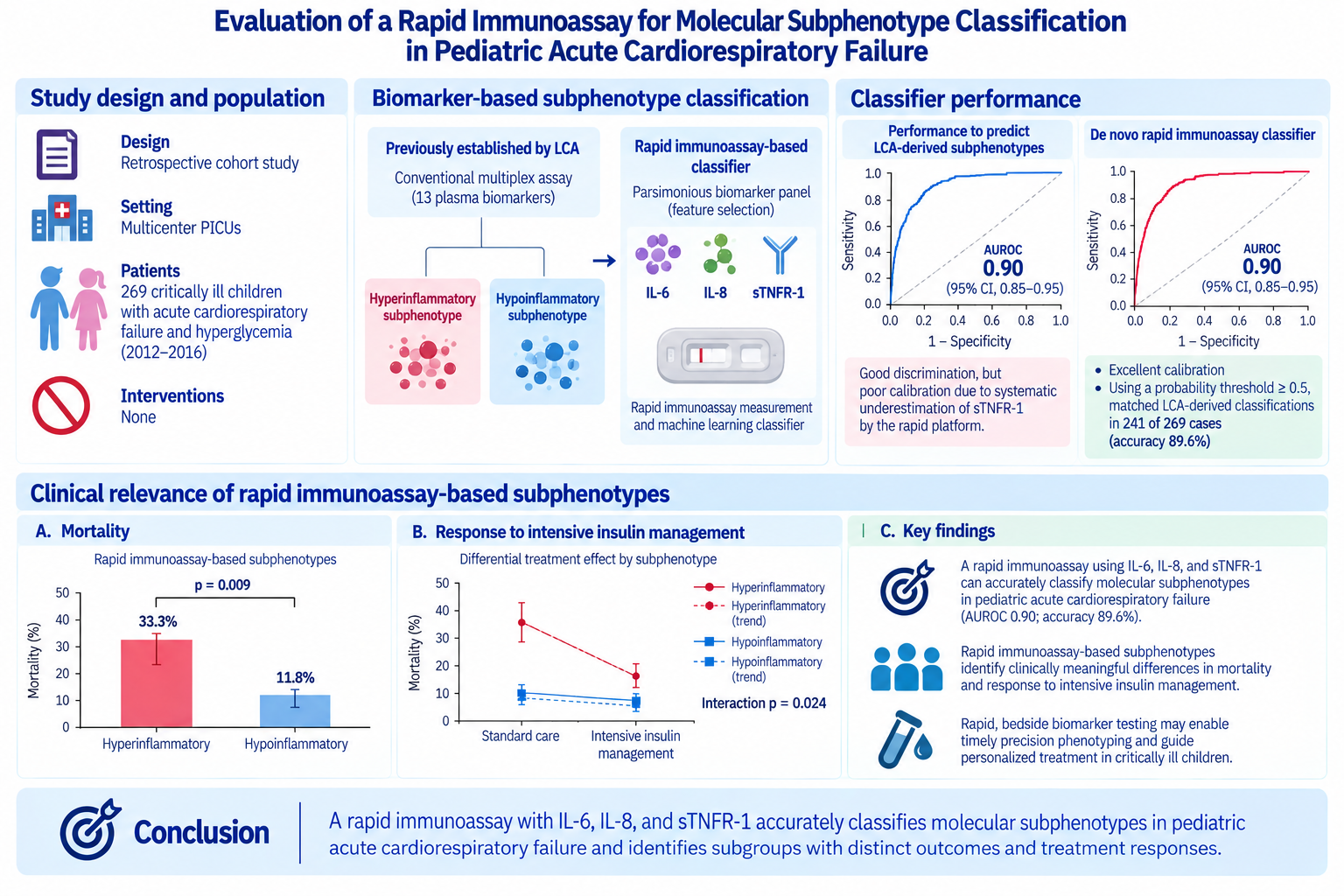
- Rapid immunoassays using IL-6, IL-8, and sTNFR-1 enable prompt classification of molecular subphenotypes in pediatric acute cardiorespiratory failure.
- A novel rapid immunoassay-based classifier approximates latent class analysis (LCA) subphenotypes with high accuracy (~90%) and excellent calibration.
- Subphenotype classification by rapid assay correlates with mortality differences and identifies children who benefit from intensive insulin management, underscoring precision medicine potential.
- Operational advantages of rapid immunoassays facilitate integration of biomarker-guided strategies into multicenter critical care settings.
Background
Pediatric acute cardiorespiratory failure remains a critical syndrome with significant mortality and morbidity in pediatric intensive care units (PICUs). Hyperglycemia is frequently observed and linked to adverse outcomes, complicating management in this vulnerable population. Recent advances highlight biological heterogeneity within such syndromes, where molecular subphenotypes—distinguished by distinct biomarker profiles rather than clinical phenotype alone—may guide tailored therapeutics to improve outcomes. Latent class analysis (LCA) of plasma biomarkers has delineated hyperinflammatory and hypoinflammatory classes, exhibiting differential prognoses and treatment responses, particularly regarding intensive insulin management. However, conventional multiplex biomarker assays pose logistical impediments for real-time clinical application, requiring complex sample handling and extended assay durations.
Accurate, rapid biomarker quantification is vital to operationalize subphenotype-based precision medicine in acute pediatric critical illness. This review synthesizes evidence from recent studies evaluating rapid immunoassays’ suitability for biomarker measurement, classifier performance, and clinical outcome correlations in pediatric patients with acute cardiorespiratory failure and hyperglycemia.
Key Content
Evolution of Biomarker-Based Molecular Subphenotyping
Earlier investigations employed conventional multiplex assays measuring panels of 13 plasma proteins to identify biologically distinct hyperinflammatory and hypoinflammatory subphenotypes via LCA. These classes exhibited divergent clinical trajectories and responses to intensive insulin treatment, delineating a framework for targeted interventions.
However, the complexity and turnaround time of conventional platforms hinder prospective, bedside subphenotyping essential for clinical trials or therapeutic decisions. This gap motivated assessment of rapid immunoassays requiring minimal handling and providing expedited biomarker quantification.
Methodological Advances: Comparison of Platforms
The pivotal 2026 retrospective multicenter cohort study by Sallee et al. (PMID: 42704284) re-assayed plasma samples from 269 hyperglycemic critically ill children using a rapid immunoassay platform. Compared with prior conventional multiplex measurements, rapid immunoassays displayed strong correlations for IL-6, IL-8, and sTNFR-1 (Pearson r = 0.87–0.93). Notably, the rapid platform systematically underestimated sTNFR-1 concentrations, affecting cross-platform calibration.
Applying a parsimonious classifier developed on multiplex data—incorporating just IL-6, IL-8, and sTNFR-1—directly to rapid immunoassay values yielded an AUROC of 0.90 (95% CI 0.85–0.95) confirming strong discriminative ability. Yet, calibration was suboptimal due to biomarker measurement biases.
To overcome this, a de novo classifier trained on rapid immunoassay data underwent internal validation by bootstrapping, also achieving an AUROC of 0.90 (95% CI 0.86–0.95) with excellent calibration. Using a threshold probability ≥0.5, this classifier matched LCA-derived subphenotypes with 89.6% accuracy (241/269 cases), demonstrating reliable reproducibility.
Clinical Implications: Prognostic and Predictive Utility
Rapid immunoassay-defined hyperinflammatory subphenotypes displayed significantly higher mortality compared to hypoinflammatory counterparts (33.3% vs. 11.8%; p = 0.009), consistent with prior observations using conventional assays. Moreover, these subphenotypes predicted heterogeneous treatment effects of intensive insulin therapy, with a statistically significant interaction (p = 0.024), affirming clinical relevance.
The feasibility of rapid biomarker quantification and parsimonious molecular classification supports integration of subphenotype identification into real-time clinical workflows and prospective precision medicine trials in pediatric critical care.
Expert Commentary
Sallee et al.’s work represents a critical advance in translating molecular subphenotyping from research settings to practicable bedside tools. The successful adaptation of an LCA-derived multi-biomarker signature onto an expedited, minimally handled rapid immunoassay platform showcases technological and operational feasibility. This approach addresses a key barrier to deploying precision therapeutics in critical care: timely identification of distinct biological endotypes during the initial patient evaluation.
The study’s identification of strong biomarker correlations across platforms despite measurement scale differences underscores the importance of platform-specific calibration for classifier accuracy. The systematic underestimation of sTNFR-1 by the rapid assay highlights challenges in assay standardization that must be considered when implementing classifiers clinically.
Clinically, confirmation that rapid immunoassay-based subphenotypes preserve prognostic differentiation and predictive treatment response highlights the potential to enrich future clinical trials and to individualize therapies such as insulin management. This aligns with growing evidence that hyperinflammatory subphenotypes benefit from tailored interventions whereas hypoinflammatory groups may have different trajectories or therapeutic needs.
Limitations include retrospective design, limiting generalizability, and the need for external validation across broader cohorts and diverse PICU settings. Future efforts should focus on prospective validation, integration with electronic health records, and assessment of feasibility in real-time clinical decision-making.
The mechanistic rationale for selected biomarkers—IL-6 and IL-8 as pro-inflammatory cytokines mediating immune activation, and sTNFR-1 reflecting TNF pathway activity—supports their robust association with inflammatory phenotypes in critical illness. Their combined prognostic relevance aligns with extensive literature on systemic inflammation in pediatric and adult critical syndromes.
Conclusion
The evaluation of a rapid immunoassay for molecular subphenotype classification in pediatric acute cardiorespiratory failure provides compelling evidence that simplified biomarker panels measured expediently can recapitulate complex latent class structures. This facilitates prognostically meaningful patient stratification and identifies subgroups likely to benefit from intensified insulin therapy.
Operationally, rapid immunoassay platforms promise to overcome key translational hurdles in biomarker-driven critical care medicine, supporting the design and conduct of precision trials. Further prospective validation and real-world implementation studies will refine classifier accuracy, support scalable integration into PICUs, and improve outcomes through biologically informed individualized treatments.
References
- Sallee CJ, Taylor CS, Zinter MS, Markovic D, Lim MJ, Costa Monteiro A, Cortado R, Schwingshackl A, Agus M, Matthay M, Sapru A. Evaluation of a Rapid Immunoassay for Molecular Subphenotype Classification in Pediatric Acute Cardiorespiratory Failure. Crit Care Med. 2026 Sep 7. doi:10.1097/CCM.0000000000007339. PMID: 42704284.
- Sallee CJ, Zinter MS, Taylor CS, et al. Evaluation of a Rapid Immunoassay for Molecular Subphenotype Classification in Pediatric Acute Cardiorespiratory Failure [Preprint]. Research Square. 2025 Sep 23:rs.3.rs-7596498.v1. doi:10.21203/rs.3.rs-7596498.v1. PMID: 41041556.