Highlight
- Teplizumab administration in children and adolescents with newly diagnosed stage 3 type 1 diabetes significantly preserves stimulated C-peptide levels at 78 weeks.
- The treatment leads to a significant reduction in exogenous insulin requirements and increases time in range (TIR) for blood glucose levels compared with placebo.
- Beta cell function preservation by teplizumab is consistent irrespective of HLA-DR3/DR4 haplotype or baseline autoantibody status.
Study Background
Type 1 diabetes (T1D) is an autoimmune condition characterized by progressive destruction of insulin-producing pancreatic beta cells, resulting in lifelong insulin dependence. In children and adolescents, T1D onset is often rapid and associated with significant metabolic instability. Preservation of residual beta cell function early after diagnosis is critical, as it correlates with better glycemic control, reduced hypoglycemia risk, and lower long-term complication rates. Despite advances in insulin therapy, no curative or beta cell-preserving treatments are routinely available in clinical practice.
Immunomodulatory therapies targeting the autoimmune process represent a promising strategy to preserve beta cell function. Teplizumab, an anti-CD3 monoclonal antibody, has demonstrated potential to delay T1D onset in at-risk relatives and to preserve endogenous insulin production in recent-onset patients. The PROTECT trial is a phase 3 randomized, placebo-controlled study evaluating teplizumab’s efficacy and safety in pediatric patients newly diagnosed with stage 3 T1D (post-diagnosis phase with measurable beta cell function) to further validate these benefits.
Study Design
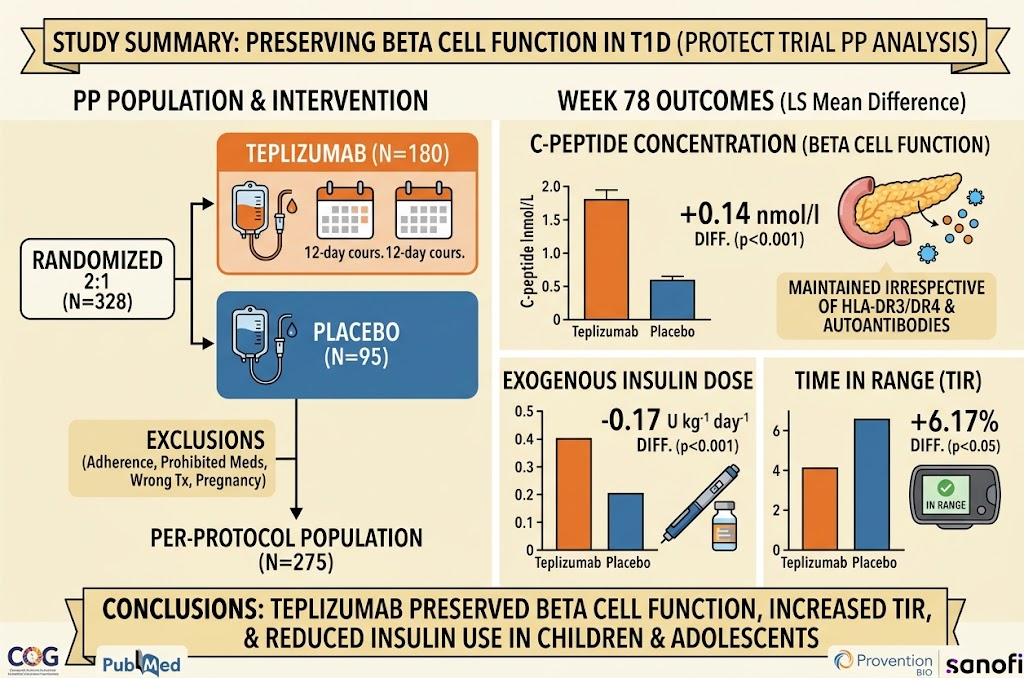
The PROTECT trial enrolled 328 participants aged 8-17 years diagnosed with stage 3 T1D, defined by a peak stimulated C-peptide level of at least 0.2 nmol/l, indicative of residual beta cell activity. Subjects were randomized in a 2:1 ratio to receive two courses of intravenous teplizumab or placebo, each administered over 12 consecutive days. The study’s primary endpoint was the change from baseline in stimulated C-peptide levels at 78 weeks post-treatment initiation, assessed by mixed-meal tolerance test (MMTT).
For the per-protocol (PP) analysis, participants who demonstrated less than 80% adherence to the treatment regimen, used prohibited concomitant medications, received incorrect treatment, or became pregnant were excluded, resulting in 275 evaluable subjects (180 teplizumab, 95 placebo). Subgroup analyses evaluated efficacy relative to HLA-DR3 and HLA-DR4 haplotypes, as well as baseline T1D autoantibody profiles.
Key Findings
The PP analysis confirmed a statistically robust preservation of beta cell function in the teplizumab group compared with placebo. At week 78, the least squares mean difference in stimulated C-peptide concentration change from baseline was 0.14 nmol/l (95% CI 0.10 to 0.18, p<0.001), indicating significantly less decline in endogenous insulin secretion.
Clinically meaningful benefits accompanied this preservation of beta cell function. Participants treated with teplizumab required significantly less exogenous insulin at week 78, with a least squares mean difference of -0.17 U/kg/day (95% CI -0.26 to -0.08, p<0.001). Additionally, teplizumab recipients demonstrated improved glycemic control reflected by a 6.17% increase in time spent within target blood glucose range (TIR) compared to placebo (95% CI 0.13 to 12.2%, p<0.05).
Subgroup analyses revealed that teplizumab’s efficacy was consistent regardless of HLA-DR3 or HLA-DR4 allele presence. Similarly, beta cell function preservation did not vary according to baseline autoantibody status, suggesting broad applicability across pediatric T1D immunophenotypes. Safety outcomes were consistent with prior teplizumab studies, with no new safety signals emerging in this PP cohort.
Expert Commentary
The PROTECT trial’s PP analysis substantiates teplizumab as a promising immunotherapeutic agent capable of modifying the natural history of T1D soon after clinical diagnosis in children and adolescents. Preservation of residual beta cell function conveys numerous benefits, including lower insulin exposure and improved glycemic stability, which align with better quality of life and reduced chronic complication risks.
Important to clinical translation, this study demonstrates efficacy independent of HLA subtype or autoantibody profile, suggesting teplizumab could be broadly offered without molecular stratification. However, the exclusion of participants with poor adherence or protocol deviations in the PP population analysis may introduce bias favoring efficacy. Real-world effectiveness will require further evaluation.
Mechanistically, teplizumab modulates T-cell responses implicated in beta cell autoimmunity by inducing anergy and promoting regulatory phenotypes, thus tempering the autoimmune attack. These immunomodulatory effects likely underpin the durable beta cell preservation observed at 78 weeks.
Limitations of the trial include the relatively short observation period beyond 78 weeks; longer-term data will be critical to assess sustained efficacy and clinical outcomes such as microvascular complications. Moreover, combining teplizumab with other beta cell supportive therapies warrants exploration to optimize residual insulin secretion and glycemic control.
Conclusion
The per-protocol analysis of the PROTECT trial reinforces teplizumab’s efficacy in preserving endogenous beta cell function and improving clinical parameters in pediatric patients newly diagnosed with stage 3 type 1 diabetes. Its benefits transcend HLA and autoantibody-defined subgroups, enhancing its potential applicability in routine clinical practice. These findings signify a substantial advance in early T1D management through immunomodulation, highlighting the need for integration into clinical guidelines and further real-world investigation.
Funding and Clinical Trials Registration
The PROTECT trial was funded by Provention Bio, a Sanofi company. The trial is registered at ClinicalTrials.gov under the identifier NCT03875729.
References
- Herold KC, Dayan CM, Chatenoud L, et al. Preserving beta cell function in children and adolescents with newly diagnosed stage 3 type 1 diabetes: per-protocol population analysis from the PROTECT randomised trial. Diabetologia. 2026 Sep 10; PMID: 42720752.
- Atkinson MA, Eisenbarth GS. Type 1 diabetes: new perspectives on disease pathogenesis and treatment. Lancet. 2001 Jul 7;358(9277):221-9.
- Herold KC, Gitelman SE, Willi SM, et al. Teplizumab improves and stabilizes beta cell function in antibody-positive high-risk individuals. Sci Transl Med. 2019 Mar 6;11(486):eaau3633.
- Orban T, Bundy B, Becker DJ, et al. Costimulation modulation with abatacept in patients with recent-onset type 1 diabetes: a randomized, double-blind, placebo-controlled trial. Lancet. 2011 Jul 9;378(9789):412-9.