Highlight
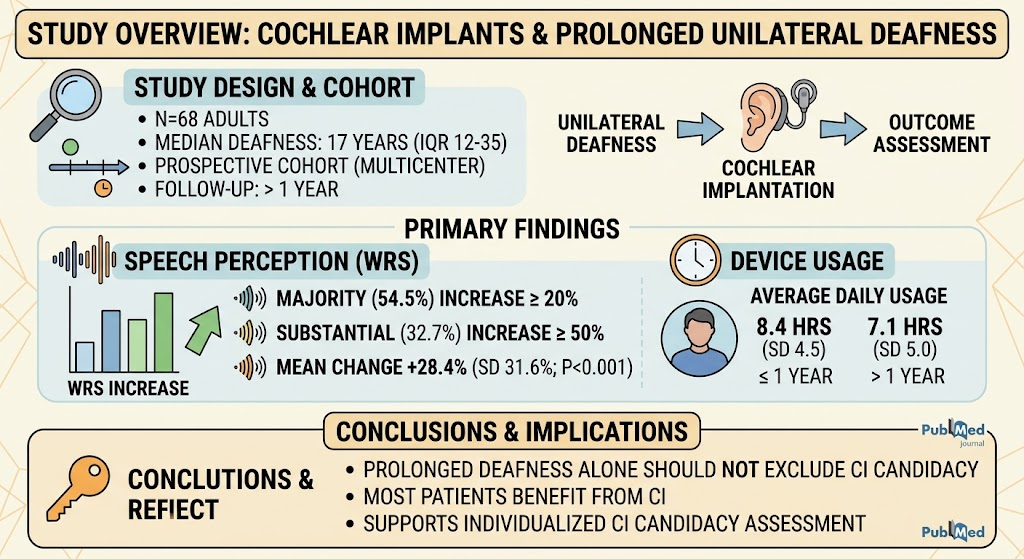
- Adults with unilateral deafness lasting over 10 years show significant improvement in speech recognition after cochlear implantation.
- More than half of the patients had a clinically meaningful increase (≥20%) in word recognition scores post-implantation.
- Cochlear implant usage remains high, averaging over 7 hours daily even beyond one year, indicating sustained benefit and acceptance.
- Duration of deafness alone should not exclude candidacy for cochlear implantation, supporting individualized assessment approaches.
Study Background
Unilateral severe to profound sensorineural hearing loss represents a significant clinical challenge, often resulting in functional difficulties such as impaired sound localization and speech perception in noise, even when the contralateral ear has normal hearing. Cochlear implantation (CI) is an established intervention for bilateral deafness, but its role in prolonged unilateral auditory deprivation has been less clear due to concerns about poor auditory outcomes related to neural degeneration over time. Traditional candidacy criteria often exclude patients with prolonged unilateral deafness, typically greater than 10 years, based on the presumption of limited benefit from CI. This study addresses the unmet need to clarify the effectiveness of cochlear implantation in adults with long-standing unilateral deafness and evaluates both objective speech perception outcomes and real-world device usage across multiple academic centers.
Study Design
This was a retrospective cohort study conducted at five tertiary academic centers involving 68 adult patients with unilateral severe to profound sensorineural hearing loss lasting longer than 10 years (median duration 17 years, interquartile range 12-35 years) who underwent cochlear implantation. The main outcome measures were postoperative word recognition scores (WRS) and average daily CI usage, measured up to and beyond one year following implantation. Statistical analyses included univariate and multivariable models to evaluate predictors of CI performance. The study’s methodology emphasized standardized audiologic assessments and usage monitoring to generate robust clinical data.
Key Findings
The study demonstrated substantial benefits of cochlear implantation in this cohort with prolonged unilateral deafness. The majority (54.5%, 30/55 with complete data) experienced an absolute increase of at least 20% in word recognition scores postoperatively; nearly one-third (32.7%, 18/55) showed an even greater improvement of 50% or more. When comparing pre- and post-implant speech assessments using consistent testing methods, the mean improvement was 28.4% (standard deviation 31.6%), which was both clinically significant and statistically robust (p < 0.001).
Device usage data underscored good patient acceptance and real-world utility, with average daily use of 8.4 hours within the first year post-implantation and sustained usage of 7.1 hours beyond one year. These measures suggest that not only do patients experience perceptual gains, but they also integrate the device into their daily lives effectively.
Interestingly, multivariable analysis revealed that, when accounting for those with postoperative data, duration of deafness was inconsistently predictive of speech perception outcomes, indicating that prolonged auditory deprivation does not uniformly preclude meaningful benefit from CI. This finding challenges traditional candidacy restrictions.
Expert Commentary
This multicenter study provides valuable, practice-changing evidence supporting cochlear implantation for adults with unilateral deafness, even when the hearing loss duration exceeds 10 years. The partial dissociation between auditory deprivation duration and functional outcomes suggests significant individual variability in auditory nerve and central processing plasticity, which may persist despite long-term sensory deprivation.
Current guidelines often consider prolonged unilateral deafness a relative contraindication for cochlear implantation. However, the data presented reinforce the importance of personalized candidacy assessment rather than rigid exclusion based on deafness duration alone. Audiologists and surgeons should consider comprehensive evaluation including patient motivation, residual cochlear nerve function, and potential rehabilitative benefit.
Limitations of the study include its retrospective design and variability in testing protocols across centers, which may introduce bias; nonetheless, the multicenter nature enhances generalizability. Further prospective studies with standardized testing and longer follow-up could better define predictors of success and optimize postoperative rehabilitation strategies.
Conclusion
In summary, this multicenter retrospective analysis demonstrates that cochlear implantation can yield significant speech perception improvement and sustained device use in adults with prolonged unilateral deafness, challenging traditional exclusion criteria based solely on duration of auditory deprivation. These findings advocate for individualized assessment and shared decision-making in cochlear implant candidacy, expanding treatment opportunities for a broader population of patients affected by unilateral severe to profound hearing loss. Future research should aim to refine predictive markers of outcome to tailor interventions optimally and improve quality of life for these patients.
Funding and Registration
The article does not specify funding sources or clinical trial registration data. Further details should be sought from the original publication.
References
Patel EJ, Husman T, Moon E, Wenstrup L, Scudder M, Holcomb MA, Kang H, Polite C, Asfour L, Cottrell J, McMenomey SO, Deep NL, Gordon SA, Cheng YS. A Multicenter Study of Cochlear Implantation in Adults With Prolonged Unilateral Deafness. The Laryngoscope. 2026 Sep 10. PMID: 42717814.
Additional supportive literature:
– Gantz BJ, Turner C, Gfeller KE, et al. Preservation of hearing in cochlear implant surgery: advantages of combined electric and acoustic stimulation. Otol Neurotol. 2005 Mar;26(2):634-9.
– Kelsall DC, Shallop JK. Cochlear implantation in patients with unilateral deafness: rationale, outcomes, and future directions. Otolaryngol Clin North Am. 2015 Apr;48(2):297-309.
– Arndt S, Aschendorff A, Laszig R, Wesarg T, Beck R, Schild C. Realistic expectations in unilateral cochlear implant candidates with postlingual deafness and normal or near-normal contralateral hearing. Otol Neurotol. 2011 Aug;32(6):994-1000.