Highlights
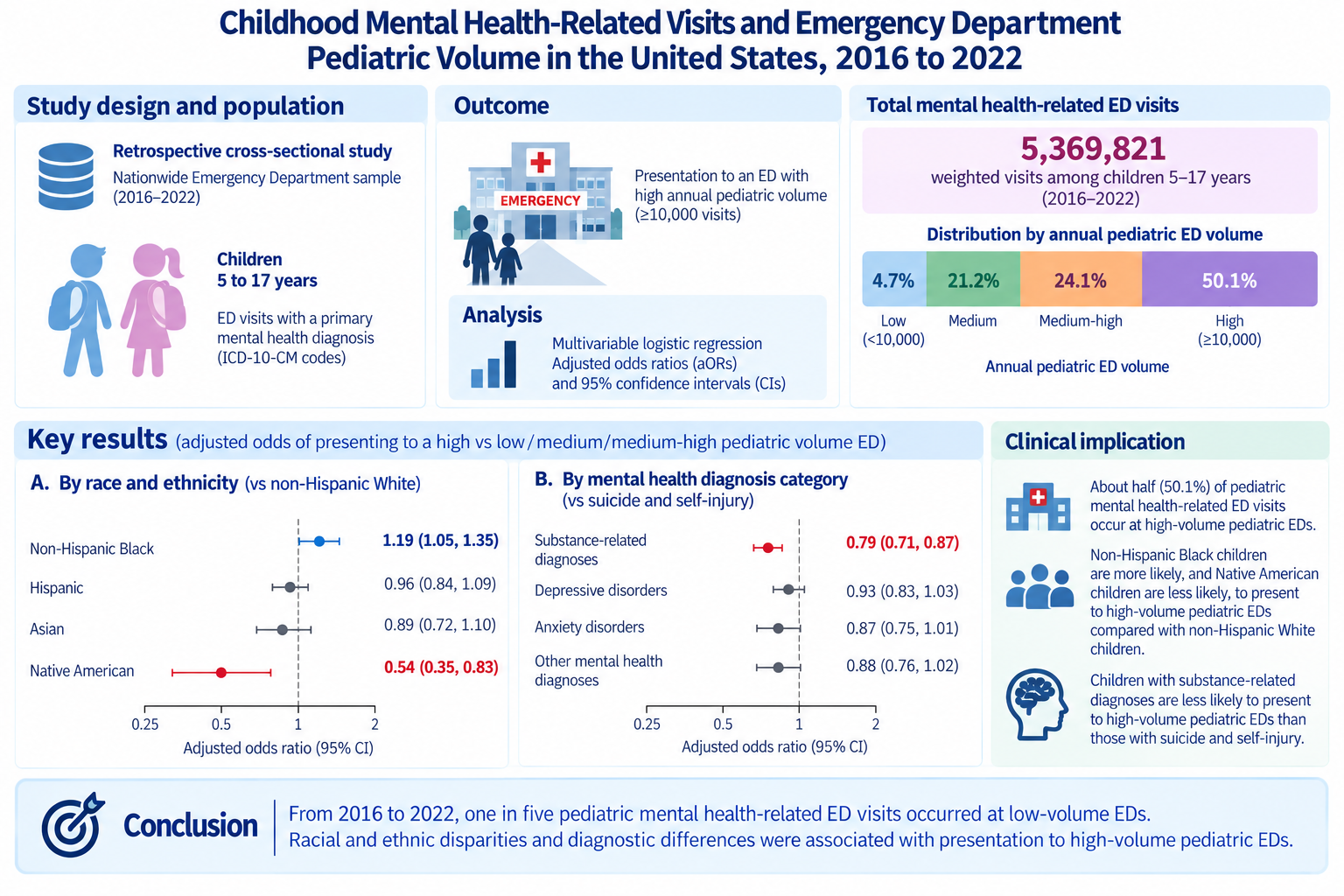
- Pediatric mental health-related ED visits have notably increased from 2016 to 2022, with half of visits concentrated in high-volume pediatric EDs (≥10,000 annual visits).
- Non-Hispanic Black children have higher adjusted odds of presenting to high-volume pediatric EDs for mental health crises compared with non-Hispanic White children, whereas Native American children have lower odds.
- Diagnosis patterns differ by ED volume: suicide and self-injury presentations are more common in high-volume EDs, while substance-related diagnoses are less likely to present there.
- Findings underscore the need for volume-tailored, culturally sensitive ED interventions to address pediatric mental health disparities and improve outcomes.
Background
Emergency department (ED) visits related to pediatric mental health have been escalating, posing critical challenges to emergency and pediatric care systems in the United States. Mental health emergencies in children and adolescents aged 5 to 17 often represent acute manifestations of underlying psychiatric conditions such as depression, anxiety, suicidality, and substance use disorders. The burden on EDs varies by their annual pediatric visit volume, potentially influencing access, resource availability, patient demographics, and treatment outcomes. Yet, granular data differentiating pediatric mental health presentations across ED volume categories has been scarce, limiting targeted care strategies. This underscores a pressing need to characterize patient and presentation patterns by ED volume to optimize mental health emergency responses.
Key Content
Study Design and Methods
The seminal study by Brewer et al. (2026) utilized the Nationwide Emergency Department Sample (NEDS) from 2016 to 2022, encompassing 5,369,821 weighted pediatric mental health-related visits among children aged 5-17 years. Mental health visits were defined via primary diagnoses coded with ICD-10-CM mental health codes. EDs were categorized by annual pediatric volume into four groups: low, medium, medium-high, and high (≥10,000 visits). The primary outcome was presentation to a high pediatric volume ED. Multivariable logistic regression models adjusted for patient-level (age, sex, race/ethnicity, diagnosis category) and hospital-level characteristics were employed to estimate adjusted odds ratios (aORs) with 95% confidence intervals (CIs).
Volume-Based Distribution and Demographic Patterns
High pediatric volume EDs accounted for half (50.1%) of mental health visits, reflecting centralization of pediatric emergency care. Black non-Hispanic children had a 19% higher odds (aOR 1.19, 95% CI 1.05–1.35) compared with White non-Hispanic children to present to these high-volume EDs, suggesting disparities in care access and utilization. Contrastingly, Native American children were underrepresented in high-volume EDs (aOR 0.54, 95% CI 0.35–0.83), potentially indicating geographic, cultural, or systemic access barriers.
Diagnostic Profiles by Volume and Their Clinical Implications
Suicide and self-injury-related presentations were more frequent in high-volume EDs, aligning with these settings’ capacity to manage complex psychiatric emergencies. Conversely, visits involving substance-related diagnoses demonstrated lower adjusted odds (aOR 0.79, 95% CI 0.71–0.87) of presentation to high-volume EDs, potentially reflecting differential referral patterns, stigma, or ED capabilities. This stratification implies that high-volume pediatric EDs serve as nexus points for critical mental health crises, while smaller-volume EDs may encounter more substance-related emergencies or less acute presentations.
Comparison with Related Literature and Contextual Trends
The Brewer et al. findings are consistent with broader data on the underutilization and disparities in emergency services during crises, notably aggravated during the COVID-19 pandemic (Isbell et al. 2020; PMID 33052821), which saw overall ED volumes decline but psychiatric visit proportions rising. The racial and ethnic disparities echoed in pediatric mental health presentations mirror wider systemic inequities identified in trauma and injury care contexts after urban hospital closures (Haider et al. 2016; PMID 27165650).
Additionally, neurobiological studies in pediatrics (Ammann et al. 2022; PMID 35058276) underscore the importance of early neural maturation and developmental trajectories in mental health, advocating for interventions targeting developmental windows identifiable within pediatric emergency care. Cognitive control cortex structures predict behavioral training outcomes (Lee et al. 2016; PMID 26937005), highlighting potential translational opportunities within ED settings to integrate brief cognitive interventions.
Implications for Emergency Department-Based Interventions
The differential patient demographics and diagnoses among pediatric ED volume categories highlight critical opportunities to refine emergency mental health care. Interventions must be culturally informed, and volume-appropriate. High-volume EDs, often urban and resource-rich, are suited for multidisciplinary psychiatric crisis teams, violence prevention, and intense safety planning. Lower-volume EDs may benefit from telepsychiatry augmentation, substance use screening, and brief motivational interventions, particularly given evidence for differential effects of motivational enhancement therapies in adolescent alcohol-positive populations (Shorey et al. 2016; PMID 27568507).
Systematic integration of volume-stratified protocols and resources can address access disparities, resource mismatches, and diagnostic differences, potentially mitigating racial and ethnic inequities in presentation and treatment.
Expert Commentary
This comprehensive epidemiological assessment by Brewer et al. represents a critical advancement in understanding pediatric mental health presentation heterogeneity across EDs stratified by pediatric volume. The use of a large, nationally representative dataset strengthens the generalizability of findings and provides robust insight into demographic and diagnostic patterns.
However, certain limitations warrant discussion. The reliance on ICD-10-CM coding may under- or misclassify some mental health diagnoses due to coding variability. The cross-sectional nature precludes causal inference regarding the determinants of ED pediatric volume utilization patterns. Additionally, structural and socioeconomic context variables at the community and hospital level were not fully explored, potentially confounding observed associations.
The findings should prompt emergency and pediatric care policymakers and clinicians to address structural disparities by expanding mental health capacity equitably across EDs. Future research should integrate granular socio-geographic data and longitudinal clinical outcomes to understand how ED volume and resource distribution influence pediatric mental health trajectories.
Biologically, these clinical patterns resonate with emerging neuroscience emphasizing early developmental influences on mental health vulnerability and plasticity which could inform ED-based screening and triage.
Conclusion
Pediatric mental health-related ED visits in the United States have increased substantially from 2016 to 2022, with marked variation in presentation patterns by ED pediatric volume. High-volume pediatric EDs serve a disproportionate share of Black children and those presenting with severe suicidality/self-injury, underscoring systemic access and care disparities. Lower presentation rates from Native American children and for substance-related disorders at high-volume EDs point to potential gaps in care access or referral biases.
Tailored, volume-stratified interventions integrated into diverse emergency care settings are imperative to improve pediatric mental health outcomes. These findings should inform health system planning, resource allocation, and culturally competent clinical protocols to support vulnerable pediatric populations.
Future research must explore longitudinal outcomes, impact of ED-based interventions, and systemic factors driving disparities. Enhanced neurodevelopmental and psychosocial understanding should be leveraged within emergency care frameworks to optimize early, equitable mental health crisis responses.
References
- Brewer AG, Michelson KA, Masias E, Walter T, Robinson K, Hoffmann JA. Childhood Mental Health-Related Visits and Emergency Department Pediatric Volume in the United States, 2016 to 2022. Ann Emerg Med. 2026 Sep 3. PMID: 42696002.
- Isbell K, DeMers M, Nagel K, Prasad N, Stockin C. Underutilization of the Emergency Department During the COVID-19 Pandemic. West J Emerg Med. 2020 Sep 24;21(6):15-23. PMID: 33052821.
- Haider AH, Saleem T, Leow JJ, et al. Effects of closure of an urban level I trauma centre on adjacent hospitals and local injury mortality: a retrospective, observational study. BMJ Open. 2016 May 10;6(5):e011700. PMID: 27165650.
- Ammann EM, Lee EY, Lim J, et al. Associations of body composition with regional brain volumes and white matter microstructure in very preterm infants. Arch Dis Child Fetal Neonatal Ed. 2022 Sep;107(5):533-538. PMID: 35058276.
- Lee J, Levin H, Huang Y, et al. Prefrontal Cortex Structure Predicts Training-Induced Improvements in Multitasking Performance. J Neurosci. 2016 Mar 2;36(9):2638-45. PMID: 26937005.
- Shorey RC, Anderson S, Stuart GL, Strong D. Moderators of Brief Motivation-Enhancing Treatments for Alcohol-Positive Adolescents Presenting to the Emergency Department. J Subst Abuse Treat. 2016 Oct;69:28-34. PMID: 27568507.