Background: The Challenge of Managing Preterm Labor and Intra-Amniotic Infection
Preterm labor, defined as uterine contractions causing cervical changes before 37 weeks of gestation, remains a leading cause of neonatal morbidity and mortality worldwide. Among women with preterm labor and intact membranes, a critical subgroup harbors intra-amniotic infection or inflammation. This subgroup is at particularly high risk of imminent spontaneous delivery and adverse neonatal outcomes due to infection-driven inflammation. Identifying these high-risk women promptly and accurately is essential for timely clinical intervention and improved outcomes.
Currently, amniocentesis remains the gold standard diagnostic procedure to detect intra-amniotic infection or inflammation, achieved by direct sampling of amniotic fluid for microbial culture, molecular assays, and inflammatory markers. However, amniocentesis is an invasive procedure associated with discomfort, procedural risks, and reservations among both patients and clinicians, limiting its routine use for all women presenting with preterm labor.
This clinical dilemma underscores an unmet medical need: the development of minimally invasive, reliable, and accessible prediction models to stratify risk for intra-amniotic infection or early spontaneous delivery, enabling rationalized amniocentesis use focused on those at highest risk.
Study Design: Multicenter External Validation of Prediction Models
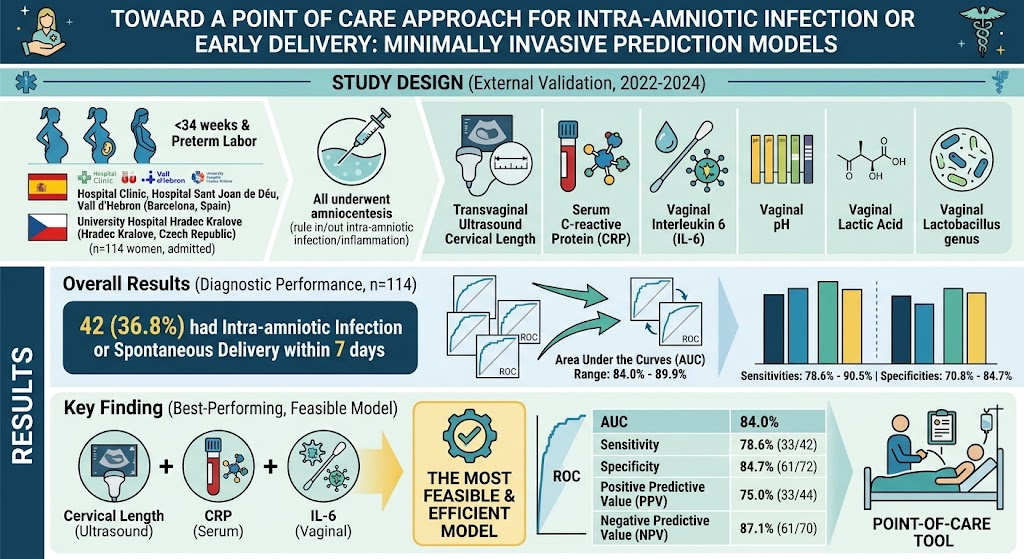
A recent study undertook external validation of four minimally invasive prediction models using clinical data collected between 2022 and 2024 from three tertiary hospitals in Spain and the Czech Republic: Hospital Clinic, Hospital Sant Joan de Déu, Vall d’Hebron Barcelona University Hospital (Spain), and University Hospital Hradec Kralove (Czech Republic).
The study population comprised 114 women diagnosed with preterm labor before 34 weeks’ gestation who underwent amniocentesis to exclude intra-amniotic infection or inflammation. The prediction models integrated a combination of clinical and biological markers:
– Transvaginal ultrasound-measured cervical length (CL)
– Serum C-reactive protein (CRP) levels
– Vaginal inflammatory marker interleukin 6 (IL-6)
– Vaginal pH
– Vaginal lactic acid concentrations
– Vaginal Lactobacillus genus prevalence
The aim was to externally validate and compare model performances in predicting intra-amniotic infection or spontaneous delivery within 7 days.
Key Findings: Performance of Prediction Models and Optimal Combinations
Among the 114 women studied, 42 (36.8%) had confirmed intra-amniotic infection or experienced spontaneous delivery within 7 days of diagnosis, highlighting the cohort’s significant risk burden.
The prediction models demonstrated encouraging diagnostic accuracy, with areas under the receiver operating characteristic curve (AUC) ranging from 84.0% (95% CI, 78.8%-89.2%) up to 89.9% (95% CI, 88.4%-91.4%). Sensitivity across various models ranged between 78.6% and 90.5%, while specificity varied from 70.8% to 84.7%, indicating solid power to correctly identify both high- and low-risk individuals.
Importantly, the most feasible and efficient model combined three parameters:
1. Transvaginal cervical length
2. Serum C-reactive protein
3. Vaginal interleukin 6
This triparametric model achieved an AUC of 84.0%, sensitivity of 78.6% (33/42), specificity of 84.7% (61/72), positive predictive value (PPV) of 75.0% (33/44), and negative predictive value (NPV) of 87.1% (61/70). Its balance of accuracy, accessibility, and minimal invasiveness supports its potential clinical utility.
Other predictors such as vaginal pH, lactic acid, and vaginal Lactobacillus genus provided value but did not outperform the combined model above, possibly due to variability and complexity in interpreting microbial flora physiology.
Expert Commentary: Implications and Considerations
This study contributes significantly to the evolving strategy of precision medicine in obstetrics by reducing reliance on invasive diagnostics for managing preterm labor risks.
By integrating cervical length measurement—commonly available in tertiary centers—with serum CRP and vaginal IL-6, clinicians can stratify risk with a high degree of confidence. This approach aligns with ongoing efforts to develop point-of-care tools that facilitate rapid decision-making to optimize antenatal counseling and interventions.
However, limitations include the moderate sample size and study population restricted to tertiary centers in Europe, which may affect generalizability to other demographic and resource settings. Further large-scale prospective validations and cost-effectiveness studies are warranted before widespread implementation.
Moreover, the biology of intra-amniotic infection and inflammation is dynamic, and prediction models must adapt alongside advances in molecular diagnostics and biomarker discovery.
Conclusion: Toward Selective, Evidence-Based Amniocentesis Guided by Minimally Invasive Models
Minimally invasive prediction models combining cervical length ultrasound, serum CRP, and vaginal IL-6 measurement demonstrate promising diagnostic accuracy for identifying women with preterm labor at high risk of intra-amniotic infection or early spontaneous delivery.
This evidence supports the selective use of amniocentesis, targeting those most likely to benefit from invasive diagnostics, thereby minimizing unnecessary procedural risks and patient burden.
Implementation of such models can enhance personalized obstetric care, improve maternal-fetal outcomes, and optimize healthcare resource utilization.
Future research should focus on external validation across diverse populations, refinement of biomarker panels, and development of user-friendly point-of-care platforms to translate these findings into everyday clinical practice.
References
1. Cobo T, Boada D, Burgos-Artizzu XP, et al. Toward a point of care approach for intra-amniotic infection or early delivery using minimally invasive prediction models in women with preterm labor. Am J Obstet Gynecol. 2026;235(2):447-457. doi:10.1016/j.ajog.2025.10.060
2. Romero R, Espinoza J, Gonçalves LF, et al. Intra-amniotic infection and preterm labor. Curr Opin Obstet Gynecol. 2005;17(6):580-585.
3. Hassan SS, Romero R, Tarca AL, et al. Proteomic biomarkers of intra-amniotic infection and preterm delivery. Am J Obstet Gynecol. 2010;203(5):398.e1-10.
4. Kacerovsky M, Pliskova L, Zlatohlavek L, et al. Vaginal fluid IL-6 and IL-8 in prediction of microbial invasion of amniotic cavity and preterm delivery in women with preterm labor. J Matern Fetal Neonatal Med. 2014;27(6):599-604.