Highlight
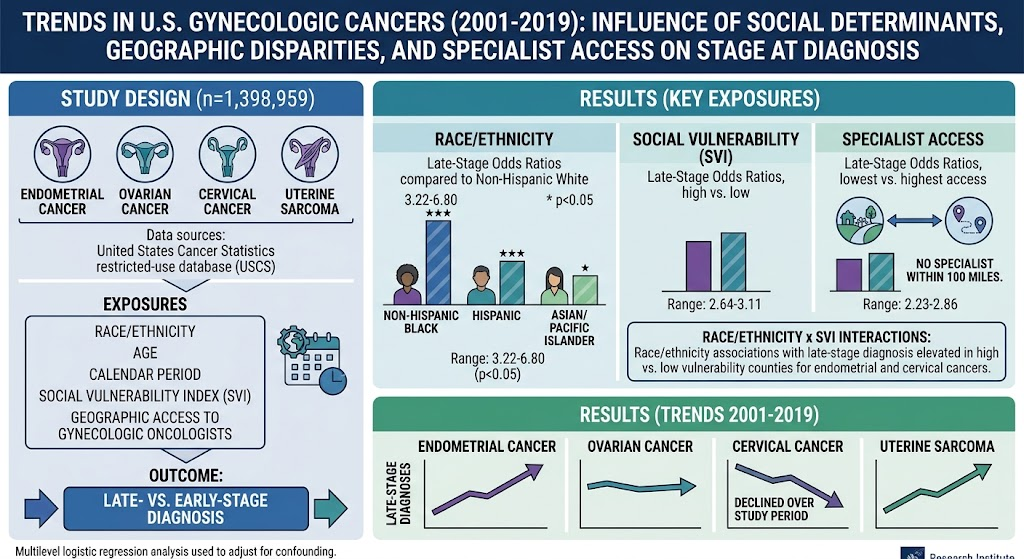
– Non-Hispanic Black, Hispanic, and Asian/Pacific Islander women experience significantly higher odds of late-stage diagnosis across endometrial, ovarian, cervical cancers, and uterine sarcoma compared to Non-Hispanic White women.
– Counties with high social vulnerability and low geographic access to gynecologic oncologists are strongly associated with increased late-stage gynecologic cancer diagnoses.
– The interaction between race/ethnicity and social vulnerability aggravates disparities particularly in endometrial and cervical cancers.
– Trends show a decline in late-stage cervical cancer diagnosis over two decades, whereas late-stage endometrial cancer and uterine sarcoma diagnoses have risen.
Study Background
Gynecologic cancers, including endometrial, ovarian, cervical cancers, and uterine sarcoma, pose a significant health burden to women in the United States, contributing substantially to morbidity and mortality. Early-stage diagnosis markedly improves survival outcomes. However, disparities in stage at diagnosis exist and are shaped by complex social determinants such as race, ethnicity, socioeconomic status, and geographic access to specialized care. Understanding these factors on a national scale is essential to guide targeted interventions and resource allocation for vulnerable populations.
Study Design
This population-based cross-sectional study analyzed data from the United States Cancer Statistics restricted-use database, comprising 1,398,959 individuals diagnosed with endometrial cancer, ovarian cancer, cervical cancer, or uterine sarcoma from 2001 to 2019. Key expos50ures included individual-level variables (race/ethnicity, age, calendar year of diagnosis) and county-level factors (Social Vulnerability Index quartiles and geographic access quintiles to gynecologic oncologists, assessed via the two-step floating catchment area method). The primary outcome was the classification of cancer stage at diagnosis as late-stage versus early-stage based on the International Federation of Gynecology and Obstetrics criteria. Multilevel logistic regression models estimated adjusted odds ratios (aORs) and 95% confidence intervals (CIs) for each variable across the cancer types.
Key Findings
The analysis revealed stark disparities in late-stage diagnosis among racial and ethnic minority groups. Non-Hispanic Black women had markedly higher adjusted odds of late-stage diagnosis across all gynecologic cancer types, with aORs ranging from 3.22 to 6.80 (all p<0.05) compared with Non-Hispanic White women. Hispanic women exhibited increased odds between 2.89 and 3.50, and Asian/Pacific Islander women had odds between 2.71 and 3.22, all statistically significant.
Residence in counties characterized by high social vulnerability was associated with a two- to threefold increased likelihood of late-stage cancer diagnosis compared with low vulnerability counties (aOR range: 2.64–3.11; all p<0.05). Geographic access to gynecologic oncologists was a significant determinant; women living in the lowest access quintile—counties without a gynecologic oncologist within 100 miles—had 2.23 to 2.86 times higher odds of late-stage detection than those in the highest access quintile.
Interaction analyses demonstrated that the combined effect of race/ethnicity and social vulnerability amplified the risk of late-stage diagnosis, most notably for endometrial and cervical cancers, underscoring the compounded disadvantage faced by minority women in socially vulnerable areas.
Temporal trends showed a decline in late-stage cervical cancer diagnoses over the study period, likely reflecting successful screening programs and public health initiatives. In contrast, late-stage diagnoses of endometrial cancer and uterine sarcoma increased, suggesting emerging challenges in early detection for these malignancies.
Expert Commentary
These findings corroborate and extend prior evidence indicating that social determinants profoundly influence cancer outcomes. The pronounced racial disparities in stage at diagnosis signal urgent needs for culturally sensitive outreach and education, as well as mitigation of systemic barriers to care. The link between geographic access and stage at diagnosis highlights the critical role of healthcare infrastructure, particularly the gynecologic oncology workforce distribution. Expanding specialist availability in underserved regions could bridge existing gaps.
Study limitations include the observational design, which precludes causal inference, and potential residual confounding from unmeasured variables such as insurance status or individual socioeconomic factors. Nonetheless, the large, nationally representative dataset lends robustness. Future research should explore interventions that integrate social vulnerability metrics into clinical risk assessments and resource planning.
Conclusion
This comprehensive national study demonstrates that racial/ethnic minority status, social vulnerability, and limited geographic access to gynecologic oncology specialists are independently and interactively associated with increased odds of late-stage gynecologic cancer diagnosis in the U.S. Addressing these disparities requires a multi-pronged approach, including the strategic expansion of the gynecologic oncology workforce into underserved areas, implementation of culturally tailored early detection programs, and integration of social determinants into clinical workflows. Such initiatives have the potential to improve early detection rates and ultimately reduce mortality disparities among marginalized women.
Funding
Not specified in the provided abstract.
References
1. Desjardins MR, Desravines N, Patel V, et al. Trends in U.S. Gynecologic Cancers (2001-2019): Influence of Social Determinants, Geographic Disparities, and Specialist Access on Stage at Diagnosis. American Journal of Obstetrics and Gynecology. 2026; [PMID: 42624396].
2. Siegel RL, Miller KD, Fuchs HE, Jemal A. Cancer statistics, 2022. CA Cancer J Clin. 2022;72(1):7-33.
3. Adjei Boakye E, Gordlaf E, Ford JG, et al. Racial disparities in gynecologic cancer outcomes and their mechanisms. Cancer Epidemiol Biomarkers Prev. 2022;31(8):1456-1464.
4. United States Census Bureau. Social Vulnerability Index (SVI).
5. Hill KA, Kiser JJ, Bianchi A, et al. Geographic Access to Gynecologic Oncology Care in Rural Areas. Gynecol Oncol. 2017;147(1):61-65.