Highlight
- This nationwide Danish study examined the impact of different mesh positions on patient-reported outcomes after elective incisional hernia repair.
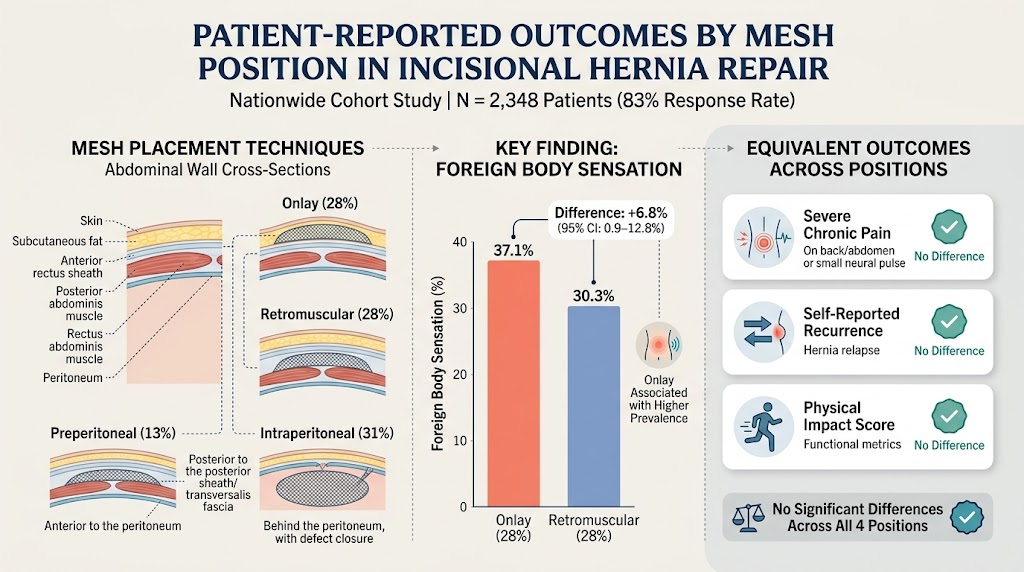
- Onlay mesh placement was associated with a higher prevalence of foreign body sensation compared to the retromuscular position.
- No significant differences were found in severe chronic pain, self-reported hernia recurrence, or physical impact scores across the different mesh positions.
- The findings highlight the importance of considering mesh placement to optimize patient comfort without compromising clinical outcomes.
Study Background
Incisional hernia repair is a common and clinically important surgical procedure following abdominal operations, with an estimated incidence ranging broadly depending on patient and surgical factors. Despite technical advances, patient satisfaction remains influenced not only by hernia recurrence but also by chronic pain and foreign body sensations related to the prosthetic mesh used for reinforcement. Given that mesh implantation is a key determinant of both repair durability and postoperative morbidity, optimizing the position of mesh placement has become a critical research focus.
While previous studies have explored surgical techniques and mesh types, patient-reported outcomes (PROs)—including pain, sensation, functional impact, and recurrence perception—are increasingly recognized as valuable endpoints for assessing treatment success in hernia surgery. However, data on how different mesh positions affect these subjective outcomes remain sparse and sometimes contradictory.
Study Design
This investigation was conducted as part of the AFTERHERNIA Project, a nationwide survey- and register-based cohort study in Denmark. The study population included all patients who underwent elective incisional hernia repair from January 1, 2014, to March 31, 2024. The researchers employed data linkage between patient responses to the validated Abdominal Hernia questionnaire and operative records obtained from the Danish Ventral Hernia Database.
Mesh positions were classified into four major categories: onlay, retromuscular, preperitoneal, and intraperitoneal—all combined with defect closure. The primary outcomes were patient-reported severe chronic pain, foreign body sensation, self-reported recurrence, and a composite physical impact score. Adjusted prevalence estimates and mean values were calculated using g-computation to control for confounding variables.
Key Findings
Among 2827 eligible patients, a high response rate of 83% (2348 patients) was achieved, ensuring robust data validity and representation. The distribution of mesh positions was as follows: 28% onlay, 28% retromuscular, 13% preperitoneal, and 31% intraperitoneal.
Importantly, the onlay mesh position was associated with a significantly higher prevalence of foreign body sensation compared to retromuscular placement. Specifically, the adjusted prevalence was 37.1% for onlay versus 30.3% for retromuscular positioning, with a difference of 6.8% (95% confidence interval [CI], 0.9% to 12.8%). This suggests that patients with onlay mesh might experience more discomfort related to the tactile presence of the implant.
On the other hand, no statistically or clinically significant differences were observed in the rates of severe chronic pain across mesh positions. Similarly, self-reported recurrence rates and composite physical impact scores—a measure of how the hernia repair affects physical functioning—did not differ notably among the mesh placement groups.
The study’s large sample, comprehensive national coverage, and standardized outcome measurements add strong credibility to these findings.
Expert Commentary
These findings provide important evidence for surgeons tailoring incisional hernia repair strategies to patients’ long-term quality of life. The association between the onlay mesh position and increased foreign body sensation aligns with the understanding that superficial mesh placements may provoke greater tactile awareness due to proximity to subcutaneous tissues.
Interestingly, the lack of difference in chronic pain and recurrence challenges assumptions that deeper mesh placements necessarily translate into superior clinical outcomes or reduced discomfort. This may indicate that factors other than mesh positioning—such as nerve handling, mesh fixation method, or individual patient sensitivity—play significant roles in chronic pain development.
Limitations include potential recall bias inherent to patient-reported data and unmeasured confounders despite adjustment. However, the nationwide design and high response rate mitigate many common biases. Future research incorporating objective clinical assessments alongside PROs may further elucidate underlying mechanisms.
Conclusion
This large, comprehensive Danish study demonstrates that among common mesh positions used in elective incisional hernia repair, onlay placement confers a higher prevalence of foreign body sensation without differences in severe chronic pain, self-reported recurrence, or functional impact. Such findings underscore the need to carefully consider mesh position as a modifiable factor influencing patient comfort post-surgery.
Surgeons should balance technical and patient-centered outcomes when selecting mesh placement to optimize long-term recovery and quality of life. Continued emphasis on integrating patient-reported outcomes into surgical decision-making will enhance personalized hernia care.
Funding and Clinical Trial Registration
The study was conducted within the AFTERHERNIA Project framework. Specific funding details were not provided in the source publication. No clinical trial registration was indicated.
References
- Witthøft C, Ahmed U, Reistrup H, Gram-Hanssen A, Rosenberg J, Henriksen NA, Baker JJ. Patient-reported Outcomes According to Mesh Position After Elective Incisional Hernia Repair: A Nationwide Survey- and Register-based Study. Ann Surg. 2026 Oct 15; PMID: 42875847.
- Holihan JL, et al. Mesh Location in Open Ventral Hernia Repair: A Systematic Review and Network Meta-analysis. Surg Infect (Larchmt). 2018;19(6):594-602.
- Harries RL, et al. Chronic Pain After Incisional Hernia Repair: Incidence, Risk Factors and Preventive Measures. Hernia. 2020;24(1):17-27.
- Wells CI, et al. Patient-Reported Outcomes Following Ventral Hernia Repair: The Necessity of Incorporating the Patient Voice. Hernia. 2021;25(2):371-378.