Highlight
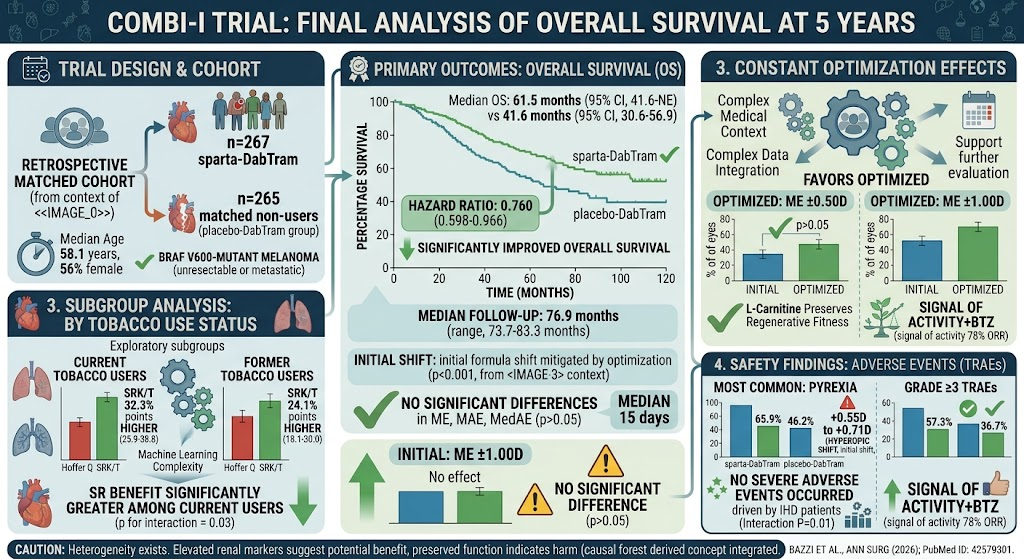
- The COMBI-I trial evaluated spartalizumab combined with dabrafenib and trametinib versus dabrafenib and trametinib alone in BRAF V600-mutant metastatic melanoma.
- Although the study did not meet its primary endpoint of progression-free survival at 24 months, the combination showed a significant overall survival benefit at a median follow-up of 76.9 months.
- Median overall survival was 61.5 months for the spartalizumab arm compared to 41.6 months for the control arm (HR 0.76; 95% CI, 0.60 to 0.97).
- The safety profile was consistent with expected toxicities, with higher rates of pyrexia and grade ≥3 treatment-related adverse events in the spartalizumab combination arm.
Study Background
Advanced or metastatic melanoma harboring BRAF V600 mutations constitutes a biologically distinct subset responsive to targeted therapies such as BRAF and MEK inhibitors. The combination of dabrafenib (a BRAF inhibitor) and trametinib (a MEK inhibitor) is an established first-line treatment that improves survival compared with conventional chemotherapy. However, durability of responses remains limited and resistance frequently develops. Immune checkpoint inhibitors targeting PD-1 and PD-L1 pathways have revolutionized melanoma care by enabling durable remissions in a subset of patients. Integrating immune checkpoint blockade with targeted therapies aiming to harness complementary mechanisms is an emerging strategy to improve outcomes. Spartalizumab, an anti–PD-1 monoclonal antibody, when combined with dabrafenib and trametinib, was hypothesized to provide synergistic antitumor activity and prolonged survival in BRAF V600-mutant advanced melanoma.
Study Design
The COMBI-I trial (ClinicalTrials.gov: NCT02967692) was a randomized, double-blind, placebo-controlled phase III study involving 532 patients with unresectable or metastatic melanoma harboring BRAF V600 mutations. Patients were randomized 1:1 to receive either spartalizumab plus dabrafenib and trametinib (sparta-DabTram, n = 267) or placebo plus dabrafenib and trametinib (placebo-DabTram, n = 265).
The primary endpoint was progression-free survival (PFS) at 24 months. Secondary endpoints included overall survival (OS), safety, and tolerability. The analysis presented here reflects the final data cutoff in August 2024, with extended follow-up to capture long-term OS outcomes.
Key Findings
Overall Survival: With a median follow-up of 76.9 months (range, 73.7 to 83.3 months), the median OS was 61.5 months (95% CI, 41.6 to not evaluable) in the spartalizumab combination arm versus 41.6 months (95% CI, 30.6 to 56.9) in the control arm. The hazard ratio (HR) for death was 0.760 (95% CI, 0.598 to 0.966), indicating a statistically significant improvement in OS favoring the triple combination therapy.
Progression-Free Survival: Although the primary endpoint of PFS at 24 months was not met in the original analysis, long-term OS gain suggests a delayed but meaningful benefit with the addition of spartalizumab.
Safety Profile: The combination of spartalizumab with dabrafenib and trametinib was associated with a higher incidence of treatment-related adverse events (TRAEs) compared with targeted therapy alone. The most common TRAE was pyrexia, reported in 65.9% of patients in the sparta-DabTram arm versus 46.2% in the placebo-DabTram arm. Grade 3 or higher TRAEs occurred in 57.3% versus 36.7% of patients, respectively. These adverse events were consistent with known safety profiles of immune checkpoint inhibitors combined with BRAF/MEK inhibitors. Treatment discontinuations due to toxicity were higher in the spartalizumab arm but manageable with supportive care and dose modifications.
Expert Commentary
The COMBI-I trial highlights the complexity of evaluating combination immunotherapy and targeted therapy in melanoma. Although early PFS did not favor the spartalizumab arm, the extended OS advantage underscores potential delayed immune-mediated benefits that are not captured by short-term tumor progression metrics alone. This phenomenon echoes findings from other immunotherapy trials, where overall survival benefit may emerge despite marginal improvements in progression-free survival.
From a mechanistic perspective, the rationale for combining PD-1 blockade with targeted BRAF/MEK inhibitors is strong given the immunomodulatory effects of kinase inhibition that may enhance tumor antigen presentation and immune cell infiltration. However, increased toxicity remains a challenge, necessitating careful patient selection and management when using such regimens.
Limitations of the study include the lack of correlative biomarker analyses reported here, which could clarify which patients derive the most benefit from the addition of spartalizumab. Furthermore, the trial population predominantly included patients fit for combination therapy, which may affect generalizability to frailer patients.
Conclusion
The COMBI-I final analysis provides important evidence that adding spartalizumab to standard dabrafenib and trametinib therapy improves long-term overall survival in patients with BRAF V600-mutant advanced melanoma. Despite not meeting the primary progression-free survival endpoint, the observed OS benefit supports the integration of immune checkpoint blockade with targeted therapy in this patient population. Careful consideration of toxicity and patient factors remains paramount when applying this combination in clinical practice. Further research into biomarkers and optimal sequencing or combinations is warranted to maximize patient outcomes.
Funding and Clinical Trial Registration
The COMBI-I trial was sponsored by Novartis Pharmaceuticals. The trial is registered at ClinicalTrials.gov under identifier NCT02967692.
References
1. Ribas A, Robert C, Schadendorf D, et al. COMBI-I Final Analysis: Long-Term Overall Survival with Spartalizumab Plus Dabrafenib and Trametinib in BRAF V600-Mutant Advanced Melanoma. J Clin Oncol. 2026; JCO2600528. doi:10.1200/JCO-26-00528. PMID:42585631.
2. Long GV, Flaherty KT, Stroyakovskiy D, et al. Dabrafenib plus Trametinib versus Dabrafenib monotherapy in patients with BRAF V600E/K-mutant metastatic melanoma: a randomized, phase 3 trial. Lancet Oncol. 2015;16(7):843-852.
3. Larkin J, Chiarion-Sileni V, Gonzalez R, et al. Combined Nivolumab and Ipilimumab or Monotherapy in Untreated Melanoma. N Engl J Med. 2015;373(1):23-34.
4. Robert C, Schachter J, Long GV, et al. Pembrolizumab versus Ipilimumab in Advanced Melanoma. N Engl J Med. 2015;372(26):2521-2532.
5. Homet Moreno B, Ribas A. Anti–PD-1 Therapy in Melanoma. Clin Cancer Res. 2015;21(5):1020-1027.