Highlight
• Liver stiffness measurement (LSM) by Fibroscan® robustly predicts transplant-free survival in PSC.
• Stratification into Baveno-VII classes (<10, 10–<15, ≥15 kPa) correlates strongly with outcome.
• Dynamic LSM changes over time independently add prognostic value beyond baseline measures.
• Incremental LSM progression corresponds to a significant increase in risk of death or transplantation.
Study Background
Primary sclerosing cholangitis (PSC) is a chronic cholestatic liver disease characterized by inflammation and fibrosis of intra- and extra-hepatic bile ducts. Its progressive course often leads to cirrhosis, hepatic decompensation, and the need for liver transplantation. Predicting which patients will experience poor outcomes remains clinically challenging, hindering personalized management and trial design. Current prognostic models rely on biochemical markers and imaging, but these may be inconsistent or cumbersome. Liver stiffness measurement (LSM) using vibration-controlled transient elastography (Fibroscan®) offers a noninvasive, rapid, reproducible method to assess hepatic fibrosis and portal hypertension. Prior retrospective studies suggested LSM could forecast clinical progression in PSC, but prospective validation in large cohorts was lacking. This study addresses the crucial unmet need for reliable, straightforward prognostic tools in PSC management.
Study Design
The FICUS (Fibroscan in Cholestatic disease: Univariable and longitudinal Study) is a large, prospective cohort study enrolling adult patients with uncomplicated PSC. Over five years, clinical, laboratory, and LSM data were collected annually. LSM was categorized into three Baveno-VII classes: <10 kPa (low risk), 10–<15 kPa (intermediate risk), and ≥15 kPa (high risk), and also analyzed as continuous values. The primary endpoint was transplant-free survival, defined as survival without liver transplantation. Statistical analysis included time-dependent multivariable Cox regression to calculate adjusted hazard ratios (aHR) and 95% confidence intervals (95% CIs). Joint modeling assessed the prognostic impact of longitudinal LSM changes. Progression was defined by a significant positive slope of individual LSM readings over time, indicating fibrosis worsening.
Key Findings
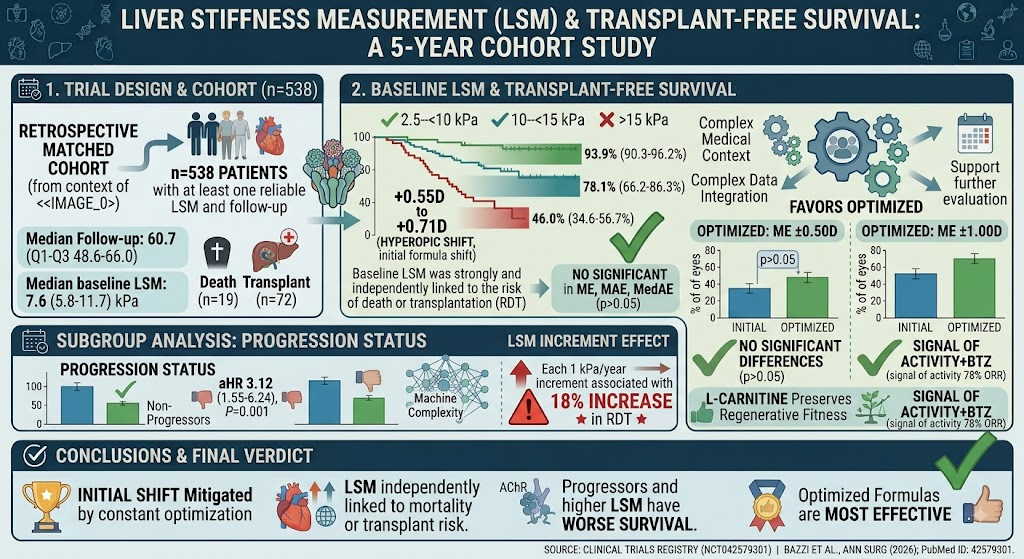
A total of 538 patients met inclusion criteria, providing reliable LSM data with a median follow-up of approximately 5 years. Median baseline LSM was 7.6 kPa. During follow-up, 19 patients died and 72 underwent liver transplantation. Baseline LSM independently predicted risk of death or transplantation (RDT). Stratified by Baveno-VII classes, 5-year transplant-free survival was 93.9% for <10 kPa, 78.1% for 10–<15 kPa, and only 46.0% for ≥15 kPa, demonstrating stepwise risk differentiation.
Beyond static measures, patients with progressive LSM, reflected by a positive slope, exhibited significantly worse outcomes (aHR 3.12, 95% CI 1.55-6.24, p=0.001). Each 1 kPa/year increase in LSM progression was associated with an 18% greater risk of RDT. These findings validate LSM dynamics as a valuable biomarker for disease trajectory and prognosis in PSC.
The study’s rigorous prospective design, sizable cohort, and longitudinal data analysis provide robust evidence supporting the prognostic utility of Fibroscan® in PSC. Reliable risk stratification enables individualized surveillance and might inform timing of transplantation or therapeutic interventions.
Expert Commentary
The results align with an evolving paradigm establishing liver stiffness as a cornerstone of noninvasive hepatic fibrosis assessment across chronic liver diseases. In PSC specifically, the incorporation of LSM into routine clinical practice can substantially augment traditional biochemical indices and imaging. This study’s prospective nature mitigates confounding and bias inherent to previous retrospective analyses. However, some limitations deserve attention: patients with uncomplicated PSC comprised the cohort, so extrapolation to those with advanced disease or dominant strictures warrants caution. Additionally, the arbitrary cutoff values from Baveno-VII, while clinically practical, may benefit from refinement to optimize sensitivity and specificity.
From a mechanistic perspective, LSM correlates with fibrosis and cholestatic injury-induced architectural distortion, which are directly linked to clinical outcomes. The dynamic aspect of repeated LSM measurements adds a powerful dimension to risk stratification, capturing disease evolution that static snapshots cannot. Clinical trials in PSC frequently suffer from heterogeneous progression and lack of surrogate endpoints; LSM offers a quantifiable marker for stratifying patients and potentially reducing trial duration or size.
Future studies should validate these findings in diverse populations and evaluate the integration of LSM with novel biomarkers or imaging modalities. Furthermore, whether LSM-guided intervention strategies improve clinical outcomes remains an important research question.
Conclusion
This landmark prospective study confirms that liver stiffness measurement by Fibroscan® is a strong, independent prognostic tool in primary sclerosing cholangitis. Both static baseline LSM values and dynamic changes over time predict transplant-free survival with high accuracy. Incorporation of LSM into clinical algorithms offers clinicians a simple, noninvasive approach for risk assessment and tailored patient management. Moreover, LSM holds promise as a surrogate endpoint in clinical trials, facilitating the development and evaluation of novel PSC therapies. Continued research is warranted to refine LSM thresholds, validate in broader cohorts, and determine the clinical impact of LSM-driven decision-making in PSC.
Funding and ClinicalTrials.gov
No funding information or clinical trial registration was reported in the article.
References
1. Chazouilleres O, Bellet J, Schramm C, et al. Prognostic performance of liver stiffness measurements in primary sclerosing cholangitis: the prospective FICUS cohort. Gastroenterology. 2026. doi:10.1053/j.gastro.2026.07.019.
2. Venkatesh SK, Rathi S. Liver Stiffness Measurement in Chronic Liver Diseases: An Update. Indian J Gastroenterol. 2022;41(1):1-16.
3. European Association for the Study of the Liver. EASL Clinical Practice Guidelines: Management of cholestatic liver diseases. J Hepatol. 2022;77(4):1153-1195.
4. Baveno VII Consensus Workshop. Expanding the Use of Transient Elastography Beyond Cirrhosis. J Hepatol. 2021;75(3):659-668.