Highlight
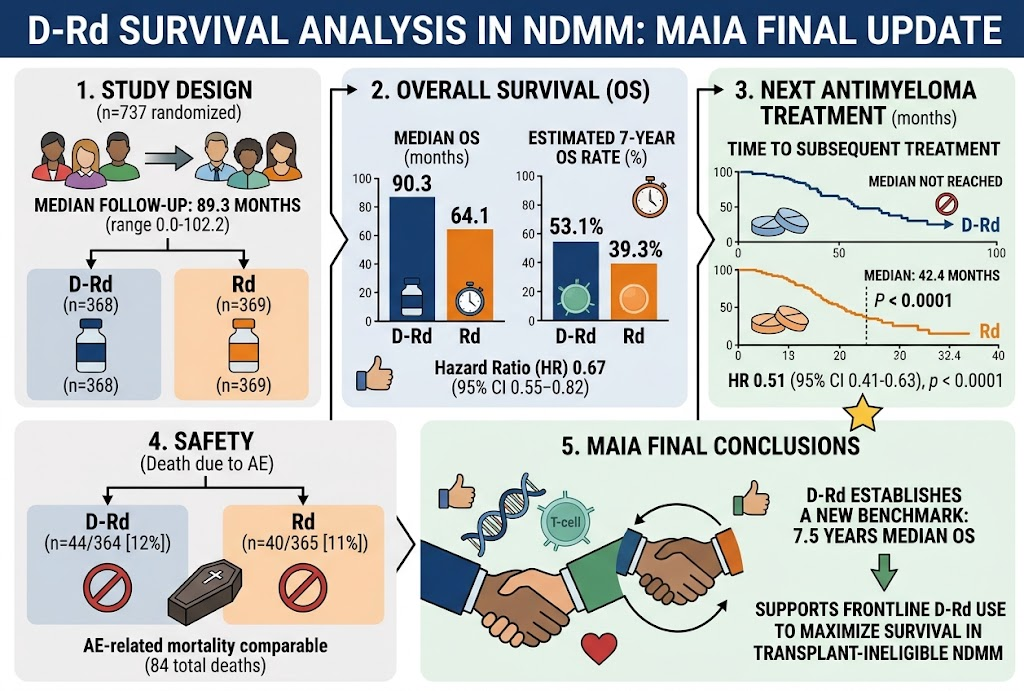
- Daratumumab combined with lenalidomide and dexamethasone (D-Rd) significantly improves median overall survival (OS) compared to lenalidomide and dexamethasone alone (Rd) in transplant-ineligible newly diagnosed multiple myeloma (NDMM) patients.
- The MAIA final analysis reports a median OS of 90.3 months (7.5 years) with D-Rd versus 64.1 months with Rd, reflecting a 33% reduction in risk of death (HR 0.67).
- Median time to subsequent antimyeloma therapy is notably longer in the D-Rd arm, with a median not reached at nearly 7.5 years follow-up.
- Long-term safety data show comparable rates of death due to adverse events between treatment groups.
Study Background
Newly diagnosed multiple myeloma (NDMM) remains a challenging hematologic malignancy, particularly in patients who are ineligible for autologous stem cell transplant due to age or comorbidities. This subset represents a significant proportion of the myeloma patient population and often experiences inferior outcomes compared to transplant-eligible patients. Historically, therapeutic advances have focused on extending progression-free survival (PFS) and overall survival (OS) while maintaining tolerability in these frail patients.
Daratumumab — a monoclonal antibody targeting CD38 on myeloma cells — added to the backbone of lenalidomide and dexamethasone, showed promising efficacy and manageable safety in earlier phases of the MAIA trial, a randomized phase 3 study. Prior interim analyses demonstrated superior PFS and OS, but long-term survival data were awaited for definitive assessment of the regimen’s impact. The final survival analysis of the MAIA trial now provides a robust and mature dataset to inform clinical decisions in this underserved patient group.
Study Design
The MAIA trial was a randomized, open-label, phase 3 clinical study enrolling 737 transplant-ineligible patients with NDMM. Patients were randomized in a 1:1 ratio to receive either daratumumab plus lenalidomide and dexamethasone (D-Rd) or lenalidomide and dexamethasone alone (Rd).
Treatment continued until disease progression or unacceptable toxicity. The primary endpoints initially included PFS and OS, with secondary endpoints encompassing response rates, safety profiles, and time to subsequent therapy. A protocol amendment in July 2021 enabled a long-term extension phase focusing on OS follow-up.
The median follow-up at final analysis was 89.3 months (approximately 7.5 years), enabling a comprehensive evaluation of long-term survival and subsequent therapy patterns.
Key Findings
The final survival analysis of MAIA reveals that the addition of daratumumab to lenalidomide and dexamethasone confers a significant overall survival benefit over Rd alone. Median OS was extended to 90.3 months (95% CI, 80.8–not estimable) with D-Rd, compared to 64.1 months (95% CI, 56.0–70.8) with Rd. This corresponds to a hazard ratio (HR) of 0.67 (95% CI, 0.55–0.82), denoting a 33% relative reduction in the risk of death.
The estimated 7-year OS rates were 53.1% for the D-Rd arm versus 39.3% in the Rd arm. This survival advantage reflects a substantial improvement in outcomes for transplant-ineligible NDMM patients, a population historically associated with poorer prognosis.
Additionally, the median time to subsequent antimyeloma therapy was not reached in patients receiving D-Rd at this extended follow-up, whereas it was 42.4 months (95% CI, 33.5–50.6) in the Rd cohort. The HR for time to subsequent treatment was 0.51 (95% CI, 0.41–0.63; P < 0.0001), demonstrating delayed disease progression or treatment failure in the daratumumab arm.
Safety data showed a comparable incidence of deaths related to adverse events: 12% in the D-Rd group versus 11% in the Rd group, indicating no significant excess in treatment-related mortality despite the prolonged therapy duration.
Clinical Interpretation
These results substantiate the role of daratumumab in frontline therapy for transplant-ineligible NDMM patients, establishing a new benchmark median OS exceeding 7 years. The durable survival benefit combined with a favorable safety profile supports current guideline recommendations endorsing D-Rd as a standard-of-care regimen in this setting.
Expert Commentary
Experts in multiple myeloma therapeutics recognize the MAIA final analysis as a landmark in improving outcomes for older or frail patients who cannot undergo stem cell transplantation. Daratumumab’s immunotherapeutic mechanism, combined with the immunomodulatory agent lenalidomide and corticosteroid dexamethasone, delivers a potent and tolerable triplet regimen.
The extended follow-up also addresses concerns regarding long-term toxicity and secondary malignancies, with no new safety signals emerging. Clinicians are encouraged to incorporate daratumumab-based combinations early in treatment to maximize survival gains.
Potential limitations include the open-label design and patient selection bias toward fitter transplant-ineligible candidates. Nevertheless, the generalizability of findings to broader populations remains robust given the trial’s large international enrollment.
Conclusion
The MAIA final survival analysis provides compelling evidence that frontline therapy with daratumumab, lenalidomide, and dexamethasone significantly improves overall survival in transplant-ineligible NDMM patients. The median OS of 7.5 years represents a meaningful advance, bridging an important unmet clinical need for this high-risk cohort.
Future research may focus on integrating novel agents and refining risk-adapted approaches to further improve long-term outcomes and quality of life for patients with multiple myeloma who are ineligible for transplant.
Funding and Trial Registration
The MAIA study was supported by Janssen Research & Development, LLC. The trial is registered at ClinicalTrials.gov (NCT02252172).
References
1. Facon T, Kumar SK, Orlowski RZ, et al. Daratumumab, lenalidomide, and dexamethasone in transplant-ineligible newly diagnosed multiple myeloma: MAIA final survival analysis. Leukemia. 2026 Aug 24. PMID: 42637879.
2. Sonneveld P, Broijl A. Treatment of relapsed and refractory multiple myeloma. Haematologica. 2016;101(4):541-551.
3. Rajkumar SV. Multiple myeloma: 2020 update on diagnosis, risk-stratification and management. Am J Hematol. 2020;95(5):548-567.