Highlight
- PTeye-guided near-infrared autofluorescence (NIRAF) significantly improves intraoperative identification of parathyroid glands (PGs) compared to visual inspection alone during total thyroidectomy.
- Use of PTeye results in higher rates of in situ preservation of 3-4 parathyroid glands and reduces inadvertent parathyroidectomy.
- The probe’s benefit is especially pronounced for junior surgeons, translating into reduced transient hypoparathyroidism rates.
- Permanent hypoparathyroidism rates were not significantly altered, indicating the need for further research on long-term outcomes.
Study Background
Parathyroid glands are small endocrine organs located adjacent to the thyroid that regulate calcium homeostasis through parathyroid hormone (PTH) secretion. During total thyroidectomy, inadvertent injury or removal of these glands remains a major cause of postoperative hypoparathyroidism—a clinical condition associated with symptomatic hypocalcemia, prolonged hospital stays, and diminished quality of life. Visual identification of these diminutive glands is challenging, compounded by anatomical variability and surgical experience. Consequently, techniques that improve real-time intraoperative identification and preservation of parathyroid glands are highly sought after to reduce morbidity.
Recent advances introduced near-infrared autofluorescence (NIRAF)-based devices, such as the PTeye probe, which exploit the intrinsic autofluorescent properties of parathyroid tissue, allowing surgeons to detect glands reliably without exogenous contrast agents. This technology provides immediate feedback, potentially facilitating safer dissection and gland preservation.
Study Design
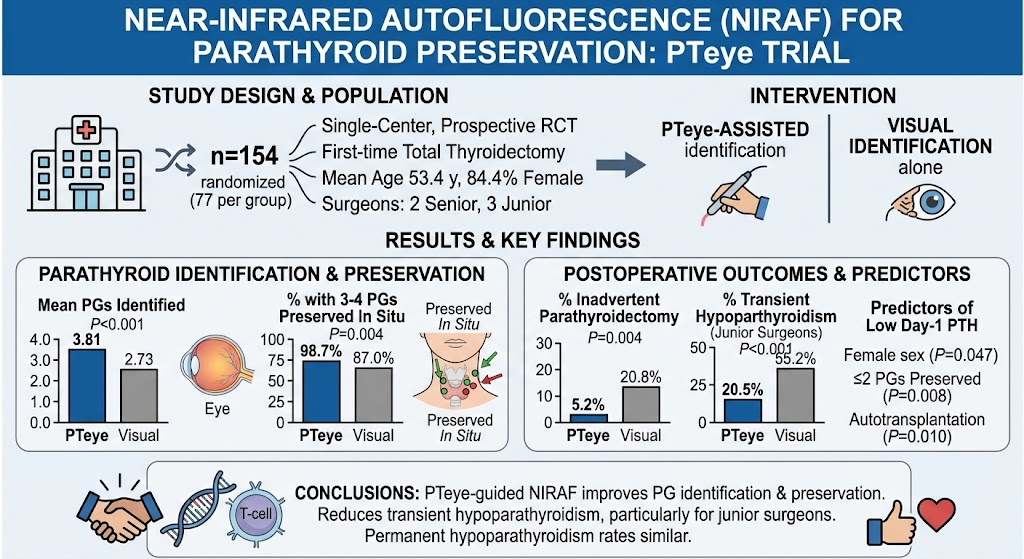
This prospective, single-center randomized controlled trial enrolled patients undergoing first-time total thyroidectomy. Participants (n=154) were randomized evenly to either PTeye-assisted parathyroid gland identification or conventional visual inspection. The surgeries were performed by a mix of two senior and three junior surgeons to analyze outcomes across different experience levels.
The primary endpoint was the mean number of parathyroid glands identified intraoperatively. Secondary endpoints included rates of inadvertent parathyroidectomy (unintentional removal), autotransplantation of parathyroid tissue, and incidence of transient and permanent hypoparathyroidism defined by postoperative serum parathormone levels and symptomatic hypocalcemia.
Key Findings
The trial demonstrated a statistically significant increase in the mean number of parathyroid glands identified using PTeye compared to visual identification alone—3.81 versus 2.73 glands per patient (P < 0.001). Furthermore, PTeye users exhibited a higher proportion of patients with preservation of 3-4 glands in situ (98.7% vs. 87%, P = 0.004), underscoring enhanced gland conservation.
Inadvertent parathyroidectomy was substantially reduced in the PTeye group (5.2%) relative to controls (20.8%, P = 0.004), indicating superior gland recognition and avoidance of excision.
Interestingly, among junior surgeons, autotransplantation rates were higher with PTeye usage (33.3%) than senior surgeons (10.5%, P = 0.015), suggesting that enhanced detection might lead less-experienced surgeons to opt for autotransplantation in case of compromised glands.
Clinical predictors of low postoperative day-1 PTH levels included female sex (P=0.047), preservation of two or fewer glands (P=0.008), and autotransplantation (P=0.010), highlighting risk factors for postoperative hypoparathyroidism.
Crucially, transient hypoparathyroidism incidence significantly decreased in junior surgeons when using PTeye (20.5% vs. 55.2%, P < 0.001), whereas senior surgeons experienced no significant difference. This finding points to the utility of PTeye as a training adjunct and operative safeguard for less experienced operators.
Permanent hypoparathyroidism rates were comparable between groups, suggesting that while PTeye effectively reduces immediate postoperative functional impairment, its impact on long-term parathyroid function requires further evaluation.
Expert Commentary
The study provides compelling evidence supporting the adoption of NIRAF-based intraoperative parathyroid identification to optimize gland preservation and reduce transient hypoparathyroidism. These results align with previous observational studies indicating that NIRAF improves surgeon confidence and gland detection rates.
The differential impact observed between junior and senior surgeons highlights a practical scenario where PTeye may bridge the experience gap, standardizing outcomes. However, the higher autotransplantation among junior surgeons using PTeye merits cautious interpretation, as overtreatment could have downstream effects on parathyroid function and graft viability.
Limitations include the single-center design and sample size that may limit generalizability. Additionally, long-term functional outcomes beyond last follow-up were not substantially impacted, underscoring the need for larger, longer-term studies to determine if early benefits translate into permanent hypoparathyroidism risk reduction.
Mechanistically, NIRAF leverages intrinsic fluorophores in parathyroid tissue, enabling safe and reproducible gland identification without exogenous dyes, minimizing procedural complexity and risk.
Conclusion
This randomized controlled trial corroborates the clinical utility of PTeye-guided near-infrared autofluorescence in enhancing parathyroid gland identification and preservation during total thyroidectomy. PTeye usage notably reduces inadvertent parathyroidectomy and transient hypoparathyroidism, particularly benefiting surgeons with less experience. While permanent hypoparathyroidism remains unaffected in the short term, the technology holds promise as an adjunct to improve surgical safety and outcomes.
Future research should focus on multicenter validation, exploring integration into surgical training, cost-effectiveness analyses, and long-term patient-centered outcomes. Incorporating technologies like PTeye may ultimately establish new standards in endocrine surgery quality assurance and complication mitigation.
Funding and Trial Registration
The study was conducted at a single center with appropriate ethical approvals. Funding details and trial registration numbers were not provided in the abstract; readers are advised to consult the full publication for such information.
References
1. Barczyński M, Pac A, Krakowska K, Kłodziejska K, Dworak M, Konturek A. Near-infrared Autofluorescence Probe Versus Visual Identification for Parathyroid Detection and Functional Preservation During Total Thyroidectomy: A Randomized Controlled Trial. Ann Surg. 2026 Aug 25; PMID: 42638312.
2. McWade MA, Paras C, White LM, et al. A Novel Optical Approach to Intraoperative Detection of Parathyroid Glands. Surgery. 2013;154(6):1371-1377.
3. Ladurner R, Sindwani R, Baruah S, et al. Near-infrared Autofluorescence Imaging for Parathyroid Detection: A Systematic Review and Meta-analysis. Laryngoscope. 2020;130(4):936-942.
4. Kim SW, Kim JH, Park H, et al. Clinical Impact of Near-Infrared Autofluorescence Imaging on Postoperative Hypoparathyroidism after Thyroidectomy: A Prospective Randomized Study. Surgery. 2021;169(5):1285-1291.