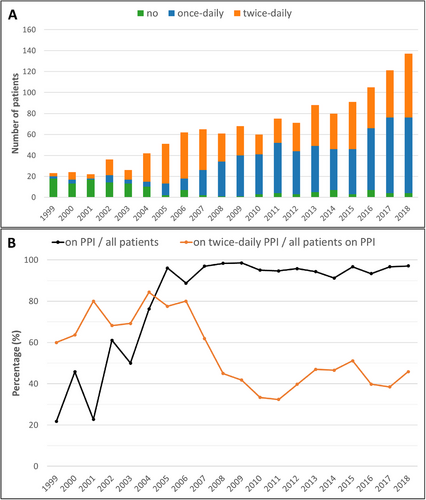
Proton pump inhibitors (PPIs) were used in 89.4% of lung transplant recipients (LTR) in the first year post-transplant and usage rose to over 90% after 2007.
Long-term PPI therapy showed no significant association with reduced chronic lung allograft dysfunction (CLAD) or improved survival outcomes in LTR.
Differing PPI dosing regimens (once vs twice daily) and reflux burden assessed by pH-impedance monitoring did not impact transplant outcomes.
Incidence of acute rejection and positive bronchoalveolar lavage cultures were comparable regardless of PPI exposure.
Study Background
Lung transplantation remains the definitive treatment for many end-stage pulmonary diseases but is limited by chronic lung allograft dysfunction (CLAD), which significantly impairs long-term survival. Gastroesophageal reflux disease (GERD) is frequently observed in lung transplant recipients and has been implicated as a risk factor for CLAD due to potential microaspiration causing allograft injury. Proton pump inhibitors have been routinely prescribed to manage GERD and theoretically reduce reflux-related allograft injury. However, evidence for the long-term clinical benefit of PPI use in lung transplant populations is limited and conflicting. This gap underlines the need to clarify whether routine PPI administration translates into improved post-transplant outcomes.
Study Design
This investigation was a large, single-center, retrospective cohort study including 1308 adult, first-time lung transplant recipients at a Canadian transplant center from 1999 through 2018. Inclusion criteria required survival without CLAD at 1-year post-transplant. PPI exposure was defined as continuous use for at least 8 weeks initiated within the first 6 months after transplantation. Clinical outcomes examined included time to CLAD onset, time to death or retransplantation, acute rejection episodes in the first year, and prevalence of positive bronchoalveolar lavage cultures as a marker of infection or inflammation. Sub-analysis examined differences by dosing frequency (once vs twice daily) and by reflux severity determined from 24-hour pH-impedance monitoring.
Key Findings
Proton pump inhibitor use was extraordinarily common in this cohort, with almost 90% of lung transplant recipients prescribed PPIs within the first year post-transplant, reaching over 90% prevalence after 2007, reflecting evolving clinical practice trends.
Multivariable regression analyses adjusting for potential confounders revealed no statistically significant differences in the primary outcomes related to PPI exposure. The time to CLAD did not differ between those on PPIs and those not on PPIs. Similarly, no survival benefit was demonstrated in terms of time to death or retransplantation. Acute rejection incidence and positive bronchoalveolar lavage cultures in the first post-transplant year were also comparable between groups.
Additional analyses showed no differences in key outcomes when comparing once-daily vs twice-daily PPI dosing schedules or when factoring in the number of reflux episodes on pH-impedance monitoring. This suggests that greater PPI intensity or reflux burden did not meaningfully influence the risk of CLAD or other adverse outcomes.
These findings challenge the assumption that routine long-term PPI use in lung transplant recipients confers protection against graft injury due to reflux.
Expert Commentary
The near-universal adoption of PPI therapy in lung transplant recipients has reflected a precautionary strategy aimed at mitigating GERD-associated reflux injury to the allograft. However, the absence of clear clinical benefits in this robust longitudinal study raises important questions regarding the appropriateness of widespread PPI use in this context.
Potential explanations for these findings include the possibility that PPIs, while effective at acid suppression, may not fully prevent non-acid reflux or microaspiration, which still pose risks to the transplanted lung. Alternatively, GERD may not be as crucial a driver of CLAD development as hypothesized, or the multifactorial pathogenesis of CLAD may overshadow any effects of reflux management alone.
Limitations acknowledged by the investigators include the retrospective design, potential for unmeasured confounding, and single-center setting affecting generalizability. Furthermore, adherence and detailed dosing compliance were not exhaustively assessed.
Notably, prior smaller studies have suggested possible benefits of acid suppression or antireflux procedures on transplant outcomes, but this large cohort with long follow-up provides stronger evidence tempering these impressions. Current guidelines emphasize individualized assessment of GERD and considered use of PPIs, consistent with these findings.
Conclusion
This comprehensive 20-year observational study demonstrates that long-term proton pump inhibitor therapy is nearly universal in lung transplant recipients but shows no clear association with improved clinical outcomes including chronic lung allograft dysfunction, survival, rejection, or infection rates. These results call into question the routine blanket use of PPIs post-lung transplantation, urging clinicians to critically evaluate the indications and potential risks of chronic acid suppression in this population. Prospective randomized controlled trials are needed to definitively define the role of PPIs and other reflux interventions in optimizing long-term lung transplant outcomes.
Funding and ClinicalTrials.gov
The referenced study did not specify external funding sources or clinical trial registration information in the abstract.
References
1. Zhang CYK, Ramendra R, Aversa M, et al. Long-Term Proton Pump Inhibitors in Lung Transplant Recipients: Near-Universal Use Without Clear Impact on Clinical Outcomes Over a 20-Year Observational Study. Clin Transplant. 2026 Oct;40(10):e70706. PMID: 42878165.
2. D’Ovidio F, Mura M, Ridsdale R, et al. GERD and lung transplantation: Is there a link? Am J Transplant. 2010;10(5):1229-1235.
3. Blondeau K, Mertens V, Vanaudenaerde BM, et al. Reflux and allograft injury in lung transplantation. Curr Opin Organ Transplant. 2010;15(5):569-573.
4. Arias-Stella J, Filomeno LT, Sin DD. Gastroesophageal reflux disease and lung transplantation: The evidence base and clinical implications. Can Respir J. 2016;2016:9450857.
5. Scheffert JL, Davis CS, Kaza AK, et al. Antireflux Surgery in Lung Transplantation: A Systematic Review. Ann Thorac Surg. 2018;106(3):850-860.