Highlight
- Negative low-dose CT (LDCT) screening is associated with a significantly lower long-term risk of lung cancer incidence and all-cause mortality compared to nonscreened individuals.
- Lung cancer-specific mortality after a negative LDCT screen does not differ significantly from nonscreened populations over a median follow-up of 8.6 years.
- Long-term lung cancer risk among negatively screened individuals is comparable to that in low-risk populations, supporting risk-stratified surveillance rather than uniform annual rescreening.
- Current smokers with negative screening results remain at higher lung cancer incidence risk compared to low-risk groups, highlighting the need for tailored follow-up strategies.
Study Background
Lung cancer remains a leading cause of cancer-related morbidity and mortality worldwide. Early detection through low-dose computed tomography (LDCT) screening programs has demonstrated mortality benefits, primarily by identifying lung cancers at earlier, more treatable stages. However, clinical guidelines face uncertainty regarding the optimal frequency and duration of rescreening after an initial negative LDCT result, especially as negative screens do not exclude future risk entirely. Understanding the long-term incidence and mortality risks among individuals with negative LDCT results is critical to developing evidence-based surveillance protocols that optimize resource utilization and patient outcomes.Study Design and Methods
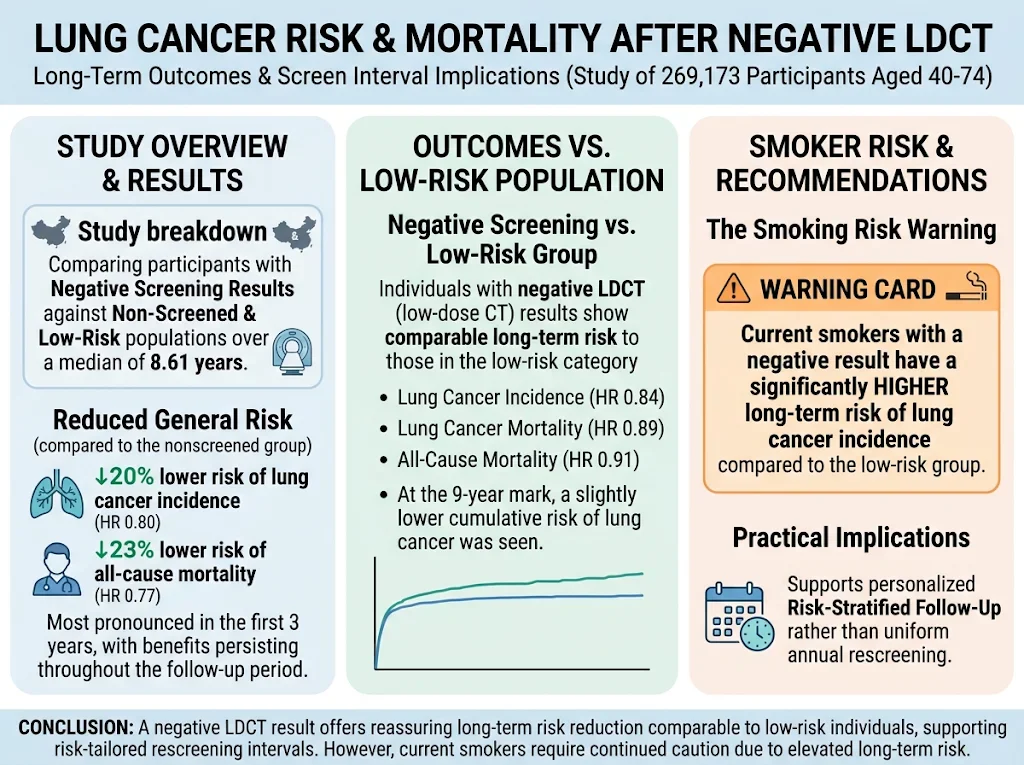
This prospective cohort study analyzed data from China’s National Lung Cancer Screening Program spanning 2012 to 2019, incorporating provincial initiative datasets. The population included 269,173 participants aged 40 to 74 years, stratified into four groups: nonscreened, negative LDCT screening results, positive screening results, and a low-risk population cohort. Lung cancer incidence and mortality were tracked over a median follow-up period of 8.61 years. The study utilized inverse probability weighting combined with Cox proportional hazard models to calculate adjusted hazard ratios (HRs) and 95% confidence intervals (CIs), allowing for rigorous risk estimation in the setting of potential confounding baseline differences.Key Findings
During follow-up, 3,173 incident lung cancer cases and 2,083 lung cancer-related deaths were documented. Compared to the nonscreened group, individuals with negative LDCT screening results demonstrated a significantly decreased risk of lung cancer incidence (HR 0.80; 95% CI, 0.65-0.97) and all-cause mortality (HR 0.77; 95% CI, 0.70-0.85). However, lung cancer-specific mortality in this group was not significantly different (HR 0.88; 95% CI, 0.69-1.12), suggesting that while negative scans confer lower incidence and overall death risk, lung cancer deaths were not statistically reduced. Importantly, the reduction in lung cancer risk persisted over the entire follow-up, with the greatest risk reduction observed in the first three years post-screening. When compared to the low-risk group, those with negative screening results had similar lung cancer incidence (HR 0.84; 95% CI, 0.68-1.03), lung cancer mortality (HR 0.89; 95% CI, 0.69-1.15), and all-cause mortality (HR 0.91; 95% CI, 0.80-1.05), although a modestly lower lung cancer risk was noted at nine years. Stratified analysis revealed that current smokers with negative LDCT results exhibited a higher long-term risk of lung cancer incidence relative to the low-risk group, underscoring the ongoing risk associated with smoking even after negative screening.Expert Commentary
This robust, population-based analysis enhances understanding of long-term lung cancer dynamics following negative LDCT screening. The findings support a nuanced approach to screening intervals—arguing against uniform annual rescreening for all individuals and instead favoring risk-adapted surveillance that incorporates baseline risk factors such as smoking status. Limitations include observational design and potential residual confounding despite adjustment. Generalizability to populations outside of China warrants further study considering differences in lung cancer epidemiology and screening practices internationally. Mechanistically, a negative LDCT may represent a period of stability or absence of detectable pulmonary nodules, temporarily lowering cancer risk but not eliminating carcinogenesis, especially in ongoing smokers. Therefore, ongoing risk assessment remains essential to timely identification of incident disease.Conclusion
Individuals with negative LDCT lung cancer screening results exhibit a sustained reduction in lung cancer incidence and all-cause mortality compared to nonscreened populations, with risks comparable to low-risk groups. Lung cancer-specific mortality, however, does not significantly differ. These results argue for adopting personalized, risk-stratified rescreening protocols rather than uniform annual CT scans, which may reduce healthcare burden without compromising early cancer detection. Continued smoking remains a critical modifier of risk and necessitates close follow-up despite negative initial screens. Future research should aim to refine individual risk models incorporating demographic, behavioral, and imaging biomarkers to optimize tailored lung cancer surveillance strategies, ultimately improving clinical outcomes while conserving resources.Funding and ClinicalTrials.gov
The study was conducted under the auspices of China’s National Lung Cancer Screening Program and affiliated provincial initiatives. Funding sources were not explicitly detailed in the publication. Registration information was not provided.References
1. Liu H, Yan S, Liu P, et al. Lung Cancer Incidence and Mortality After Negative Low-Dose CT Imaging Screening Results. Chest. 2026;170(5):1625-1638. PMID: 42385994. 2. National Lung Screening Trial Research Team. Reduced lung-cancer mortality with low-dose computed tomographic screening. N Engl J Med. 2011;365(5):395-409. 3. Mazzone PJ, Silvestri GA, Patel S, et al. Screening for Lung Cancer: CHEST Guideline and Expert Panel Report. Chest. 2018;153(4):954-985. 4. Oudkerk M, Liu S, Heuvelmans MA, Walter JE, Field JK. Lung cancer LDCT screening and mortality reduction—evidence, pitfalls and future perspectives. Nat Rev Clin Oncol. 2021;18(3):135-151.Specialty calculators
For clinical reference; use professional judgment.