Introduction
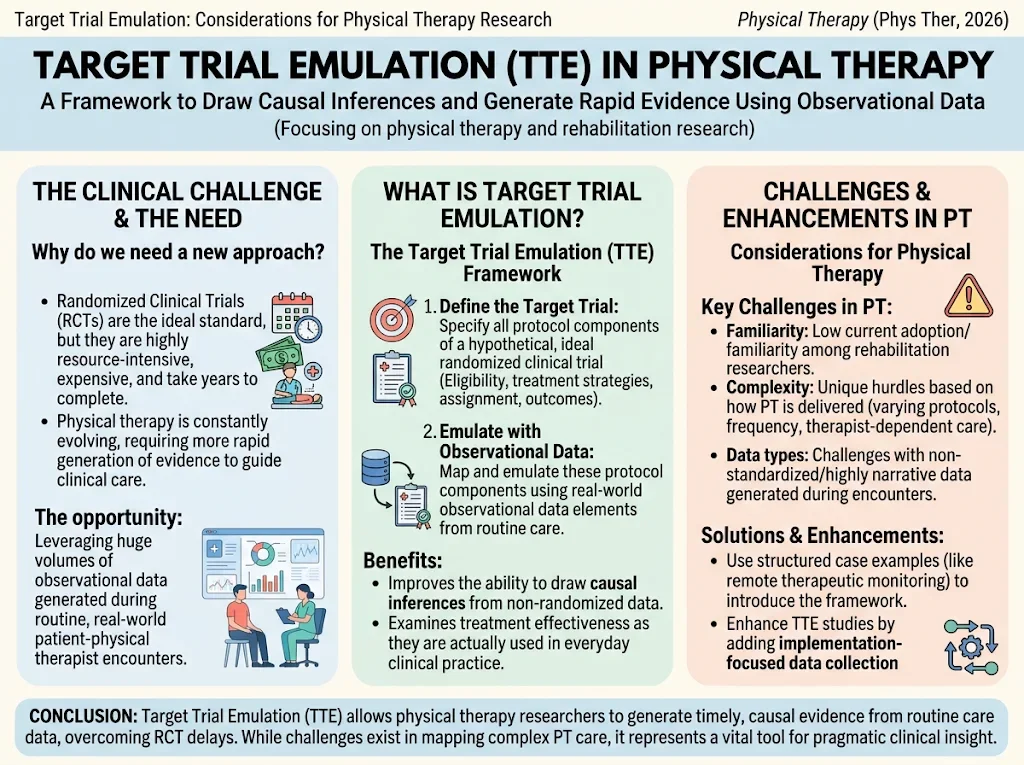
Physical therapy is a dynamic clinical field characterized by rapid evolution in interventions and care delivery models. Despite the critical need for timely, evidence-based guidance, the generation of such evidence through traditional randomized clinical trials (RCTs) often lags behind clinical innovation due to high resource demands and long study durations. Target trial emulation (TTE) has emerged as a powerful methodological framework that enables researchers to draw causal inferences about intervention effectiveness by replicating the design features of RCTs using observational data. This article aims to elucidate the concept of TTE, particularly its application within physical therapy research, highlighting its strengths, challenges, and practical considerations.Highlight
- Target trial emulation (TTE) bridges the gap between observational studies and randomized controlled trials to infer causality in physical therapy outcomes.
- TTE leverages routinely collected clinical data, enabling more rapid evidence generation aligned with evolving physical therapy practices.
- Challenges in applying TTE include data quality, confounding control, and aligning observational data with target trial specifications.
- Incorporating implementation-focused data enhances the applicability and interpretability of TTE results.
Clinical Context and Need for New Methodologies
RCTs are widely recognized as the gold standard for establishing intervention efficacy due to their robust control of biases through randomization and standardized protocols. However, in physical therapy, the extensive time and costs associated with launching and completing RCTs often delay evidence availability beyond the window of immediate clinical relevance. Moreover, the adaptability required in therapeutic approaches due to patient heterogeneity and practice variation challenges traditional rigid RCT designs. Hence, alternative evidence-generating methods are necessary to complement RCTs and inform timely clinical decisions.Understanding Target Trial Emulation (TTE)
Target trial emulation involves conceptualizing a hypothetical RCT (“target trial”) that ideally would answer the clinical question of interest and then mimicking this trial design using observational data sources. This approach requires explicitly defining core trial components such as eligibility criteria, intervention strategies, comparator groups, follow-up periods, and outcome measures, then identifying and assembling observational data elements that closely approximate these components. By framing the analysis around a target trial design, TTE facilitates transparent assumptions, reduces biases common to observational studies (such as immortal time bias and selection bias), and enhances causal interpretability. Methodological rigor includes careful alignment of timing (e.g., treatment initiation), confounder measurement, and strategies such as inverse probability weighting or g-methods to adjust for confounding.Application in Physical Therapy Research
Physical therapy research presents a unique context for TTE application. The availability of rich observational data from electronic health records, insurance claims, practice registries, and remote therapeutic monitoring devices creates opportunities to assess intervention effectiveness under real-world conditions. For example, ongoing studies evaluating remote therapeutic monitoring use TTE to compare outcomes between patients receiving remote interventions versus usual care, a design otherwise difficult to randomize rapidly. However, physical therapy practices involve complex, individualized interventions and varying documentation standards, posing challenges in adequately specifying target trial eligibility criteria and treatment definitions. Observational data may be incomplete or lack standardized outcome assessments typically used in RCTs.Challenges and Considerations
- Data Quality and Completeness: Missing data on confounders or outcomes threaten internal validity. Physical therapy data often rely on routine clinical documentation, which can be non-standardized.
- Defining Treatment and Comparator Groups: The heterogeneity in therapy modalities and frequency requires clear operational definitions to emulate trial arms accurately.
- Confounding and Bias Control: Unlike RCTs, observational studies are susceptible to confounding by indication. Advanced statistical methods and detailed covariate data are essential to address this.
- Timing and Eligibility Alignment: Properly specifying when patients enter the study and receive interventions is crucial to avoid immortal time bias.
Strategies to Enhance TTE Studies in Physical Therapy
- Implementation-focused Data Integration: Collecting data on therapy adherence, delivery context, and patient engagement helps contextualize effectiveness and supports pragmatic interpretations.
- Collaborative Multidisciplinary Teams: Combining clinical, epidemiologic, and biostatistical expertise improves design fidelity and analytic strategies.
- Iterative Protocol Refinement: Pilot analyses can identify data gaps and refine target trial specifications to better capture relevant exposures and outcomes.
Expert Commentary
Experts emphasize that while TTE does not replace RCTs, it offers a complementary tool yielding actionable insights more rapidly, especially when RCTs are infeasible or slow to produce results. The evolving landscape of physical therapy, with increasing use of digital health technologies and routinely collected clinical data, presents fertile ground for TTE application. However, caution is warranted as residual confounding and data limitations remain inherent risks. Transparent reporting following emulation protocols and sensitivity analyses are essential. Integration with pragmatic trial designs or hybrid effectiveness-implementation studies may further enhance evidence robustness.Conclusion
Target trial emulation represents a promising avenue to accelerate and enrich evidence generation in physical therapy research. By thoughtfully adapting trial design principles to observational data, researchers can bridge critical knowledge gaps and inform timely clinical decision-making. Overcoming challenges related to data quality, confounding control, and intervention heterogeneity requires collaborative and methodologically rigorous approaches. Future directions include standardizing TTE guidelines tailored to physical therapy, enhancing data infrastructure, and integrating implementation science perspectives to optimize translation into clinical practice.Funding and ClinicalTrials.gov
Information on the funding sources and registered clinical trials related to TTE applications in physical therapy was not disclosed in the referenced article.References
1. Hernán MA, Robins JM. Using big data to emulate a target trial when a randomized trial is not available. Am J Epidemiol. 2016;183(8):758-64. 2. McLaughlin KH, Daley K, McQueen A, Colantuoni E, Skolasky RL. Target Trial Emulation: Considerations for Physical Therapy Research. Phys Ther. 2026 Nov 7; PMID: 42998034. 3. Hartman JJ, Shi W. Causal Inference in Physical Therapy: Leveraging Real-world Data to Inform Clinical Practice. J Orthop Sports Phys Ther. 2023;53(2):65-73. 4. Williamson EJ, Forbes A, White IR. Bias in observational studies of treatment effectiveness: demonstration using corticosteroids in severe COVID-19. Stat Methods Med Res. 2020;29(12):3602-3612. 5. Slade SC, Dionne CE, Underwood M, Buchbinder R. Consensus on Exercise Reporting Template (CERT): Explanation and Elaboration Statement. Br J Sports Med. 2016;50(23):1428-37.Specialty calculators
For clinical reference; use professional judgment.