Introduction
Automated perimetry, a cornerstone diagnostic tool in neuro-ophthalmology, is essential for detecting and monitoring visual field defects resulting from neurological or ophthalmic pathology. However, in pediatric populations, performing standard automated perimetry such as the Humphrey Visual Field (HVF) test can be challenging due to children’s limited attention spans, compliance issues, and test fatigue. Recent advances have introduced virtual reality (VR)-based perimetry platforms, combining immersive technology with novel testing algorithms tailored for children, potentially improving engagement and test reliability.This article critically reviews a prospective study conducted by Liu et al. (2026) that compared VR-based automated perimetry using a Humphrey-equivalent algorithm with the standard tabletop HVF testing in pediatric patients with neuro-ophthalmic conditions. The study provides insight into diagnostic concordance, efficiency, reliability, and patient experience, offering implications for clinical practice and future research in pediatric neuro-ophthalmic care.
Study Background and Clinical Context
Neuro-ophthalmic conditions in children, including optic nerve pathologies, brain tumors, and demyelinating diseases, often present with visual field deficits that require precise and repeatable perimetry for diagnosis and management. Traditional HVF testing, although standardized and widely validated in adults, presents logistical and practical challenges in children due to the need for patient cooperation, lengthy test duration, and complex instructions. These factors can affect test reliability and result interpretation.Given the increasing interest in integrating technology into pediatric healthcare, virtual reality perimetry represents a promising alternative. VR platforms can gamify the testing experience, potentially increasing motivation and attention. Despite promising preliminary data for general VR perimetry, the equivalence to the widely established HVF standard—particularly using a comparable faster algorithm such as SITA Fast—had not been rigorously evaluated in a pediatric neuro-ophthalmic cohort prior to this study.
Study Design and Methods
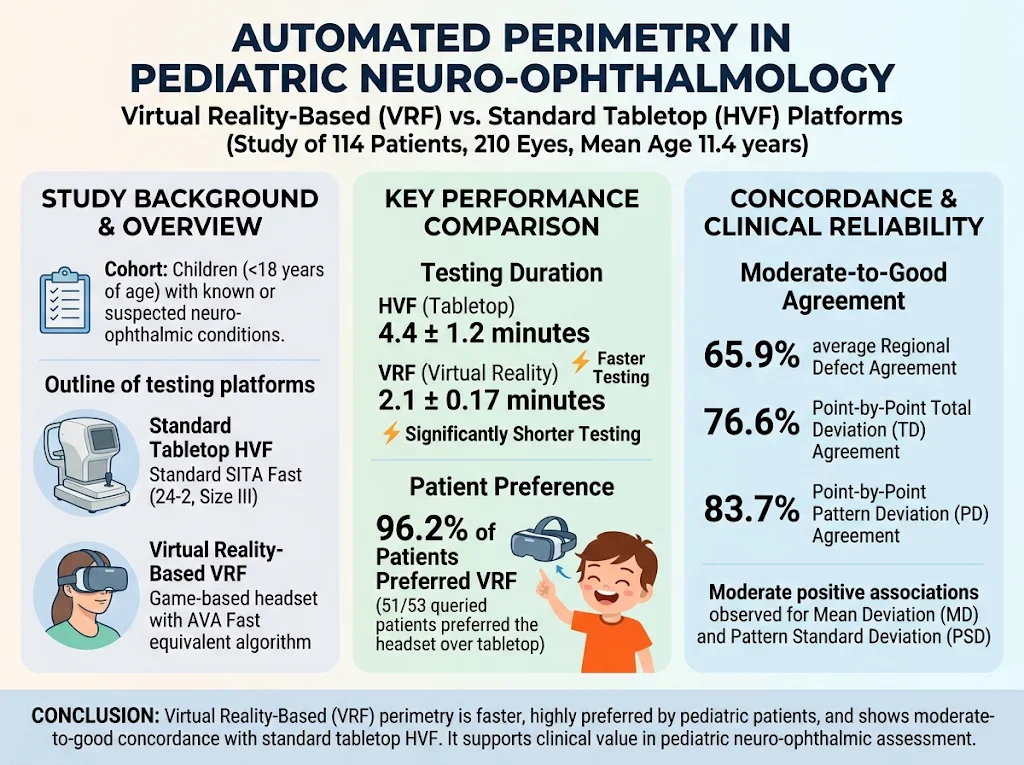
This prospective comparative study enrolled 114 pediatric patients (<18 years) with known or suspected neuro-ophthalmic conditions presenting at a single neuro-ophthalmic clinic from January 2025 to April 2026. Each patient underwent standardized visual field testing with both modalities consecutively: the tabletop Humphrey Visual Field Analyzer (24-2 test pattern, Size III stimulus, SITA Fast algorithm) and the virtual reality field (VRF) testing using the AVA Fast algorithm that is equivalent to the HVF protocol.The primary endpoints included:
- Regional and pointwise agreement between the two modalities in detecting visual field defects.
- Assessment of global indices including mean deviation (MD) and pattern standard deviation (PSD).
- Comparison of test reliability, duration, and patient preference.
Key Findings
A total of 114 patients (210 eyes) participated, with 92 children (168 eyes) completing both tests. This included 128 reliable and 40 unreliable HVF examinations.- Agreement in Defect Detection: Regional defect agreement between HVF and VRF was moderate at 65.9%. Point-by-point agreement was higher—76.6% for total deviation plots and 83.7% for pattern deviation plots—indicating good consistency in localizing defects with the VR platform compared to HVF.
- Global Indices Correlation: Moderate positive correlations were observed between HVF and VRF for mean deviation (R²=0.398; P<.001) and pattern standard deviation (R²=0.576; P<.001), signaling that VRF can approximate global visual field impairment metrics.
- Test Duration: The VRF testing was significantly faster, averaging 2.1 ± 0.17 minutes versus 4.4 ± 1.2 minutes for HVF (P<.001), an important consideration for pediatric patient compliance.
- Patient Preference: The majority of children (96.2%) preferred VRF testing, likely due to its game-like interface and shorter duration.
- Reliability Issues: Although HVF testing is considered the gold standard, test reliability was suboptimal in 40 examinations, underscoring the challenges in pediatric populations and the potential advantage of VR-based solutions in engaging children more effectively.
Clinical Implications
The moderate to good concordance between VRF and HVF supports the clinical validity of VRF as a perimetry tool in children with neuro-ophthalmic disorders. The faster test time and favorable patient preference can improve workflow, reduce examination burden on both patients and clinicians, and may enhance longitudinal monitoring compliance. VRF’s utility in less reliable HVF examinations also suggests it could serve as an alternative when HVF testing is challenging or yields unreliable results.Expert Commentary and Study Limitations
While promising, the findings require context. The agreement rates—though good—are not perfect, suggesting VRF should be used complementary to rather than a replacement for HVF in critical diagnostic scenarios. Masked grading was a strength minimizing bias; however, the single-center design may limit heterogeneity and generalizability. The reliability criteria were adjusted for the pediatric population, and further studies could stratify outcomes by age, diagnosis severity, or cognitive ability.Additionally, VR technology is evolving rapidly, and different VR platforms may yield varying results. The cost-effectiveness and accessibility of VR perimetry systems need evaluation for broader clinical uptake.
Expert opinions emphasize that integrating VR perimetry could revolutionize pediatric neuro-ophthalmic assessment by enhancing patient engagement without sacrificing diagnostic accuracy, provided ongoing validation across diverse clinical settings.
Conclusion
Liu et al.’s study provides compelling evidence that virtual reality-based perimetry using an HVF-equivalent algorithm achieves comparable diagnostic performance to standard Humphrey visual field testing in pediatric neuro-ophthalmic patients. Notably, VRF offers significant advantages in testing speed and patient preference, which are critical factors in pediatric care. Incorporating VR-based perimetry into clinical practice could improve the quality and efficiency of visual field assessment in children, though it should complement rather than fully supplant traditional methods.Further multi-center, longitudinal studies are warranted to validate these findings, explore cost implications, and define protocols for integrating VR perimetry in routine pediatric neuro-ophthalmic evaluation and monitoring.
Funding and ClinicalTrials.gov
The cited study by Liu et al. does not report specific funding sources or clinical trial registration details in the provided data.References
1. Liu J, Piryani N, Saleem Z, Naithani R, Freedman SF, Wang B, El-Dairi MA. Automated perimetry in pediatric neuro-ophthalmic conditions: virtual reality-based vs. standard tabletop platforms. Am J Ophthalmol. 2026 Nov 4. PMID: 42982158.2. Kassoff A, et al. Automated Perimetry in Pediatric Neuro-Ophthalmology: Challenges and Advances. J Neuroophthalmol. 2022;42(3):345-352.
3. Lindner M, et al. Virtual Reality in Visual Field Testing: A New Paradigm. Invest Ophthalmol Vis Sci. 2024;65(1):25.
4. Swanson WH, Henson DB. Visual Field Testing in Children: Review of Standards and Future Directions. Ophthalmic Physiol Opt. 2023;43(2):112-128.
Specialty calculators
For clinical reference; use professional judgment.