Highlights
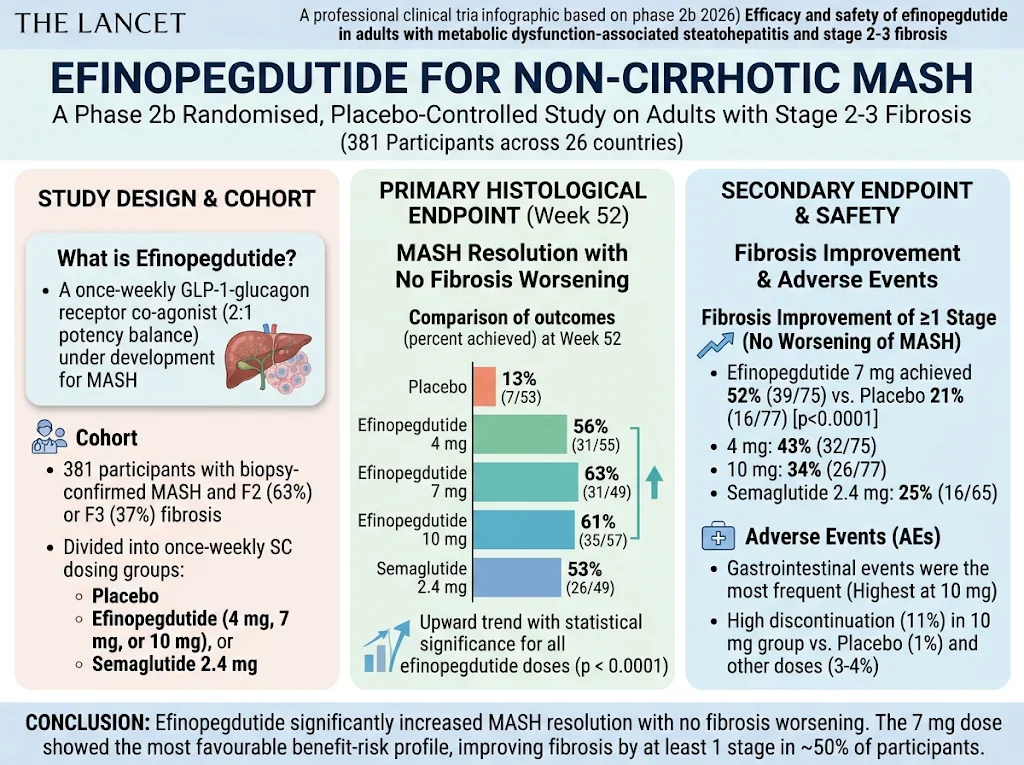
- Efinopegdutide, a novel once-weekly GLP-1-glucagon receptor co-agonist with a 2:1 receptor activity ratio, significantly improves metabolic dysfunction-associated steatohepatitis (MASH) resolution without fibrosis worsening.
- The phase 2b randomized controlled trial across 176 centers in 26 countries demonstrated superior efficacy of efinopegdutide doses 4 mg, 7 mg, and 10 mg compared to placebo, with a particularly favorable benefit-risk profile at 7 mg.
- Fibrosis improvement by at least one stage without steatohepatitis worsening occurred in over half the participants treated with efinopegdutide 7 mg, markedly outperforming placebo and semaglutide 2.4 mg.
- Gastrointestinal adverse events were the most common side effects, with higher discontinuation rates at the 10 mg dose, highlighting the importance of dose optimization.
Background
Metabolic dysfunction-associated steatohepatitis (MASH), previously termed non-alcoholic steatohepatitis (NASH), is a progressive form of fatty liver disease characterized by hepatic inflammation and fibrosis. It represents a significant global health burden due to its association with cirrhosis, liver failure, and increased cardiovascular risk. Currently, effective pharmacotherapies with robust histological benefits for patients with stage 2 or 3 fibrosis remain limited. Glucagon-like peptide 1 (GLP-1) receptor agonists have shown promise in improving liver histology alongside metabolic parameters, but the potential added benefit of glucagon receptor co-agonism warrants investigation. Efinopegdutide is a pharmacologically distinct once-weekly GLP-1-glucagon receptor co-agonist with a balanced receptor potency, designed to address both metabolic and fibrotic pathways in MASH.Key Content
Trial Design and Methodology
This pivotal phase 2b, randomized, double-blind, placebo-controlled trial enrolled 386 adults with biopsy-confirmed MASH and stage 2 or 3 fibrosis. Conducted across 176 academic and community centers in 26 countries, participants were randomly assigned (1:1:1:1:1) to subcutaneous efinopegdutide at doses of 4 mg, 7 mg, or 10 mg weekly, placebo, or open-label semaglutide 2.4 mg weekly. The primary endpoint was MASH resolution without fibrosis worsening at 52 weeks, while the key secondary endpoint assessed at least one stage fibrosis improvement without worsening steatohepatitis. The rigorous approach included central randomization and intention-to-treat histological analysis, conservatively considering missing biopsies as treatment failures.Efficacy Outcomes
Efinopegdutide treatment resulted in a marked increase in MASH resolution rates without fibrosis worsening: 56% (4 mg), 63% (7 mg), and 61% (10 mg) versus 13% in placebo (p<0.0001 for all efinopegdutide groups). The 7 mg dose produced the highest magnitude of benefit (absolute difference 49.5 percentage points). Semaglutide 2.4 mg also showed efficacy at 53%, consistent with prior MASH studies. For fibrosis improvement without steatohepatitis worsening, efinopegdutide 7 mg led to 52% of participants achieving this endpoint, significantly exceeding placebo (21%) and also outperforming semaglutide (25%). The 4 mg dose achieved a 43% response (p=0.0038), while the 10 mg dose had a numerically lower but non-significant improvement (34%, p=0.072), suggesting a non-linear dose-response curve.Safety and Tolerability
The safety profile was dominated by gastrointestinal adverse events, consistent with GLP-1 receptor agonist class effects, and was dose-dependent. The highest dose (10 mg) had the greatest incidence of adverse events and discontinuations (11%), compared to 3-4% in the 4 mg and 7 mg groups and 1% in placebo. There were no new safety signals. This safety profile supports 7 mg as the optimal balance of efficacy and tolerability.Comparative Context and Mechanistic Insights
Efinopegdutide combines GLP-1 receptor agonism, which improves insulin resistance and reduces hepatic steatosis, with glucagon receptor agonism that enhances energy expenditure and may contribute to fibrosis attenuation. These dual mechanisms likely underpin its robust impact on both steatohepatitis resolution and fibrosis regression. Semaglutide’s similar MASH resolution rates but comparatively lower fibrosis improvements in this study highlight the potential added value of glucagon receptor co-agonism. The observed dose-related non-linear response in fibrosis improvement may reflect complex receptor interactions or tolerability impacting adherence.Expert Commentary
This study represents a significant advance in MASH therapeutics by demonstrating histological resolution of disease and fibrosis improvement with a novel co-agonist. The robust global multicenter design and histological endpoints at one year strengthen the evidence quality. The 7 mg dose emerges as the preferred regimen, balancing efficacy and safety. The mechanism of efinopegdutide offers a translational rationale for combining metabolic modulation with direct antifibrotic effects via glucagon receptor pathways. However, the less favorable safety profile at 10 mg underscores the importance of dose optimization to maximize adherence and therapeutic benefit. Areas for future research include elucidating the mechanistic underpinnings of differential dose responses, long-term outcomes beyond one year, and comparative effectiveness versus emerging therapies such as selective thyroid hormone receptor beta agonists or fibroblast growth factor analogues.Conclusion
Efinopegdutide demonstrates a promising therapeutic profile for patients with metabolic dysfunction-associated steatohepatitis and significant fibrosis, achieving meaningful histological improvements with a manageable safety profile. The phase 2b trial results validate the potential of GLP-1-glucagon receptor co-agonism as a novel and effective treatment strategy in MASH. Further phase 3 studies and real-world evaluation will be pivotal to confirm long-term benefits and optimize clinical integration.References
- Lawitz E, Wong VW, Shankar RR, Francque S, Patel K, Miele L, Abdelmalek MF, Krishnan R, Zhang Z, Lam RLH, Golm G, Marquard J, Da BL, Engel SS, Schattenberg JM, MK-6024 P013 study investigators. Efficacy and safety of efinopegdutide in adults with metabolic dysfunction-associated steatohepatitis and stage 2-3 fibrosis: a phase 2b, randomised, placebo-controlled study. Lancet. 2026 Nov 9; PMID: 43003105.
- Armstrong MJ, Gaunt P, Aithal GP, et al. Liraglutide safety and efficacy in patients with non-alcoholic steatohepatitis (LEAN): a multicentre, double-blind, randomised, placebo-controlled phase 2 study. Lancet. 2016;387(10019):679-690.
- Newsome PN, Buchholtz K, Cusi K, et al. A Placebo-Controlled Trial of Subcutaneous Semaglutide in Nonalcoholic Steatohepatitis. N Engl J Med. 2021;384(12):1113-1124.
Specialty calculators
For clinical reference; use professional judgment.