Introduction and Context
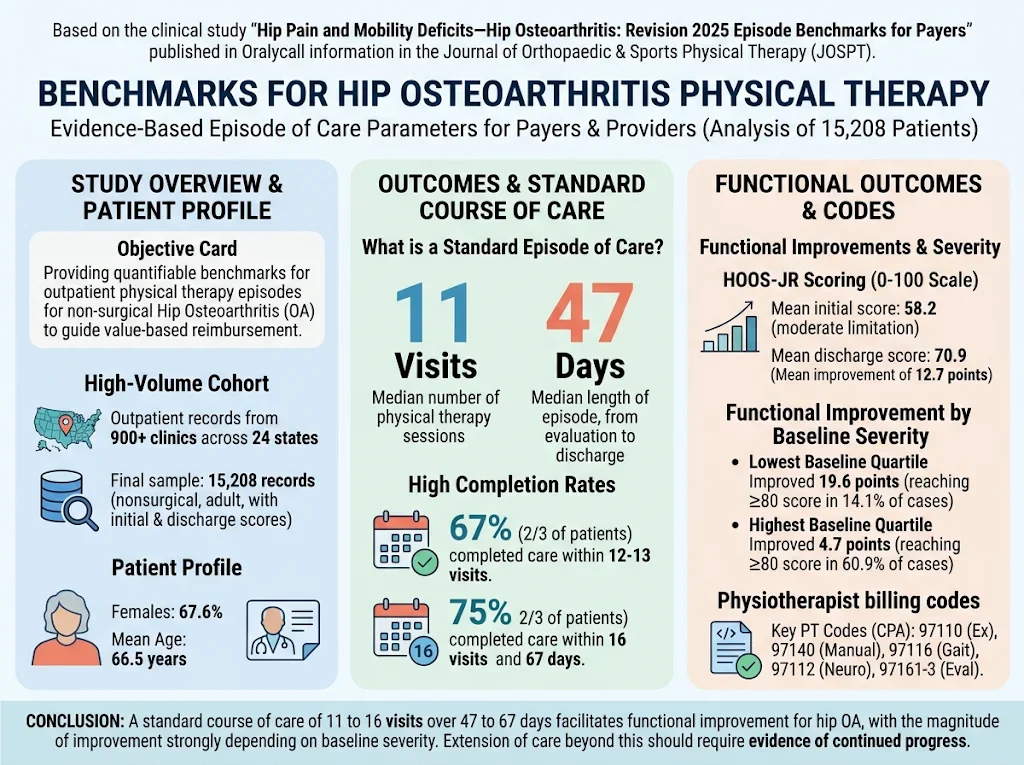
Hip osteoarthritis (OA) is a leading cause of pain and functional loss in older adults. Radiographic hip OA affects a substantial portion of adults over 55 in the United States, and clinicians increasingly deliver conservative care—especially outpatient physical therapy (PT)—to manage symptoms and delay or avoid joint replacement. In response to payer demand for evidence-based, value-focused authorization criteria, the American Physical Therapy Association (APTA) issued a focused revision in 2025 producing episode benchmarks for hip pain and mobility deficits attributable to hip OA. Those benchmarks, published as “Hip Pain and Mobility Deficits—Hip Osteoarthritis: Revision 2025: Episode Benchmarks for Payers” (Bise CG et al., J Orthop Sports Phys Ther. 2026), were designed to define expected care components, visit ranges, outcome measures, and escalation triggers so payers can authorize episodes that match clinical need while clinicians can deliver guideline-consistent care. Why this update matters now – Health systems and payers are shifting to episode-based and value-based payment models; standardized benchmarks help align authorization with recommended care intensity and outcomes. – Increasing evidence supports structured exercise, manual therapy, and patient education for hip OA; benchmarks translate that evidence into actionable episode expectations. – Telehealth, home-based programs, and new value metrics (patient-reported outcomes) have matured since prior releases, requiring revised guidance.New Guideline Highlights
The APTA 2025 episode benchmarks focus on outpatient PT management for the ICD-10 diagnoses commonly used for hip OA, including M16.x (primary, secondary, dysplastic, posttraumatic coxarthrosis) and M25.55/M25.65 (hip pain, hip stiffness). Key practical messages: – Episode scope: Benchmarks define an initial conservative episode of care (typical duration, visit frequency, and core interventions) rather than specifying individual clinician decision rules. – Visit and duration ranges: Typical conservative PT episodes for hip OA are expected to fall within standard ranges (see boxed benchmarks below). – Core interventions: Therapeutic exercise (strength, neuromuscular control, aerobic activity), manual therapy when appropriate, gait and mobility training, education (self-management, weight management), and assistive-device training are prioritized. – Outcome measurement: Standardized patient-reported outcome measures (PROMs) such as the Hip disability and Osteoarthritis Outcome Score (HOOS) or WOMAC are recommended to track progress and authorize continued care. – Escalation criteria: Benchmarks specify triggers for medical imaging, medication review, or surgical referral when conservative care fails or red flags are present. Key takeaways for clinicians and payers – Expect most patients to improve within 6–12 weeks of guideline-based PT. – Transparent outcome reporting tied to authorization (e.g., improvement in HOOS/WOMAC or performance measures) supports continued care beyond the initial episode. – Benchmarks emphasize individualized care within set ranges rather than rigid visit caps.Updated Recommendations and Key Changes from Prior Versions
APTA’s 2025 revision updates the previous episode guidance in several important ways. Major changes include: – Explicit ICD-10 coverage: The revision lists specific hip OA and hip pain ICD-10 codes (M16.0–M16.7, M25.55, M25.65) to reduce coding ambiguity when payers authorize episodes. – Outcome-driven authorization: The new benchmarks require baseline and interval PROMs (HOOS or WOMAC) and recommend reporting of minimum clinically important differences (MCID) to justify continuation of care. – Telehealth and hybrid delivery: Benchmarks recognize telehealth and home-based programs as acceptable within an episode when clinically appropriate, with recommended visit mixes. – Emphasis on conservative management hierarchy: Greater clarity on sequencing—education and exercise first, adjuncts (manual therapy, short-term assistive device) when indicated, and imaging/specialist referral reserved for failures or red flags. – Integration with value-based payment: Benchmarks include suggested performance metrics for payers (functional improvement, reduced pain scores, reduced opioid prescribing, and progression to arthroplasty) to measure value across episodes. Side-by-side summary (previous guidance vs. 2025 revision) – Episode length: Prior: variable; 2025: recommended initial conservative episode 6–12 weeks. – Visit range: Prior: site- and clinician-dependent; 2025: recommended typical range 6–12 visits (with rationale below). – Outcome measures: Prior: inconsistent; 2025: required baseline and interval PROMs (HOOS/WOMAC) and objective performance tests (30-second sit-to-stand, timed up-and-go). – Telehealth: Prior: limited guidance; 2025: explicitly accepted as part of episode when combined with in-person care as needed.Topic-by-Topic Recommendations
Diagnosis and baseline assessment – Clinical diagnosis: Hip OA should be diagnosed on the basis of history (activity-related hip/groin pain, morning stiffness <30 minutes), physical exam (reduced internal rotation and flexion, pain with hip movement), and radiographs when indicated. ACR/Arthritis Foundation diagnostic criteria and clinical algorithms remain relevant (Kolasinski et al., 2020). – When to image: Routine radiographs are not required to start PT if clinical presentation is consistent with hip OA, but weight-bearing AP pelvis and lateral hip x-rays are appropriate if there is atypical pain, trauma, rapid progression, or prior surgical history. – Baseline measures (recommended): HOOS or WOMAC, Numeric Pain Rating Scale (NPRS), patient-specific functional scales, timed up-and-go (TUG), and 30-second sit-to-stand. Episode structure and benchmarks (APTA 2025 recommendations) – Typical initial conservative episode: Duration 6–12 weeks. – Typical visit count: 6–12 visits across the episode, individualized by severity and comorbidities. – Visit frequency example: 1–3 visits/week early (first 2–4 weeks) tapering as home program adherence and function improve. – Acceptable variance: Patients with severe disability, high pain, or multimorbidity may require extended episodes; such extensions should be justified by objective outcome trajectories and clinician documentation. Core interventions (evidence-aligned) – Therapeutic exercise (Grade A/B evidence): Progressive strengthening (hip abductors, extensors), range-of-motion, neuromuscular control, and aerobic conditioning are first-line and supported by ACR and Cochrane evidence (Kolasinski et al., 2020; Fransen et al., 2014). – Manual therapy (Grade B): When used adjunctively, manual techniques (hip mobilizations, soft tissue mobilization) can enhance short-term pain and function, especially when paired with exercise. – Education and self-management (Strong recommendation): Instruction on activity modification, pacing, weight management, footwear, and joint protection. – Assistive devices and gait training (Conditional): Temporary cane use on contralateral side or shoe lifts for leg-length discrepancy can reduce pain and improve gait symmetry when indicated. – Modalities (Electrotherapeutic, heat/ice): Consider as adjuncts for short-term symptom control but not substitutes for exercise-based care. Treatment progression and discharge criteria – Expected response timeline: Many patients show measurable improvement in pain and function within 4–8 weeks of structured exercise and manual therapy. – Objective criteria to continue or discharge: Improvement toward MCID on PROMs (e.g., HOOS/WOMAC), improved performance on TUG or sit-to-stand, or documented progress in individualized functional goals. – When to escalate: Lack of meaningful improvement after 8–12 weeks of guideline-based PT, worsening pain despite adherence, new neurological signs, or radiographic evidence of advanced disease should prompt medical/surgical consultation. Special populations and comorbidities – Obesity: Integrate weight-loss counseling and safe aerobic conditioning; refer to nutrition services when needed. – Older adults and frailty: Emphasize progressive resistance training adapted to tolerance; monitor for fall risk and incorporate balance training. – Posttraumatic or dysplastic OA: Consider earlier imaging and orthopedic referral due to structural contributors. – Patients on anticoagulation or with cardiac disease: Modify manual techniques and exercise progression in collaboration with medical team. Follow-up and outcome reporting – Recommended PROMs: HOOS or WOMAC at baseline, 4–8 weeks, and at episode end. – Performance tests: TUG and 30-second sit-to-stand at the same intervals for objective functional tracking. – Payer-facing metrics: Report percent achieving MCID, change in opioid prescriptions (if applicable), and rate of progression to surgical referral within 6 months.Expert Commentary and Insights
Committee perspectives – The expert panel emphasized that episode benchmarks are meant to reflect expected care for typical patients with hip OA receiving outpatient PT, not to be interpreted as rigid visit caps. They advocated for documentation of clinical reasoning and outcome trajectory to support deviations when needed. – Telehealth inclusion reflected accumulated evidence that remote-guided exercise programs can be effective when combined with periodic in-person assessments. Key controversies and areas of debate – Visit caps vs. individualized care: Payers often seek clear limits; clinicians argue that complex patients need flexibility. The revision seeks a middle ground—transparent expectable ranges tied to outcome progress. – Use of passive modalities: There is ongoing debate about reimbursement for passive modalities with limited evidence; the panel recommended limiting their role to adjunctive, short-term pain relief. – Timing of imaging and surgical referral: While conservative management is emphasized, experts note that structural disease and patient preferences may justify earlier orthopedic evaluation. Future research priorities identified by the committee – Better prediction models to identify who will respond to short conservative episodes versus who will require prolonged care or earlier arthroplasty. – Comparative-effectiveness trials of telehealth vs. hybrid vs. in-person programs for hip OA. – Standardizing PROMs and MCIDs across diverse populations and comorbidity profiles.Practical Implications
For clinicians – Align assessment and documentation with benchmark requirements: use HOOS/WOMAC and TUG to document baseline and progress. – Design episodes to emphasize progressive exercise and self-management; reserve modalities as adjuncts. – Prepare outcome-based justifications for extended or intensified courses of care when patient complexity warrants it. For payers – Use APTA benchmarks to inform prior authorization parameters that focus on outcome trajectories rather than rigid visit counts alone. – Require submission of baseline and interval PROMs to support continuation beyond the initial episode. – Allow telehealth and hybrid delivery models consistent with clinical needs. For patients – Expect an initial 6–12 week course of PT focused on exercise, education, and functional training. – Ask your clinician about PROMs and functional tests so you can track progress together. – If pain or function do not improve after 8–12 weeks, discuss further medical or surgical evaluation.Patient Vignette
Maria Johnson, a 67-year-old retired teacher, reports progressive right hip pain with walking and climbing stairs for 9 months. Baseline HOOS is 48/100; TUG is 14 seconds. She begins a 10-week PT episode guided by the APTA benchmarks: baseline PROMs, twice-weekly sessions for 3 weeks (manual therapy + progressive strengthening), then weekly supervised sessions with a home program focusing on hip abductor and extensor strengthening and a supervised walking program. At 8 weeks her HOOS improves to 68 and TUG to 10 seconds—exceeding the MCID—supporting discharge to maintenance with monthly check-ins. If she had failed to improve, the benchmark would support communicating with her PCP for medication review and orthopedic consult for possible imaging and discussion of arthroplasty.References
– Bise CG, Lutz A, Myers N, Martin R. Hip Pain and Mobility Deficits—Hip Osteoarthritis: Revision 2025 Episode Benchmarks for Payers. J Orthop Sports Phys Ther. 2026;56(11):748-749. doi:10.2519/jospt.2026.0503. PubMed PMID: 42966903. URL: https://pubmed.ncbi.nlm.nih.gov/42966903/ – Kolasinski SL, Neogi T, Hochberg MC, et al. 2019 ACR/Arthritis Foundation Guideline for the Management of Osteoarthritis of the Hand, Hip, and Knee. Arthritis Care Res (Hoboken). 2020;72(2):149-162. doi:10.1002/acr.24131. – Fransen M, McConnell S, Hernandez-Molina G, Reichenbach S. Exercise for osteoarthritis of the hip. Cochrane Database Syst Rev. 2014;(4):CD007912. doi:10.1002/14651858.CD007912.pub2. – Bennell KL, Dobson F, Hinman RS. Exercise in osteoarthritis of the hip and knee. Best Pract Res Clin Rheumatol. 2014 Apr;28(1):85-100. doi:10.1016/j.berh.2014.01.005. – Zhang Y, Jordan JM. Epidemiology of osteoarthritis. Clin Geriatr Med. 2010 Aug;26(3):355-369. doi:10.1016/j.cger.2010.03.001. – American Academy of Orthopaedic Surgeons Clinical Practice Guideline: Treatment of Osteoarthritis of the Hip. 2nd Edition. AAOS; 2017. URL: https://www.aaos.org/quality/clinical-practice-guidelines/ – Centers for Disease Control and Prevention. Osteoarthritis: Data and Statistics. URL: https://www.cdc.gov/arthritis/data_statistics/index.htm Note: This article summarizes the APTA 2025 episode benchmarks as published by Bise et al. (JOSPT 2026) and places them in the context of existing OA care guidelines and evidence. Clinicians should integrate these benchmarks with individualized clinical judgement and local payer policies.Specialty calculators
For clinical reference; use professional judgment.