Highlight
- Wire-based fractional flow reserve (FFR) is the clinical standard for guiding coronary revascularization but remains underutilized.
- Vessel fractional flow reserve (vFFR), derived from angiography without need for pressure wire, offers a less invasive alternative.
- The randomized multicenter LIPSIA-STRATEGY trial found vFFR-guided revascularization to be noninferior to wire-based FFR guidance with similar 1-year major adverse cardiac event rates.
- The trial highlights potential for broader adoption of physiological assessment in intermediate coronary stenoses using wire-free methods while acknowledging limitations in relative noninferiority analyses.
Study Background
Coronary artery disease (CAD) remains a leading cause of morbidity and mortality worldwide. Accurate assessment of intermediate coronary stenoses is essential to determine the need for revascularization. Currently, wire-based fractional flow reserve (FFR) measurement—a technique that uses a pressure-sensing wire to quantify the hemodynamic significance of coronary lesions—is the gold standard for physiologic lesion assessment. FFR guidance improves clinical outcomes and reduces unnecessary interventions compared to angiography-alone strategies. Despite guideline endorsements, FFR use is limited by procedural time, costs, and patient discomfort. Angiography-derived FFR, or vessel fractional flow reserve (vFFR), estimates lesion-specific physiological significance based on angiographic images and computational modeling, avoiding the need for pressure wires or hyperemic agents. Previous nonrandomized and observational studies suggested promise for vFFR, but randomized trial evidence comparing vFFR to wire-based FFR remained inconclusive. The LIPSIA-STRATEGY trial set out to clarify whether angiography-derived vFFR can guide coronary revascularization as effectively as invasive wire-based FFR in patients with intermediate coronary lesions, including those presenting with acute or chronic coronary syndromes.Study Design
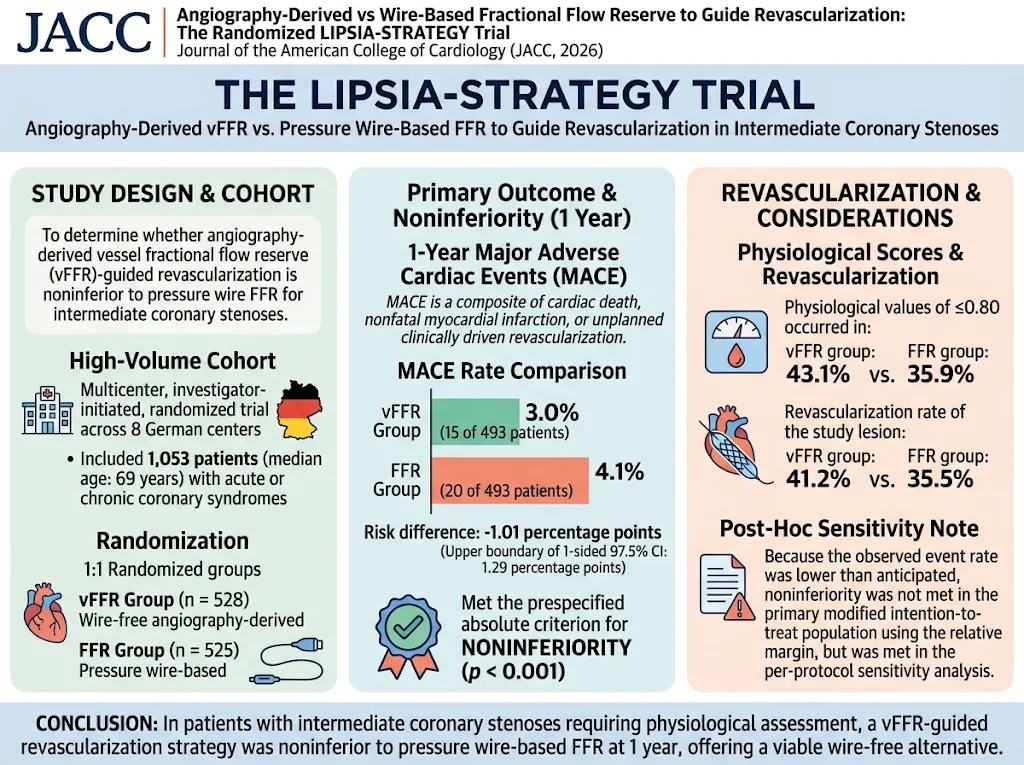
LIPSIA-STRATEGY was a prospective, multicenter, investigator-initiated randomized controlled trial conducted across eight German centers. It enrolled 1,053 patients with acute or chronic coronary syndromes who had at least one intermediate coronary artery stenosis requiring physiological evaluation. Patients were randomized in a 1:1 fashion to receive revascularization based on either angiography-derived vFFR or wire-based FFR. Both strategies used a threshold of 0.80 or less to indicate hemodynamically significant stenosis warranting revascularization. The primary endpoint was the incidence of major adverse cardiac events (MACE) at one year, defined as the composite of cardiac death, nonfatal myocardial infarction, or unplanned clinically driven revascularization. The study employed a modified intention-to-treat analysis to test noninferiority of vFFR compared with FFR, using a prespecified noninferiority margin of 3.5 percentage points.Key Findings
Of the 1,053 randomized patients (median age 69 years), 528 were allocated to the vFFR group and 525 to the FFR group. The primary endpoint was assessable in 986 patients (93.7%). At one year, MACE occurred in 3.0% of patients in the vFFR arm compared with 4.1% in the FFR arm, resulting in a risk difference of -1.01 percentage points favoring vFFR (P for noninferiority <0.001). The upper limit of the one-sided 97.5% confidence interval was 1.29 percentage points, well below the prespecified margin. The relative risk was 0.75 (95% CI: 0.39 to 1.45), indicating no statistically significant difference. Physiologically significant lesions (vFFR or FFR values ≤0.80) were identified in 43.1% versus 35.9% of patients, respectively. Correspondingly, revascularization was performed in 41.2% of the vFFR group and 35.5% of the FFR group. Notably, the overall event rate was lower than anticipated, affecting the conservativeness of the noninferiority margin on a relative scale. Post hoc sensitivity analyses applying a relative margin of 1.44 showed that noninferiority was not met in the modified intention-to-treat population but was confirmed in the per-protocol analysis.Safety and Procedural Considerations
The vFFR approach, avoiding wire manipulation and hyperemic agents, may reduce procedural time and patient discomfort without compromising safety. Although the trial did not specifically elaborate on procedural complications or adverse events related to the physiological assessment methods, event rates were comparable between groups.Expert Commentary
The LIPSIA-STRATEGY trial provides valuable randomized evidence supporting the use of angiography-derived physiological assessment as an alternative to wire-based FFR in selecting patients for coronary revascularization in intermediate lesions. This could potentially improve uptake of physiology-guided strategies by mitigating barriers such as cost, procedural complexity, and patient discomfort. However, the nuanced interpretation of noninferiority margins and sensitivity analyses underscores the importance of cautious clinical translation. The slightly higher rate of revascularization in the vFFR group prompts questions about the balance between diagnostic sensitivity and specificity and whether increased interventions translate into improved long-term outcomes. Current guidelines recommend FFR measurement for intermediate stenoses, but newer noninvasive and wire-free technologies are increasingly promising. Clinicians should consider institutional expertise, patient characteristics, and procedural logistics when selecting an assessment method. Limitations of the trial include the lower event rate than anticipated, limiting statistical power, and lack of detailed mechanistic or hemodynamic correlates. Longer-term follow-up would better define the sustained equivalence and clinical benefit of vFFR-guided management.Conclusion
In patients with intermediate coronary stenoses requiring physiological evaluation, the LIPSIA-STRATEGY trial demonstrated that angiography-derived vFFR-guided revascularization is noninferior to wire-based FFR guidance at one year for the composite endpoint of major adverse cardiac events. Given the advantages of a wire-free approach, vFFR represents a practical alternative that may enhance the utilization of physiology-guided interventions. Clinicians should interpret the findings considering relative margins and conduct comprehensive patient assessment although these data support expanding options for functional lesion assessment in contemporary cardiology practice. Future research should focus on longer-term outcomes, cost-effectiveness, and real-world implementation of angiography-derived physiology.Funding and Clinical Trial Registration
The LIPSIA-STRATEGY trial was investigator-initiated and conducted in Germany, registered under ClinicalTrials.gov Identifier NCT03497637 with protocol ID HRC045277.References
1. Majunke N, Desch S, Kister T, et al. Angiography-Derived vs Wire-Based Fractional Flow Reserve to Guide Revascularization: The Randomized LIPSIA-STRATEGY Trial. J Am Coll Cardiol. 2026 Nov 1; [PMID: 43033171]. 2. Pijls NH, De Bruyne B, Peels K, et al. Measurement of fractional flow reserve to assess the functional severity of coronary-artery stenoses. N Engl J Med. 1996 Mar 14;334(26):1703-8. 3. Toth GG, De Bruyne B, Kala P, et al. Vasodilatory capacity of the coronary microcirculation is preserved in patients with ischemia and nonobstructive coronary artery disease. J Am Coll Cardiol. 2016 Feb 9;67(5):435-43. 4. ESC Guidelines for the management of coronary artery disease published 2020. 5. Lee JM, Hwang D, Park J, et al. Computed tomography-derived fractional flow reserve: a comprehensive review. JACC Cardiovasc Imaging. 2020 Oct;13(10):2261-2274.Specialty calculators
For clinical reference; use professional judgment.