Highlight
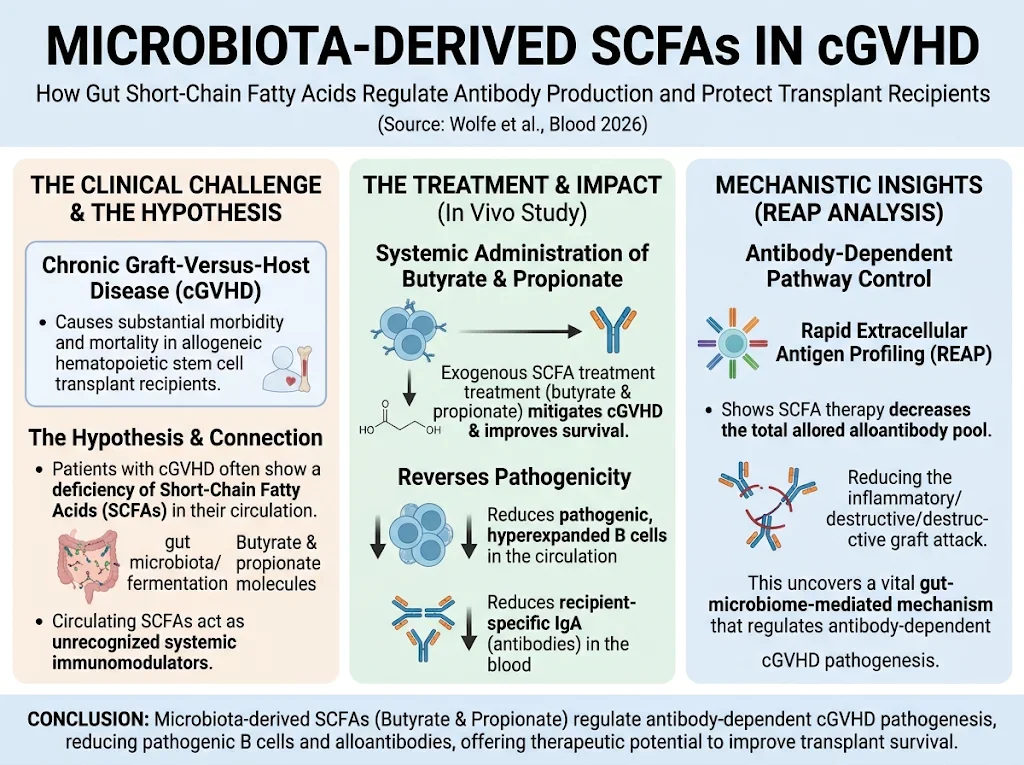
Microbiota-derived short-chain fatty acids (SCFAs), specifically butyrate and propionate, play a crucial immunomodulatory role in regulating antibody production that drives chronic graft-versus-host disease (cGVHD). Systemic administration of these SCFAs in murine models reduces B cell hyperexpansion and pathogenic alloantibodies, thereby mitigating cGVHD development and improving survival post-allogeneic hematopoietic stem cell transplantation (HSCT). This research uncovers a novel gut-immune axis mechanism with potential translational applications in preventing antibody-mediated transplant complications.
Study Background
Chronic graft-versus-host disease (cGVHD) remains a leading cause of morbidity and mortality in recipients of allogeneic hematopoietic stem cell transplantation, manifesting as a complex syndrome characterized by immune-mediated damage to multiple organs. Despite advances in transplant protocols and immunosuppressive therapies, the incidence and severity of cGVHD continue to pose significant clinical challenges.
Emerging evidence implicates the gut microbiota and its metabolites in modulating host immune responses. Among these metabolites, short-chain fatty acids (SCFAs)—notably butyrate, propionate, and acetate—are produced by bacterial fermentation of dietary fibers in the colon and have demonstrated diverse roles in maintaining intestinal mucosal integrity and systemic immune regulation.
Prior clinical observations have linked lower circulating SCFA levels with increased cGVHD incidence, pointing to a possible protective immunomodulatory function of these microbial metabolites. However, the mechanistic pathways through which SCFAs influence systemic alloimmune responses and antibody production in cGVHD have not been fully elucidated.
Study Design
Wolfe et al. investigated the immunomodulatory effects of two key SCFAs— butyrate and propionate—on cGVHD pathogenesis using established murine models of allogeneic HSCT. The study employed systemic administration of exogenous SCFAs to recipient mice undergoing transplantation, with multiple cohorts receiving either butyrate, propionate, or vehicle control.
Outcomes measured included overall survival, clinical and histopathological manifestations of cGVHD, and immunophenotyping to evaluate B cell dynamics and antibody profiles. A novel rapid extracellular antigen profiling (REAP) technique was applied to characterize the breadth of alloantibodies present in circulation post-transplant. The study also assessed recipient-specific IgA levels to investigate mucosal antibody responses.
Key Findings
The study demonstrated that systemic administration of butyrate or propionate resulted in significant attenuation of cGVHD severity and improved survival in recipient mice. Key immunological findings include:
- Reduction of Pathogenic B cell Expansion: SCFA treatment decreased the hyperexpansion of pathogenic B cells, which are implicated in aberrant antibody-mediated tissue injury in cGVHD.
- Decreased Alloantibody Production: Both butyrate and propionate lowered total alloantibody levels detected by REAP profiling, indicating a broad suppression of the humoral alloimmune response.
- Lower Recipient-Specific IgA: Circulating recipient-specific IgA, which may contribute to tissue-specific immune pathology, was also reduced following SCFA administration.
- Survival Benefit and Clinical Improvement: Mice treated with SCFAs exhibited milder manifestations of cGVHD and prolonged survival, underscoring the therapeutic potential of microbiota-derived metabolites in modulating alloimmune injury.
These findings establish a mechanistic link between microbiota-derived SCFAs and modulation of antibody-dependent pathogenesis in chronic GVHD, highlighting the gut microbiome’s systemic immunoregulatory influence.
Expert Commentary
This study adds to the growing body of evidence that the metabolic output of the intestinal microbiome critically shapes systemic immune responses following HSCT. By focusing on the role of SCFAs in regulating B cell-mediated alloimmunity, Wolfe et al. provide a compelling biological rationale for therapeutic interventions aimed at restoring or supplementing these microbial metabolites after transplantation.
The use of REAP, a high-throughput antigen profiling technique, enhances understanding of the complex alloantibody landscape in cGVHD, which may have implications beyond transplant immunology to other antibody-mediated conditions.
Limitations of this preclinical study include its murine model basis, which may not fully replicate human cGVHD heterogeneity. The systemic administration of SCFAs, while beneficial in mice, raises questions about optimal dosing, delivery methods, and long-term effects in humans. Furthermore, the interplay between SCFA-producing gut bacteria, dietary influences, and patient-specific microbiome compositions warrants further clinical investigation.
Conclusion
Microbiota-derived short-chain fatty acids, specifically butyrate and propionate, emerge as critical immunomodulators that suppress pathogenic B cell hyperexpansion and alloantibody production, thereby mitigating chronic GVHD development in mouse models. This bench-to-bedside insight emphasizes the potential of microbiome-targeted therapies or SCFA supplementation as adjunct strategies to prevent or treat antibody-driven cGVHD in allogeneic HSCT recipients.
Future clinical trials are needed to evaluate safety, feasibility, and efficacy of SCFA-based interventions in human transplant populations, as well as to clarify their role within the broader gut-immune axis influencing transplant outcomes.
Funding and ClinicalTrials.gov
The study was supported by grants attributed to the authors’ institutions; specific funding sources were not detailed in the abstract. There is no registered clinical trial associated with this preclinical research at this time.
References
Wolfe AE, Ho T, Chakka SR, et al. Microbiota-derived short-chain fatty acids control cGVHD development by regulating antibody production. Blood. 2026 Nov 16; PMID: 43038184. Available from: https://pubmed.ncbi.nlm.nih.gov/43038184/
Reddy P, Ferrara JL. The biology of chronic graft-versus-host disease. Blood. 2003;102(7):2349-2355.
Smith PM, Howitt MR, Panikov N, et al. The microbial metabolites, short-chain fatty acids, regulate colonic Treg cell homeostasis. Science. 2013;341(6145):569-573.
Markey KA, Hill GR. Recent developments in chronic graft-versus-host disease. Blood. 2020;136(6):661-670.
Specialty calculators
For clinical reference; use professional judgment.