Highlight
1. Circulating apolipoprotein J (ApoJ), a liver-derived molecular chaperone, correlates with renal dysfunction in type 2 diabetes mellitus (T2DM) patients.
2. ApoJ accumulation in the kidney disrupts TFEB-mediated lipid homeostasis, exacerbating lipid accumulation and renal fibrosis in diabetic kidney disease (DKD).
3. Hepatocyte-specific ApoJ deletion or pharmacological blockade using the ApoJ antagonist MK53 reduces ApoJ renal accumulation, restores lipid balance, and ameliorates DKD pathology.
4. The study introduces a liver-to-kidney pathogenic axis contributing to diabetic renal injury with potential therapeutic implications.
Study Background
Diabetic kidney disease (DKD) is a leading cause of end-stage renal disease globally, driven by complex metabolic derangements including ectopic lipid accumulation in renal tissues. Lipotoxicity within proximal tubular epithelial cells (PTECs) is understood to contribute significantly to DKD progression by inducing cell injury and fibrosis. Apolipoprotein J (ApoJ), also known as clusterin, is a multifunctional glycoprotein primarily secreted by the liver and involved in cellular stress response and lipid transport. Although implicated in systemic metabolic regulation, the specific role of ApoJ in kidney lipid metabolism and DKD pathophysiology remained unclear prior to this investigation. Understanding ApoJ’s mechanistic involvement offers potential targets for therapeutic intervention in DKD, where current management remains suboptimal.
Study Design
This translational study combined clinical observations with mechanistic molecular experiments and animal models. Circulating ApoJ levels were measured in a cohort of 201 individuals with type 2 diabetes mellitus. Associations between ApoJ concentrations and renal function indices were assessed using Spearman’s correlation analysis.
Mechanistic insights were gained through proteomic analyses of kidney tissues and proximal tubular epithelial HK2 cells subjected to nutrient excess to model diabetic conditions. Functional validation involved both gain- and loss-of-function experiments manipulating ApoJ expression in vitro.
In vivo, tissue-specific ApoJ-knockout mice—particularly with hepatocyte-targeted ApoJ deletion—were utilized alongside standard murine DKD models to explore the systemic and renal effects of ApoJ. A pharmacologic approach tested the ApoJ antagonist MK53 for its capacity to reverse pathological findings.
Endpoints included renal histology, lipid accumulation measures, indices of fibrosis, molecular markers of autophagy and ubiquitination pathways, and functional renal parameters.
Key Findings
The clinical arm demonstrated a positive association between plasma ApoJ levels and worsening renal function in patients with T2DM, suggesting a pathogenetic link between circulating ApoJ and kidney impairment.
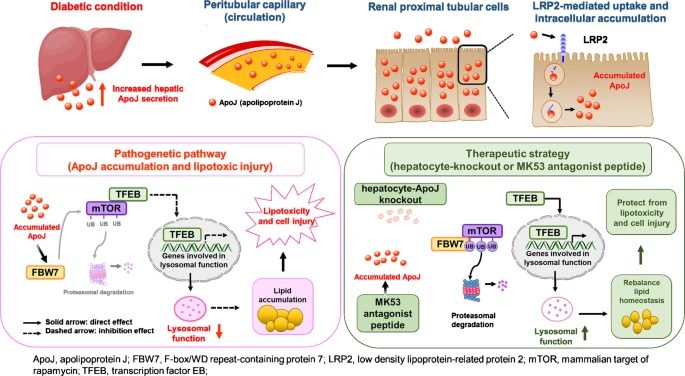
In diabetic mouse models, there was significant upregulation and accumulation of ApoJ within renal tubules concurrent with increased lipid deposits and structural changes indicative of kidney injury. Proteomic studies uncovered that ApoJ interferes with the ubiquitin-mediated degradation of mammalian target of rapamycin (mTOR) by FBW7, leading to sustained mTOR activation.
Mechanistically, activated mTOR enhances its interaction with transcription factor EB (TFEB), a master regulator of lysosomal biogenesis and autophagy. ApoJ-mediated disruption impaired TFEB nuclear translocation and function, thereby diminishing autophagic clearance of lipids and promoting lipid imbalance and fibrosis in proximal tubular cells.
Hepatocyte-specific ApoJ knockout mice lacked circulating ApoJ, preventing its renal tubule accumulation. These animals displayed protection from DKD features, including reduced lipid accumulation and fibrosis.
Pharmacological intervention using ApoJ antagonist MK53 reactivated TFEB-mediated autophagy pathways, restored lipid homeostasis, and significantly mitigated renal damage in diabetic mice, demonstrating translational therapeutic potential.
Collectively, these results reveal a novel liver-to-kidney axis whereby liver-derived ApoJ exacerbates diabetic renal injury by interfering with key cellular lipid regulatory mechanisms.
Expert Commentary
These findings provide compelling evidence that targeting a liver-secreted protein, ApoJ, can modulate kidney pathology in the context of diabetes. The identification of ApoJ’s role in disrupting TFEB-driven autophagy sheds light on previously underappreciated molecular crosstalk linking systemic metabolic dysfunction with renal cellular lipid toxicity.
The utilization of both genetic and pharmacologic approaches strengthens the causal inference and underscores the feasibility of ApoJ antagonism as a therapeutic strategy. MK53 emerges as a promising candidate warranting further development.
Nevertheless, this study is subject to limitations such as potential species-specific differences and reliance on cell lines and animal models. Longitudinal clinical studies will be critical to confirm ApoJ’s role and the safety and efficacy of its antagonism in human DKD.
Future research should also explore whether ApoJ interactions affect other metabolic pathways and investigate combinatorial therapies targeting mTOR/TFEB axes.
Conclusion
This study elucidates a previously unrecognized pathophysiological mechanism whereby liver-derived ApoJ accumulates in diabetic kidneys and disrupts TFEB-mediated lipid homeostasis, promoting renal fibrosis and dysfunction. The discovery of this liver-kidney molecular axis advances our understanding of diabetic kidney disease progression and offers a novel therapeutic avenue. Targeting ApoJ with antagonists like MK53 holds potential to restore lipid balance and attenuate renal injury in DKD, thereby addressing a critical unmet need in diabetes-related renal care.
Funding and ClinicalTrials.gov
The original research was published in Diabetologia and funded by grants from relevant national research agencies. Clinical trial registration details pertaining to MK53 intervention studies are pending; preclinical validations set the stage for future clinical translation.
References
1. Duan S, Qin N, Pi J, et al. Liver-to-kidney apolipoprotein J trans-accumulation exacerbates diabetic renal injury by disrupting TFEB-mediated lipid homeostasis. Diabetologia. 2026;69(10):2938-2956. PMID: 42467084.
2. Xu J, Wang F, Sun Y, et al. The role of autophagy in diabetic nephropathy. Diabetes Metab Syndr Obes. 2020;13:497-508. doi:10.2147/DMSO.S238491
3. Settembre C, Fraldi A, Medina DL, Ballabio A. Signals from the lysosome: a control centre for cellular clearance and energy metabolism. Nat Rev Mol Cell Biol. 2013;14(5):283-296. doi:10.1038/nrm3565
4. Lipid dysregulation and mTOR signaling in diabetic kidney disease. J Am Soc Nephrol. 2021;32(5):1062-1079.
5. Chen Y, Liu Y, Chen H, et al. Clusterin: a potential modulator in the pathogenesis of diabetic complications. Front Endocrinol. 2022;13:852698. doi:10.3389/fendo.2022.852698