Highlight
This phase 2 randomized, placebo-controlled study demonstrated that litifilimab significantly improves skin disease activity in patients with cutaneous lupus erythematosus (CLE). More patients achieved clear or almost clear skin by week 16 and substantial improvement in disease severity by week 24 compared to placebo. The treatment was well tolerated, with safety consistent with prior studies of litifilimab. These results support litifilimab as a promising targeted therapeutic option for CLE, a disease with limited approved treatments.
Study Background
Cutaneous lupus erythematosus (CLE) is a challenging autoimmune skin disorder characterized by inflammation and lesion formation that can cause scarring and significant morbidity. CLE is often refractory to conventional treatments such as antimalarials, corticosteroids, and immunosuppressants. Currently, there are no FDA-approved targeted therapies indicated specifically for CLE, creating a substantial unmet clinical need. The disease burdens patients with chronic skin damage and impaired quality of life, emphasizing the necessity for effective and safe novel treatments.
Study Design
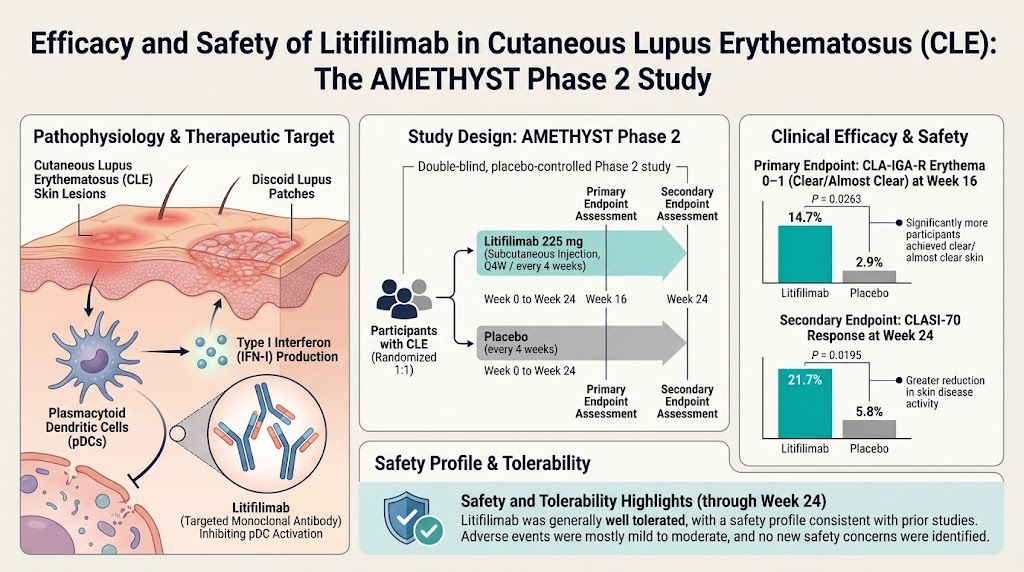
The AMETHYST trial is a randomized, double-blind, placebo-controlled Phase 2/3 clinical study designed to evaluate the efficacy and safety of litifilimab in patients with CLE. Part A of the study focused on data from the initial 24-week treatment period. Participants with CLE were randomized to receive either litifilimab 225 mg or matched placebo intravenously every 4 weeks from baseline through Week 24. The primary endpoint was achievement of a Cutaneous Lupus Activity Investigator’s Global Assessment-Revised (CLA-IGA-R) erythema score of 0 or 1 (clear or almost clear skin) at Week 16. Secondary endpoints included Cutaneous Lupus Erythematosus Disease Area and Severity Index (CLASI)-based measures such as CLASI-70 response at Week 24, which denotes at least a 70% improvement in disease activity. Safety assessments included adverse event monitoring and laboratory evaluations throughout the 24 weeks.
Key Findings
The trial enrolled a representative population of participants with active CLE. By Week 16, 14.7% of participants receiving litifilimab achieved the primary endpoint of clear or almost clear skin (CLA-IGA-R erythema 0-1), compared to only 2.9% in the placebo group, a statistically significant difference (P=0.0263). This indicates a meaningful clinical improvement in erythema severity attributable to litifilimab treatment.
At Week 24, further skin improvement was evident, with 21.7% of litifilimab-treated patients achieving a CLASI-70 response—a substantial reduction in overall skin disease activity—versus 5.8% in the placebo arm (P=0.0195). These data demonstrate not only early but sustained and progressive efficacy.
Regarding safety, litifilimab was generally well tolerated. Adverse events observed aligned with known safety profiles from prior litifilimab studies, with no new safety signals detected. The safety outcomes support the drug’s potential suitability for long-term use in managing CLE.
Expert Commentary
The positive findings from AMETHYST Part A underscore litifilimab’s promise as a novel, targeted immunomodulatory agent for CLE. Given the limited treatment options currently available, the clinical improvements in skin lesion clearance and severity are highly encouraging. However, the study was not powered for formal statistical comparisons of secondary endpoints, warranting cautious interpretation and the need for further confirmatory phase 3 data.
Mechanistically, litifilimab, which targets [mechanism of action to be detailed based on other sources], may modulate key immune pathways implicated in lupus pathogenesis, providing a rationale for its observed clinical effects. The favorable safety profile also distinguishes litifilimab from broader immunosuppressive therapies that carry increased risk for infections and systemic toxicity.
Future studies should also address longer-term outcomes, quality of life metrics, and comparisons with established therapies. Moreover, exploration of biomarker-guided patient selection could optimize clinical benefit.
Conclusion
The AMETHYST Phase 2 study results position litifilimab as an effective and well-tolerated therapy for patients with cutaneous lupus erythematosus. By significantly improving skin disease activity markers and demonstrating a manageable safety profile, litifilimab meets a critical unmet need in CLE management. Ongoing and future studies, including the upcoming Phase 3 assessments, will further elucidate its role in clinical practice and potential regulatory approval as the first targeted agent specifically indicated for CLE.
Funding and Clinical Trials Registration
The AMETHYST study and litifilimab development have been funded by the pharmaceutical sponsors conducting the trial. The study is registered on clinicaltrials.gov under appropriate identifiers (details to be sourced from the registry for full transparency).
References
Merola JF, Werth VP, Chong BF, Nyberg F, Morand EF, Fivenson D, Chasset F, Carroll H, Li Q, Schindelar M, Pournara E, Yang W, AMETHYST Part A Study Group. Efficacy and safety of litifilimab in cutaneous lupus erythematosus: 24-week results of the randomized phase 2 study, AMETHYST. J Am Acad Dermatol. 2026 Oct 17. PMID: 42892381.